
Mindmap
Freud on the Conscience
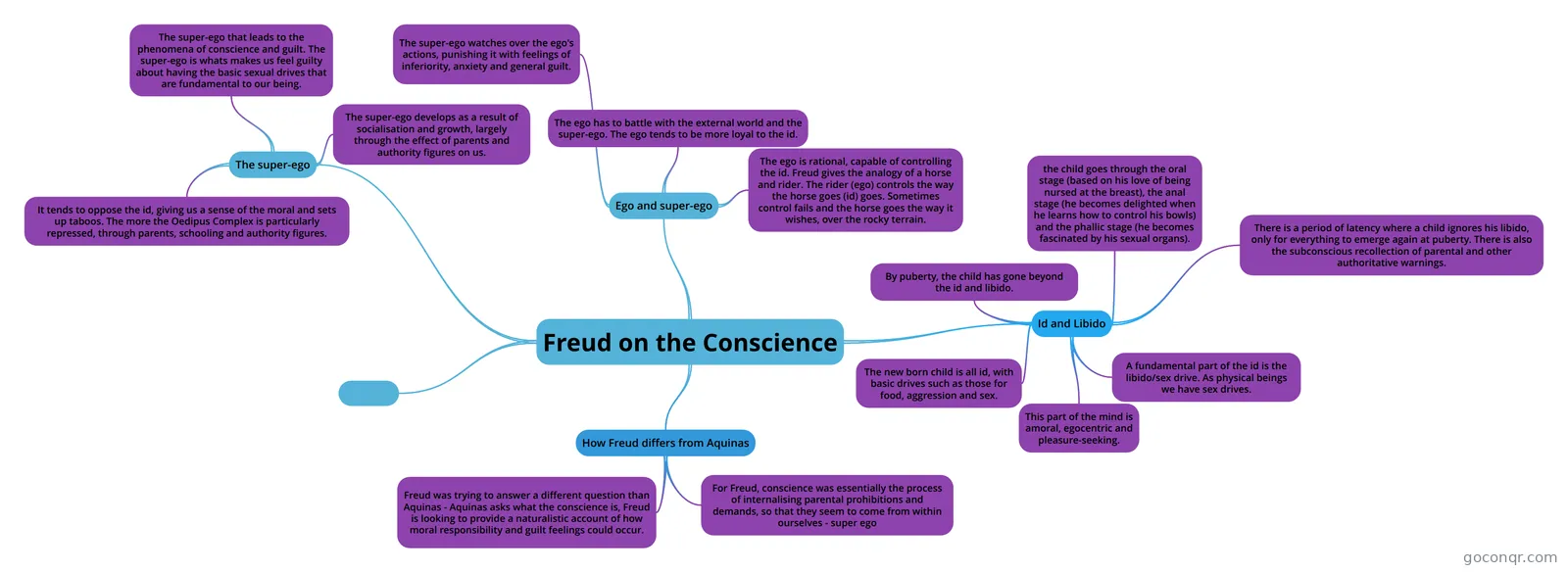
Mind map: Freud on the conscience
Inhalt der Mindmap
Freud on the Conscience
How Freud differs from Aquinas
- Freud was trying to answer a different question than Aquinas - Aquinas asks what the conscience is, Freud is looking to provide a naturalistic account of how moral responsibility and guilt feelings could occur.
- For Freud, conscience was essentially the process of internalising parental prohibitions and demands, so that they seem to come from within ourselves - super ego
Id and Libido
- The new born child is all id, with basic drives such as those for food, aggression and sex.
- This part of the mind is amoral, egocentric and pleasure-seeking.
- A fundamental part of the id is the libido/sex drive. As physical beings we have sex drives.
- the child goes through the oral stage (based on his love of being nursed at the breast), the anal stage (he becomes delighted when he learns how to control his bowls) and the phallic stage (he becomes fascinated by his sexual organs).
- There is a period of latency where a child ignores his libido, only for everything to emerge again at puberty. There is also the subconscious recollection of parental and other authoritative warnings.
- By puberty, the child has gone beyond the id and libido.
Ego and super-ego
- The ego is rational, capable of controlling the id. Freud gives the analogy of a horse and rider. The rider (ego) controls the way the horse goes (id) goes. Sometimes control fails and the horse goes the way it wishes, over the rocky terrain.
- The ego has to battle with the external world and the super-ego. The ego tends to be more loyal to the id.
- The super-ego watches over the ego's actions, punishing it with feelings of inferiority, anxiety and general guilt.
The super-ego
- The super-ego develops as a result of socialisation and growth, largely through the effect of parents and authority figures on us.
- The super-ego that leads to the phenomena of conscience and guilt. The super-ego is whats makes us feel guilty about having the basic sexual drives that are fundamental to our being.
- It tends to oppose the id, giving us a sense of the moral and sets up taboos. The more the Oedipus Complex is particularly repressed, through parents, schooling and authority figures.
Informationen
- Beschreibung
- A level Religious Studies Mindmap am Freud on the Conscience, erstellt von Georgia Loosley am 28/01/2018.
- Erstellt von
- Georgia Loosley
- Aufrufe
- 0
- Bewertung
Mehr zu Secular Approaches to Conscience