
Mindmap
Paradigms
Inhalt der Mindmap
Paradigms
According to Wikipedia, “A programming paradigm is a fundamental style of computer programming that deals with how solutions to problems must be formulated in a programming language”
key paradigms
- Objectoriented software engineering (OOSE)
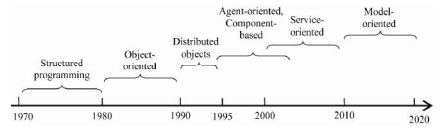
- Object-oriented paradigm (OOP) is a design- and programming-oriented paradigm that emerged in the early 1960s
- Alan Kay
- The aim of OOP, therefore, is to represent these objects and their relationships; communication between objects via their inter-relations facilitates the implementation of the intended functionalities.
- The object-oriented has been completed with the remote method invocation (RMI) mechanism, with the aim of introducing the concept of distribution in the programming model.
- The Simula-67 language laid the first foundations
- The 1980s witnessed the proliferation of object-oriented languages: Objective C (early 1980s), C++ (C with class structure) in 1983, Eiffel in 1984, Common Lisp Object System in 1987, etc.
- Object-oriented paradigm (OOP) is a design- and programming-oriented paradigm that emerged in the early 1960s
- Component-based software engineering (CBSE),
- McIlroy
- Component-based development appeared in the early 1990s in response to the failure of the object-oriented approach
- A developer only needs to know what a component includes, and not how it was implemented.
- In addition, in the component-based approach, a clear distinction is made between the development of a component and that of a system.
- Agent-oriented software engineering (AOSE)
- Hewitt
- In the mid-1990s, collective models called multi-agent systems (MASs) came into existence.
- In these models, an agent is treated as a self-contained entity
- entity with certain capabilities that enable it to carry out its services or use the services of another agent through interaction.
- – Reactive agents, which wait for an event to happen before responding to changes in their environment. – Proactive agents, which take decisions on their own initiative in their environment
- In the agent model, communication is usually asynchronous.
- Agents can respond not only to invocations of specific methods, but also to observable events in the environment.
- Proactive agents can actually question the environment for events and other messages to determine what measures to take.
- – Reactive agents, which wait for an event to happen before responding to changes in their environment. – Proactive agents, which take decisions on their own initiative in their environment
- entity with certain capabilities that enable it to carry out its services or use the services of another agent through interaction.
- Organization-based multi-agent systems (OMASs) are among the new models
- In these models, an agent is treated as a self-contained entity
- Service-oriented software engineering (SOSE)
- The service-oriented paradigm is a relatively new software development, dating from the early 2000s
- SOSE comes from requests related to systems that need to be able to withstand increasingly volatile and heterogeneous environments
- SOA became mainstream with the emergence of standards such as Web services in e-commerce, business to business (B2B) or business to consumer (B2C) based on platforms such as J2EE or NET.
- The service is a software entity that represents a specific function.
- A service is an action performed (a function rendered) by a provider for a customer
- the interaction between the supplier and customer is established via a mediator (which may be a bus) responsible for bringing various participants together.
- A service is an action performed (a function rendered) by a provider for a customer
- A key element of SOSE is the pattern of service interaction, also known as service-oriented architecture (SOA) that enables a range of services to communicate with each other.
- SOSE considers an application as a set of services interacting in a accordance with their roles and regardless of their location in order to withstand heterogeneous and loosely coupled software systems.
- SOA is essentially a collection of services that interact and communicate with each other.
- SOSE comes from requests related to systems that need to be able to withstand increasingly volatile and heterogeneous environments
- The service-oriented paradigm is a relatively new software development, dating from the early 2000s
- Objectoriented software engineering (OOSE)
top-down approach
- is to concentrate on the differentiation of conceptual aspects directly related to the paradigms
- opposed to a bottom-up approach
- examines their technological differences
Bilder und Dateien der Mindmap
Informationen
- Beschreibung
- Programacion Funcional Mindmap am Paradigms, erstellt von Daniel Velez am 14/05/2018.
- Erstellt von
- Daniel Velez
- Aufrufe
- 0
- Bewertung