
Mindmap
Football
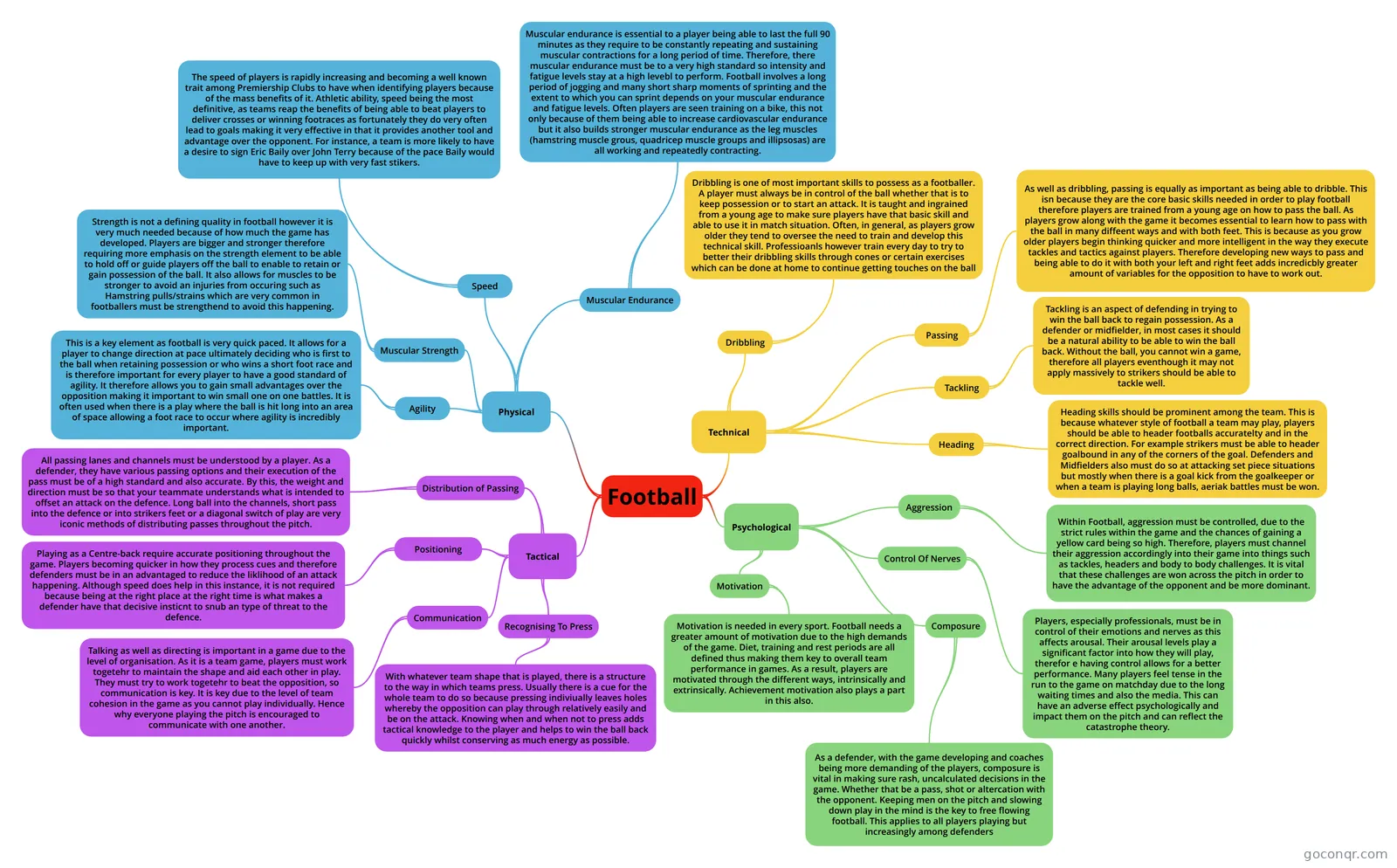
Mind map: Football
Inhalt der Mindmap
Football
Tactical
- Distribution of Passing
- All passing lanes and channels must be understood by a player. As a defender, they have various passing options and their execution of the pass must be of a high standard and also accurate. By this, the weight and direction must be so that your teammate understands what is intended to offset an attack on the defence. Long ball into the channels, short pass into the defence or into strikers feet or a diagonal switch of play are very iconic methods of distributing passes throughout the pitch.
- Positioning
- Playing as a Centre-back require accurate positioning throughout the game. Players becoming quicker in how they process cues and therefore defenders must be in an advantaged to reduce the liklihood of an attack happening. Although speed does help in this instance, it is not required because being at the right place at the right time is what makes a defender have that decisive insticnt to snub an type of threat to the defence.
- Communication
- Talking as well as directing is important in a game due to the level of organisation. As it is a team game, players must work togetehr to maintain the shape and aid each other in play. They must try to work togetehr to beat the opposition, so communication is key. It is key due to the level of team cohesion in the game as you cannot play individually. Hence why everyone playing the pitch is encouraged to communicate with one another.
- Recognising To Press
- With whatever team shape that is played, there is a structure to the way in which teams press. Usually there is a cue for the whole team to do so because pressing indiviually leaves holes whereby the opposition can play through relatively easily and be on the attack. Knowing when and when not to press adds tactical knowledge to the player and helps to win the ball back quickly whilst conserving as much energy as possible.
- Distribution of Passing
Technical
- Dribbling
- Dribbling is one of most important skills to possess as a footballer. A player must always be in control of the ball whether that is to keep possession or to start an attack. It is taught and ingrained from a young age to make sure players have that basic skill and able to use it in match situation. Often, in general, as players grow older they tend to oversee the need to train and develop this technical skill. Professioanls however train every day to try to better their dribbling skills through cones or certain exercises which can be done at home to continue getting touches on the ball
- Passing
- As well as dribbling, passing is equally as important as being able to dribble. This isn because they are the core basic skills needed in order to play football therefore players are trained from a young age on how to pass the ball. As players grow along with the game it becomes essential to learn how to pass with the ball in many diffeent ways and with both feet. This is because as you grow older players begin thinking quicker and more intelligent in the way they execute tackles and tactics against players. Therefore developing new ways to pass and being able to do it with both your left and right feet adds incredicbly greater amount of variables for the opposition to have to work out.
- Tackling
- Tackling is an aspect of defending in trying to win the ball back to regain possession. As a defender or midfielder, in most cases it should be a natural ability to be able to win the ball back. Without the ball, you cannot win a game, therefore all players eventhough it may not apply massively to strikers should be able to tackle well.
- Heading
- Heading skills should be prominent among the team. This is because whatever style of football a team may play, players should be able to header footballs accuratelty and in the correct direction. For example strikers must be able to header goalbound in any of the corners of the goal. Defenders and Midfielders also must do so at attacking set piece situations but mostly when there is a goal kick from the goalkeeper or when a team is playing long balls, aeriak battles must be won.
- Dribbling
Psychological
- Aggression
- Within Football, aggression must be controlled, due to the strict rules within the game and the chances of gaining a yellow card being so high. Therefore, players must channel their aggression accordingly into their game into things such as tackles, headers and body to body challenges. It is vital that these challenges are won across the pitch in order to have the advantage of the opponent and be more dominant.
- Control Of Nerves
- Players, especially professionals, must be in control of their emotions and nerves as this affects arousal. Their arousal levels play a significant factor into how they will play, therefor e having control allows for a better performance. Many players feel tense in the run to the game on matchday due to the long waiting times and also the media. This can have an adverse effect psychologically and impact them on the pitch and can reflect the catastrophe theory.
- Composure
- As a defender, with the game developing and coaches being more demanding of the players, composure is vital in making sure rash, uncalculated decisions in the game. Whether that be a pass, shot or altercation with the opponent. Keeping men on the pitch and slowing down play in the mind is the key to free flowing football. This applies to all players playing but increasingly among defenders
- Motivation
- Motivation is needed in every sport. Football needs a greater amount of motivation due to the high demands of the game. Diet, training and rest periods are all defined thus making them key to overall team performance in games. As a result, players are motivated through the different ways, intrinsically and extrinsically. Achievement motivation also plays a part in this also.
- Aggression
Physical
- Agility
- This is a key element as football is very quick paced. It allows for a player to change direction at pace ultimately deciding who is first to the ball when retaining possession or who wins a short foot race and is therefore important for every player to have a good standard of agility. It therefore allows you to gain small advantages over the opposition making it important to win small one on one battles. It is often used when there is a play where the ball is hit long into an area of space allowing a foot race to occur where agility is incredibly important.
- Muscular Strength
- Strength is not a defining quality in football however it is very much needed because of how much the game has developed. Players are bigger and stronger therefore requiring more emphasis on the strength element to be able to hold off or guide players off the ball to enable to retain or gain possession of the ball. It also allows for muscles to be stronger to avoid an injuries from occuring such as Hamstring pulls/strains which are very common in footballers must be strengthend to avoid this happening.
- Speed
- The speed of players is rapidly increasing and becoming a well known trait among Premiership Clubs to have when identifying players because of the mass benefits of it. Athletic ability, speed being the most definitive, as teams reap the benefits of being able to beat players to deliver crosses or winning footraces as fortunately they do very often lead to goals making it very effective in that it provides another tool and advantage over the opponent. For instance, a team is more likely to have a desire to sign Eric Baily over John Terry because of the pace Baily would have to keep up with very fast stikers.
- Muscular Endurance
- Muscular endurance is essential to a player being able to last the full 90 minutes as they require to be constantly repeating and sustaining muscular contractions for a long period of time. Therefore, there muscular endurance must be to a very high standard so intensity and fatigue levels stay at a high levebl to perform. Football involves a long period of jogging and many short sharp moments of sprinting and the extent to which you can sprint depends on your muscular endurance and fatigue levels. Often players are seen training on a bike, this not only because of them being able to increase cardiovascular endurance but it also builds stronger muscular endurance as the leg muscles (hamstring muscle grous, quadricep muscle groups and illipsosas) are all working and repeatedly contracting.
- Agility
Informationen
- Beschreibung
- Mindmap am Football, erstellt von Brian Kasanda am 08/06/2018.
- Erstellt von
- Brian Kasanda
- Aufrufe
- 1
- Bewertung
Mehr zu Football Skills and Tactics