
Mindmap
Computer Science
Inhalt der Mindmap
Computer Science
2.1 Algorithms
- Computational Thinking
- There are four elements of computational thinking, they are:
- Decomposition
- Simple tasks have simple solutions. You can break large problems that are complex into several smaller simpler tasks, this is known as decomposition
- For example you have been tasked with creating a game and you have broke it down into smaller tasks
- What type of game is it going to be?
- What is the style of the game?
- Who is the audience of the game?
- Does it have challenge and what are the rewards?
- How does the game end?
- What is the name of the game?
- This is what decomposition is about, defining the problem in more detail and making it easier to solve
- For example you have been tasked with creating a game and you have broke it down into smaller tasks
- Top Down design
- Complex problem
- Element of problem 1
- Element of problem 2
- Sub element of this part
- Sub element 2 of this part
- Element of problem 3
- With the top down design the decomposition element can be shown
- Complex problem
- Simple tasks have simple solutions. You can break large problems that are complex into several smaller simpler tasks, this is known as decomposition
- Pattern Recognition
- Being aware of any repetition in solving the task, this pattern can simplify the steps needed to solve the problem and furthermore, if the pattern can be made general, it can be used to solve other problems as well.
- Abstraction
- Removing unnessisary information is called abstraction.
- Only leaves the data that is required
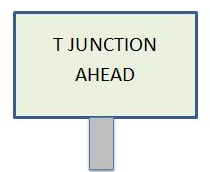
- For example a designer needs to make a T Junction sign
- The sign must follow certain rules:
- Must take no more that 1 second for a driver to look at it and understand its meaning
- Must NOT contain any words
- It MUST use the standard shape and colours of all UK road signs
- Must NOT contain any words
- Must take no more that 1 second for a driver to look at it and understand its meaning
- The sign must follow certain rules:
- The first attempt is shown to the right and as you can see it is very cluttered and will take more than a second for a driver to recognise the sign
- It also doesn't follow the rules for the shape and colour
- The second attempt is shown to the right and as you can see it is less cluttered than version 1, however it still breaks the rules as it says that there must not be any words
- It also doesn't follow the rules for the colour
- The third and final attempt follows all the rules, the shape, the colour and doesn't contain any words
- Also any unessisary clutter has been removed
- The same method of abstraction can be used for many other problems including those in Computer Programming
- Algorithmic Thinking
- There are 2 popular methods to set out an algorithm:
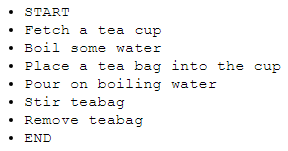
- Pseudocode - Text statements written for each step of the algorithm
- An example of Psudocode
- Psudo code is not a formal computer language and has no particular rules governing how it should be written. What is important is that Psudocode should be easy to understand, unambihiousous and error free. Especially because programmers often use it to form the basis of their programming code
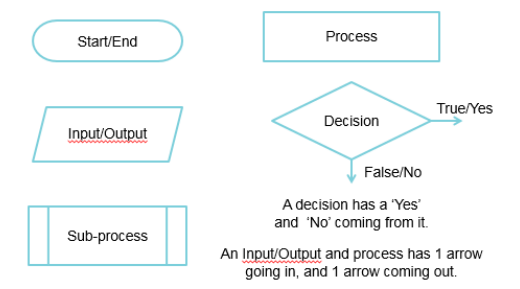
- Flow chart - This uses a set of standart shapes and arrows (Shown to the right-->) tO make a diagram of the algorithm
- Pseudocode - Text statements written for each step of the algorithm
- Algorithms often include a decisaion to be made at some point in the task. In order to handle this, a conditional statement is used.
- There are 2 popular methods to set out an algorithm:
- Decomposition
- There are four elements of computational thinking, they are:
- Computational Thinking
Bilder und Dateien der Mindmap

Informationen
- Beschreibung
- Revision notes for 2.1 Algorithms on paper 2 of the OCR computer science 1-9 scale course.
- Erstellt von
- Dan Howe
- Aufrufe
- 4
- Tags
- Verlauf
-
- Erstellt von Alex Rollin · 29 Jan 2018
- Kopiert von Dan Howe · 13 Jun 2018
- Bewertung