
Mindmap
Gradients
Inhalt der Mindmap
Gradients
Gradients can act over long distances
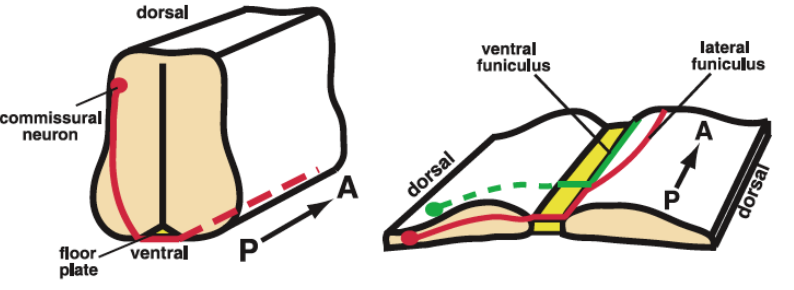
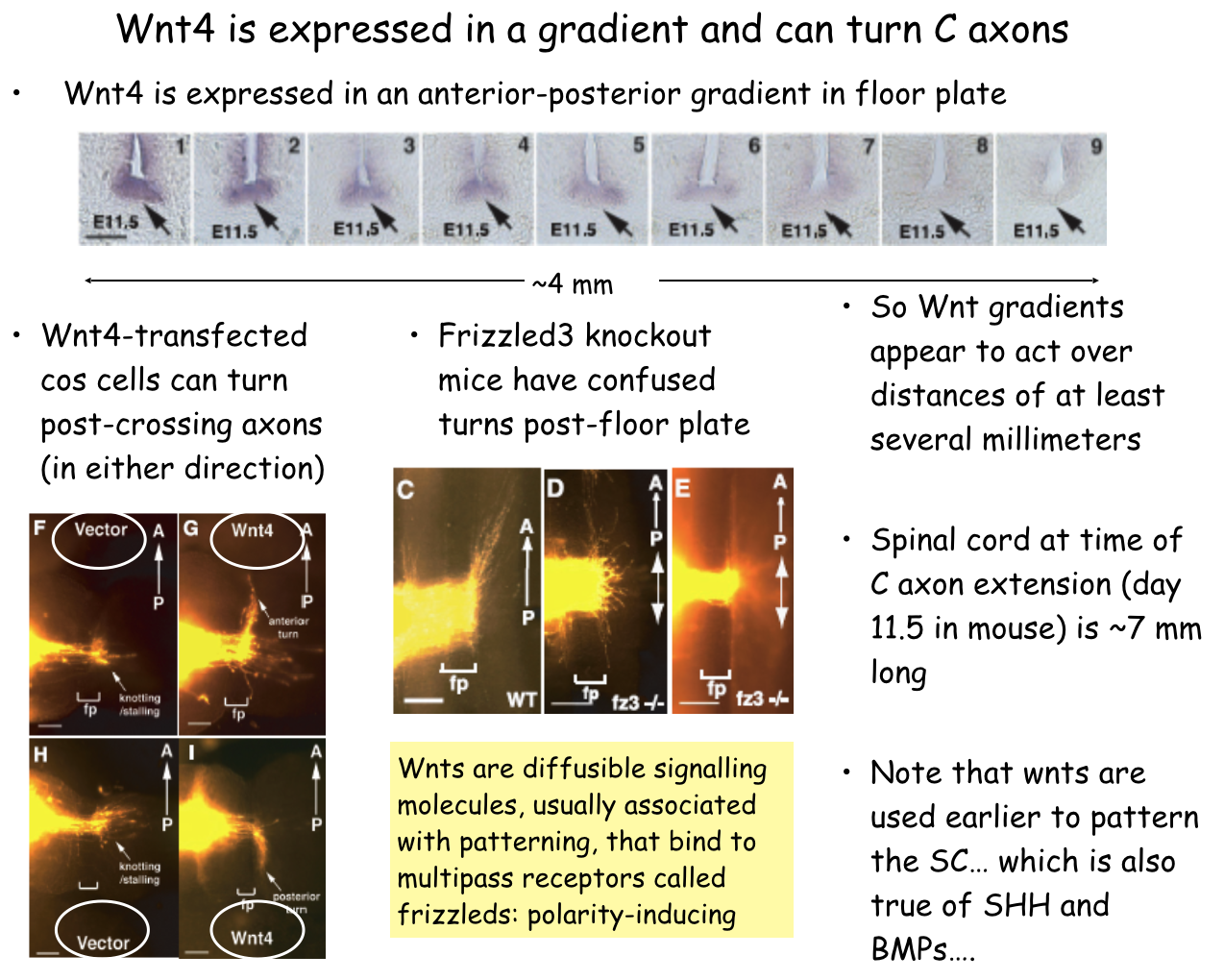
- In mammals, the majority of C axons turn rostrally after Xing the floor plate. What determines this?
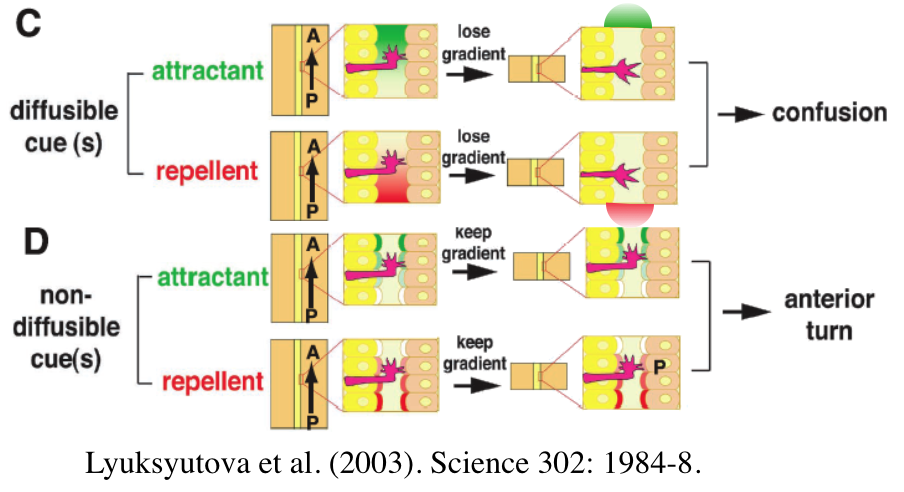
- One possibility is an A-P gradient of either an attractant or a repellant, which could be a long range diffusible cue
- or a short range, non-diffusible.
- How can we distinguish between these possibilities?
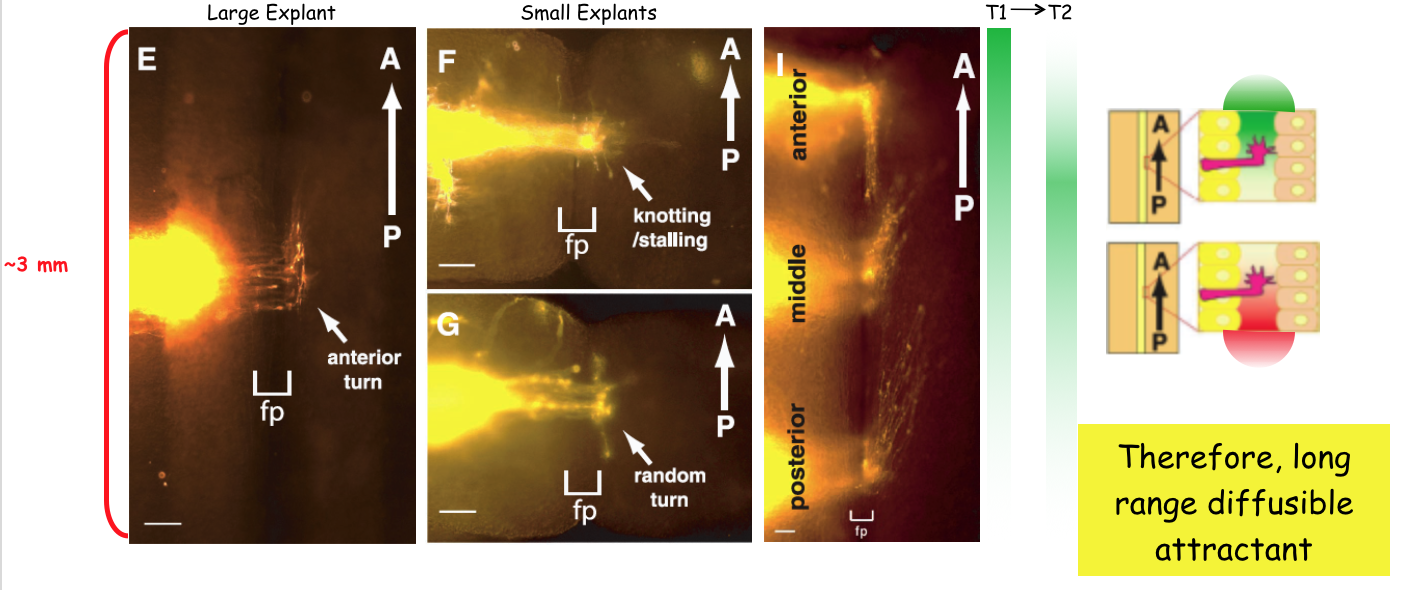
- Could distinguish by culturing large vs small explants:
- Evidence for a long range attractant
- Prediction is that a relatively small explant will lose its gradient if the chemotropic agent is diffusible (whereas a larger explant will not), which should not be true if the guiding factor is non-diffusible
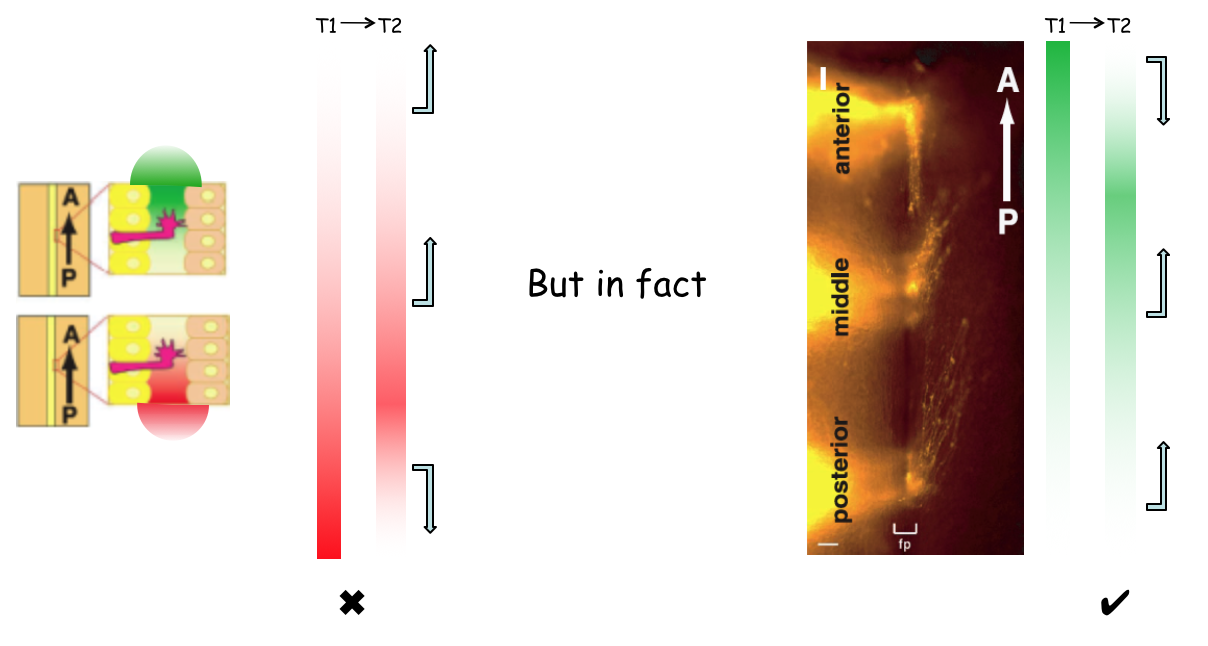
- Also, in larger explants, expect anterior-most axons to turn aberrantly if attractant, but posterior-most axons if repellant (think about it!)
- Prediction is that a relatively small explant will lose its gradient if the chemotropic agent is diffusible (whereas a larger explant will not), which should not be true if the guiding factor is non-diffusible
- If a repellant…
- One possibility is an A-P gradient of either an attractant or a repellant, which could be a long range diffusible cue
- In mammals, the majority of C axons turn rostrally after Xing the floor plate. What determines this?
Detecting gradients
- Two ways in which to measure a gradient
- Change of concentration over time (temporal detection) - cell must compare amount of ligand at two different time points
- Change of concentration across the cell (or growth cone; spatial detection) - cell must compare the amount of ligand at two different points on it surface.
- For slow-moving eukaryotic cells (ie not bacteria) spatial detection likely to be most important.
- Most of what we know has come from studies of the chemotaxis of white blood cells (neutrophils and leukocytes) and the slime mould Dictyostelium
- Accuracy of orientation
- Accuracy of orientation towards a source depends on:
- Absolute concentration of the chemoattractant - most accurate closest to the KD (dissociation constant) of the receptor*.
- * At the KD concentration, half of the receptors will be occupied giving greatest capacity for detecting increases or decreases in receptor occupancy
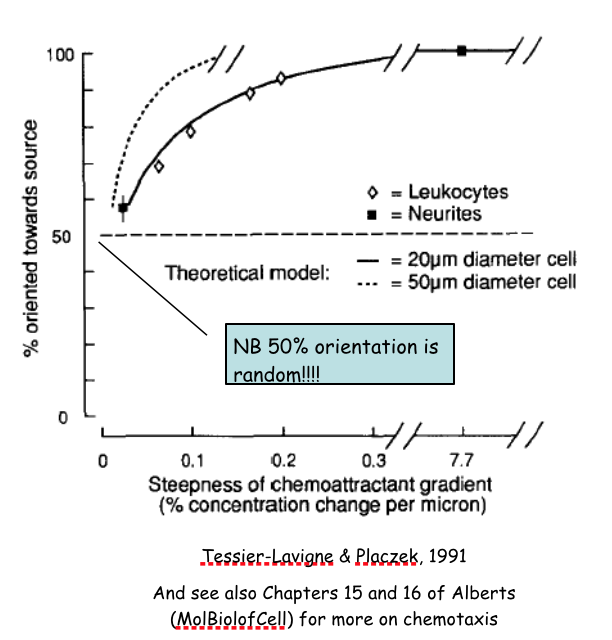
- Steepness of the gradient
- Absolute concentration of the chemoattractant - most accurate closest to the KD (dissociation constant) of the receptor*.
- Gradient is expressed as % change per micron (µm)
- Leukocytes only orient with accuracy when gradient is ≥0.2%, e.g. 2% change over a 10µm diameter
- Note that larger diameter cells orient more accurately than small cells in shallow gradients
- Recent studies indicate that neurons have similar characteristics
- Note that larger diameter cells orient more accurately than small cells in shallow gradients
- Leukocytes only orient with accuracy when gradient is ≥0.2%, e.g. 2% change over a 10µm diameter
- Accuracy of orientation towards a source depends on:
- Mechanisms to enhance range over which gradients can be detected
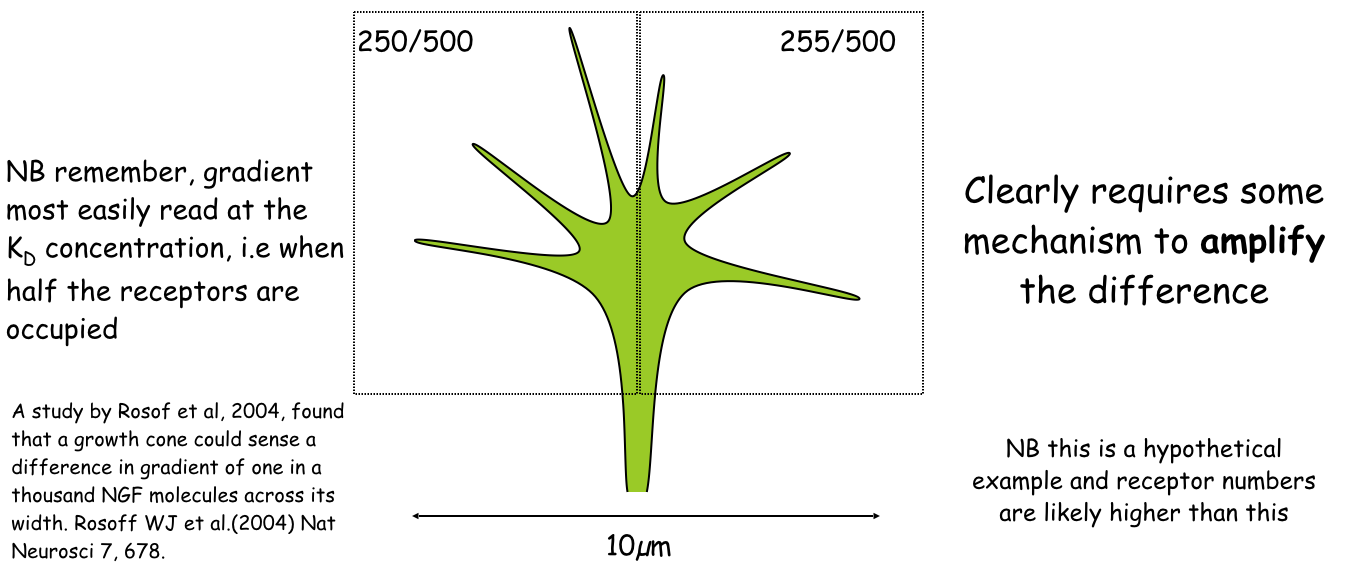
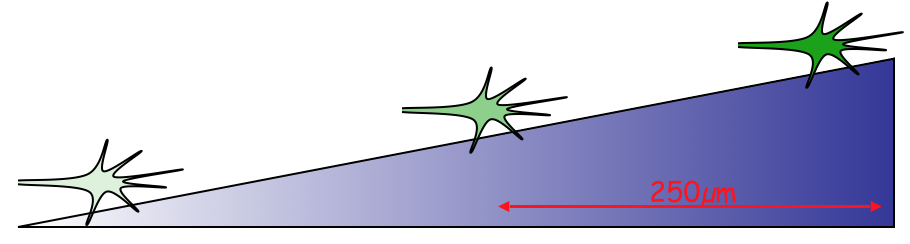
- Even relatively steep gradients (2% over 10µm) require very small differences in receptor occupancy to be detected across the growth cone.
- In mid-gradient, a growth cone with, say, 1000 receptors would require the cell to detect a difference of just 5 occupied receptors across its width for such a gradient (250 x 1.02):
- Even relatively steep gradients (2% over 10µm) require very small differences in receptor occupancy to be detected across the growth cone.
- Two ways in which to measure a gradient
Amplification and adaptation
- Two methods to enhance sensitivity of GCs to gradients
- Amplification
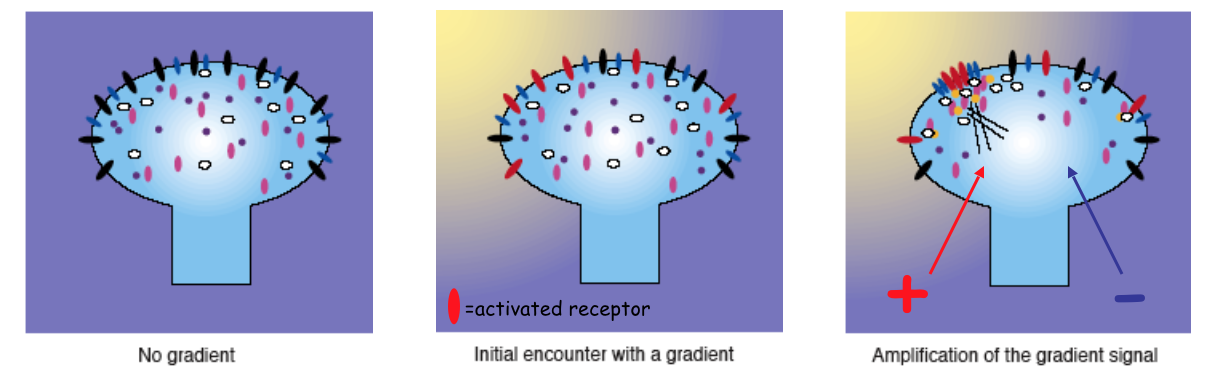
- Amplification requires local enhancement of signal together with inhibition of signal reception in other parts of the cell
- One suggested mechanism involves clustering of receptors and/or signalling components in regions where receptors activated by transporting components from other parts of the cell:
- Evidence for clustering of downstream components can be found in chemotaxing Dictyostelium…
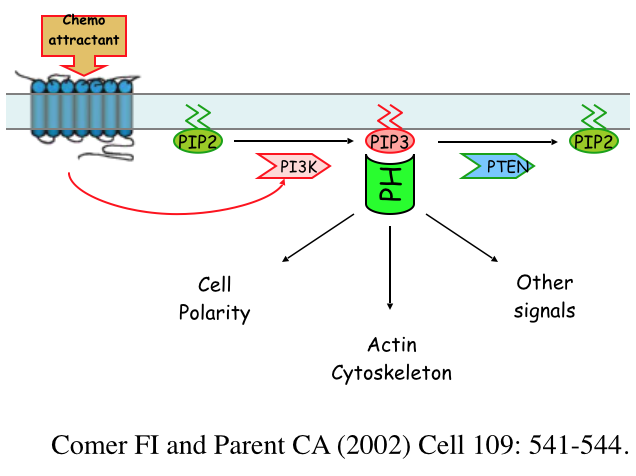
- Chemoattractants in leukocytes and Dictyostelium activate PI3Kinase via a G-protein coupled receptor (GPCR)
- Chemoattractant detected by a GPCR (7TM protein)
- This activates PI3kinase, which then phosphorylates PI(4,5)P2 (PIP2) to give PIP3 (PI(3,4,5)P3)
- This provides a docking site for proteins containing Pleckstrin Homology (PH) domains, (such as Akt), creating a localised signalling domain on the membrane
- Note that PI3K activity is antagonised by PTEN phosphatase
- This is critical to ensure that signals are highly localised and labile, dependent on continued external activation….
- Recruitment of PH domain proteins to leading edge of chemotaxing cell
- See ppt
- Chemoattractants in leukocytes and Dictyostelium activate PI3Kinase via a G-protein coupled receptor (GPCR)
- Evidence for clustering of downstream components can be found in chemotaxing Dictyostelium…
- One suggested mechanism involves clustering of receptors and/or signalling components in regions where receptors activated by transporting components from other parts of the cell:
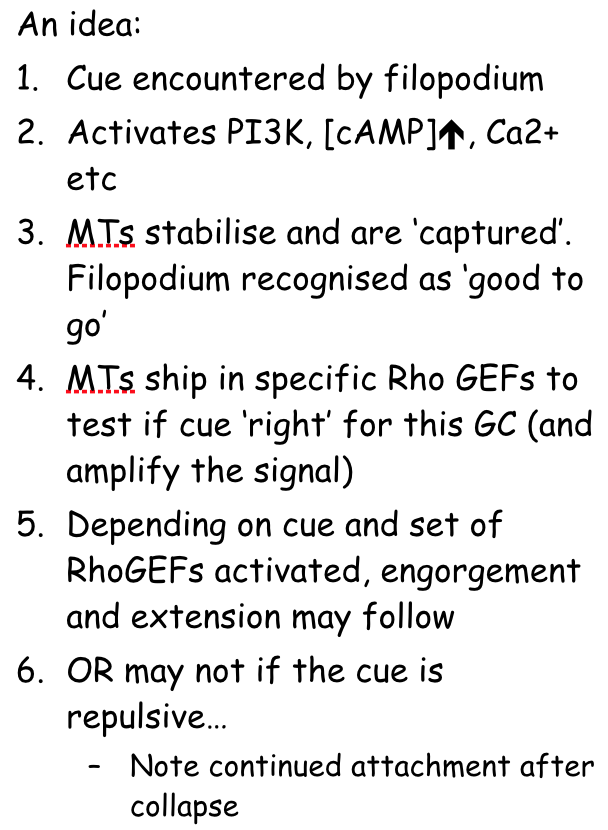
- Amplification: primes machinery to ‘test’ cue found?
- Amplification requires local enhancement of signal together with inhibition of signal reception in other parts of the cell
- Adaptation
- If growth cones operate most discriminatively when the chemoattractant concentration is closest to the receptor KD, then clearly receptors will saturate as concentration increases.
- Simple calculations show that even the shallowest gradients required to turn cells (0.2% per µm) will result in 90% receptor occupancy just 250µm from the optimal ligand concentration.
- In other circumstances - e.g. synaptic transmission - signal saturation leads to desensitization and resetting of thresholds (or resensitization if signals fall).
- Is there evidence for such ‘adaptation’ in responses to gradients?
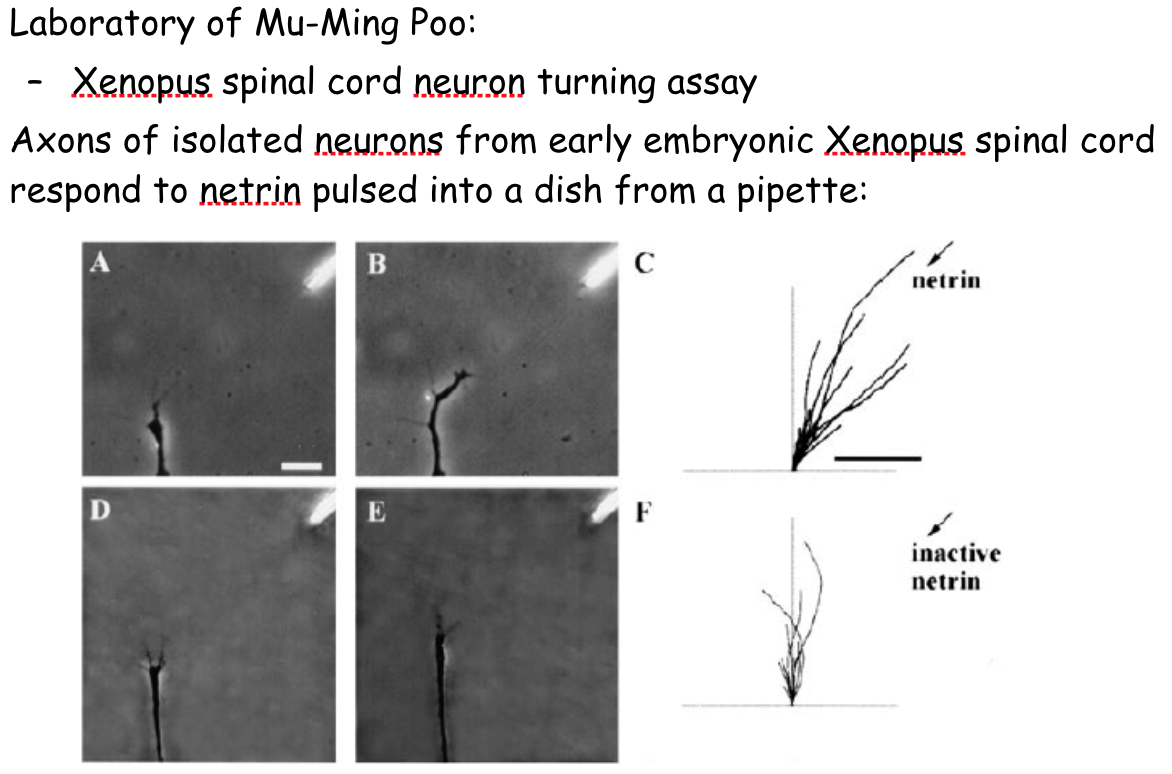
- Frog axon turning assay
- Adaptation in response to netrin?
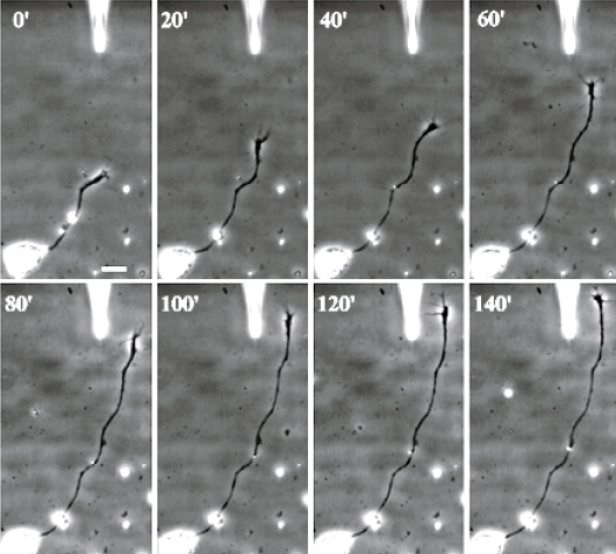
- Pulsed netrin forms an exponential gradient which is revealed by including a fluorescent marker in the pipette
- Growth cones responding to such a gradient initially exhibit a ‘zig-zagging’ trajectory
- The alternating attractive and repulsive turning suggests cycles of desentization and sensitization of the growth cone to netrin.
- Growth cones responding to such a gradient initially exhibit a ‘zig-zagging’ trajectory
- Pulsed netrin forms an exponential gradient which is revealed by including a fluorescent marker in the pipette
- Growth cones adapt to chemoattractants
- To determine whether growth cones adapt to increasing attractant concentrations, Ming et al pretreated axons with differing concentrations of netrin:
- They discovered that immediately (30min) after treatment, growth cones no longer responded (b)
- However, after a longer period (90mins), growth cones resensitized (c)
- This resensitization was dependent upon MAPKinase activation and local protein synthesis in the growth cone.
- Responses to Sema3A are subject to similar adaptation (see Piper et al 2005)
- This resensitization was dependent upon MAPKinase activation and local protein synthesis in the growth cone.
- However, after a longer period (90mins), growth cones resensitized (c)
- They discovered that immediately (30min) after treatment, growth cones no longer responded (b)
- See ppt
- To determine whether growth cones adapt to increasing attractant concentrations, Ming et al pretreated axons with differing concentrations of netrin:
- Is there evidence for such ‘adaptation’ in responses to gradients?
- In other circumstances - e.g. synaptic transmission - signal saturation leads to desensitization and resetting of thresholds (or resensitization if signals fall).
- Simple calculations show that even the shallowest gradients required to turn cells (0.2% per µm) will result in 90% receptor occupancy just 250µm from the optimal ligand concentration.
- If growth cones operate most discriminatively when the chemoattractant concentration is closest to the receptor KD, then clearly receptors will saturate as concentration increases.
Stretching gradients to the limits
- Over what distance could growth cones be guided by gradients?
- Depends upon the the shape of the gradient, which depends on how it is set up:
- Diffusible molecules e.g.
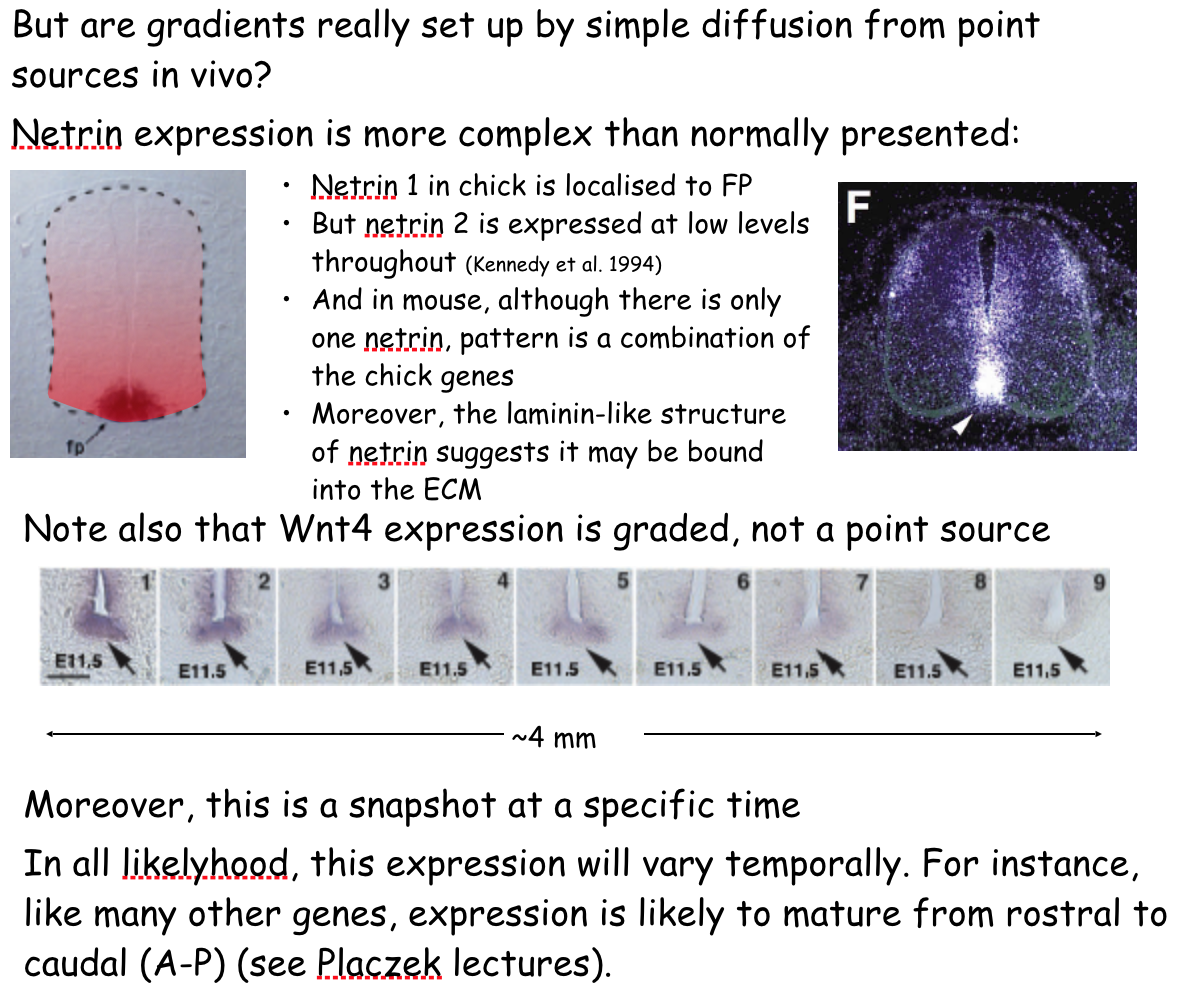
- Wnts: expression gradient along axis
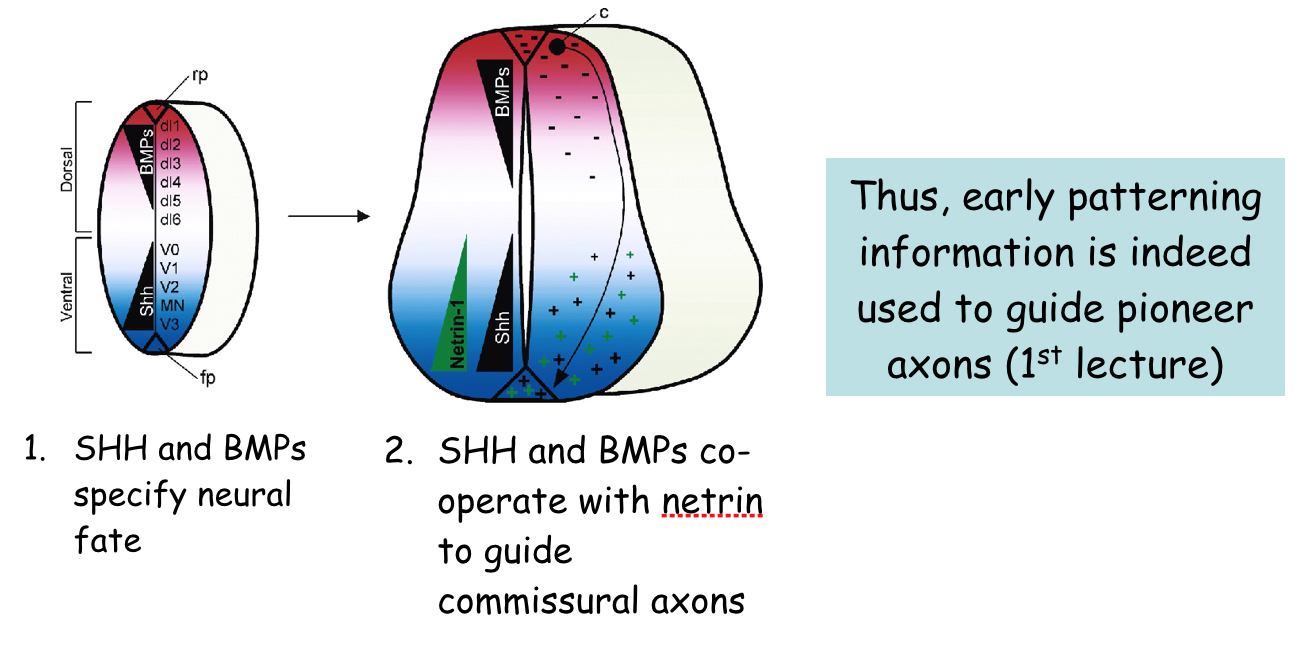
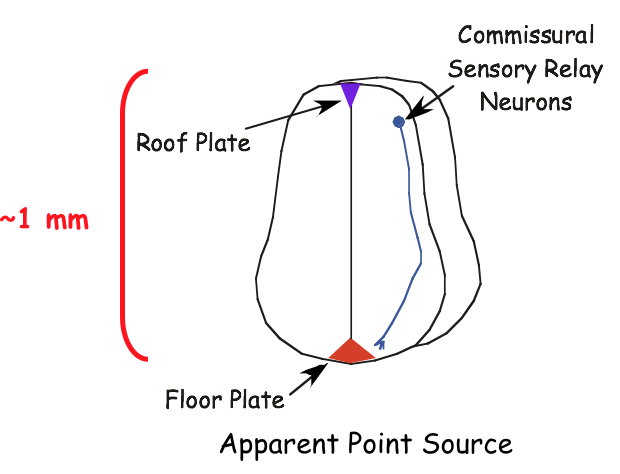
- Netrins: point source (floor plate)
- Non-diffusible molecules e.g.
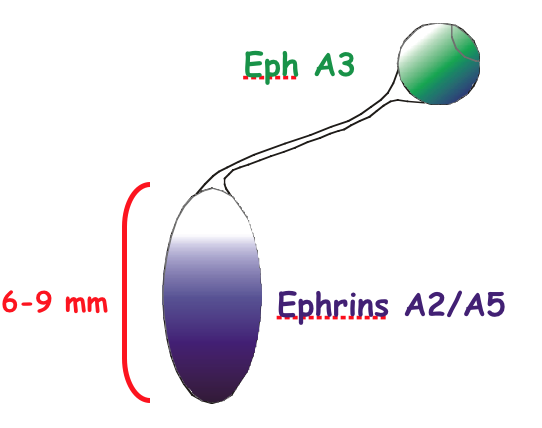
- Ephrins (tectum): surface bound molecules expressed in gradients
- These two different types of gradient have inherently different ranges of action (discussed in Goodhill (1998). Trends Neurosci 21: 226-31)….
- Diffusible molecules e.g.
- Depends upon the the shape of the gradient, which depends on how it is set up:
- Two different types of gradient
- Point source
- A gradient set up by diffusion from a point source (such as that used by Ming et al) - typically an exponential gradient - has a theoretical maximum range of 1mm, which corresponds well to supposed point source ranges in vivo:
- Point sources depend on:
- a limited diffusion rate.
- some mechanism for removing the guiding molecule - a ‘sink’ - otherwise gradient will flatten with time (depending on diffusion rates)
- Linear substrate bound gradients
- can be longer
- By contrast, a substrate bound gradient, typically more linear in shape, has a theoretical maximum range of close to 1cm.
- Again, this corresponds well with what is observed in vivo.
- Point source
- Over what distance could growth cones be guided by gradients?
Bilder und Dateien der Mindmap
Informationen
- Beschreibung
- Undergraduate BMS 381 Developmental neurobiology (AF lectures) Mindmap am Gradients, erstellt von Kristi Brogden am 30/10/2014.
- Erstellt von
- Kristi Brogden · Okt 2014
- Aktualisiert
- 19 Feb 2016
- Aufrufe
- 9
- Bewertung