
Mindmap
Polonius
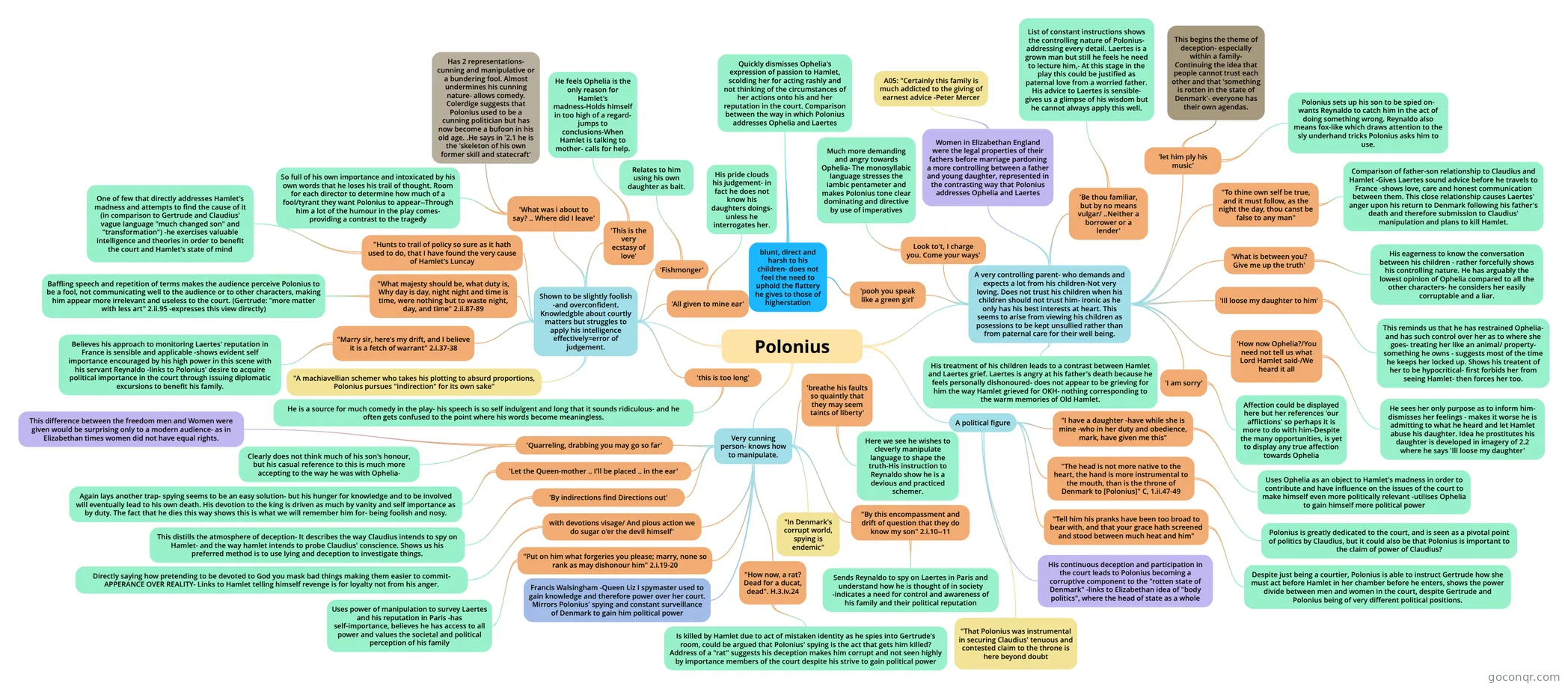
Mind map: Polonius character analysis
Inhalt der Mindmap
Polonius
A very controlling parent- who demands and expects a lot from his children-Not very loving. Does not trust his children when his children should not trust him- ironic as he only has his best interests at heart. This seems to arise from viewing his children as posessions to be kept unsullied rather than from paternal care for their well being.
- 'pooh you speak like a green girl'
- blunt, direct and harsh to his children- does not feel the need to uphold the flattery he gives to those of higherstation
- Quickly dismisses Ophelia's expression of passion to Hamlet, scolding her for acting rashly and not thinking of the circumstances of her actions onto his and her reputation in the court. Comparison between the way in which Polonius addresses Ophelia and Laertes
- blunt, direct and harsh to his children- does not feel the need to uphold the flattery he gives to those of higherstation
- Look to't, I charge you. Come your ways'
- Much more demanding and angry towards Ophelia- The monosyllabic language stresses the iambic pentameter and makes Polonius tone clear dominating and directive by use of imperatives
- 'Be thou familiar, but by no means vulgar/ ..Neither a borrower or a lender'
- List of constant instructions shows the controlling nature of Polonius- addressing every detail. Laertes is a grown man but still he feels he need to lecture him,- At this stage in the play this could be justified as paternal love from a worried father. His advice to Laertes is sensible- gives us a glimpse of his wisdom but he cannot always apply this well.
- 'What is between you? Give me up the truth'
- His eagerness to know the conversation between his children - rather forcefully shows his controlling nature. He has arguably the lowest opinion of Ophelia compared to all the other characters- he considers her easily corruptable and a liar.
- 'let him ply his music'
- Polonius sets up his son to be spied on- wants Reynaldo to catch him in the act of doing something wrong. Reynaldo also means fox-like which draws attention to the sly underhand tricks Polonius asks him to use.
- This begins the theme of deception- especially within a family- Continuing the idea that people cannot trust each other and that 'something is rotten in the state of Denmark'- everyone has their own agendas.
- 'I am sorry'
- Affection could be displayed here but her references 'our afflictions' so perhaps it is more to do with him-Despite the many opportunities, is yet to display any true affection towards Ophelia
- 'Ill loose my daughter to him'
- This reminds us that he has restrained Ophelia- and has such control over her as to where she goes- treating her like an animal/ property- something he owns - suggests most of the time he keeps her locked up. Shows his treatent of her to be hypocritical- first forbids her from seeing Hamlet- then forces her too.
- 'How now Ophelia?/You need not tell us what Lord Hamlet said-/We heard it all
- He sees her only purpose as to inform him- dismisses her feelings - makes it worse he is admitting to what he heard and let Hamlet abuse his daughter. Idea he prostitutes his daughter is developed in imagery of 2.2 where he says 'Ill loose my daughter'
- His treatment of his children leads to a contrast between Hamlet and Laertes grief. Laertes is angry at his father's death because he feels personally dishonoured- does not appear to be grieving for him the way Hamlet grieved for OKH- nothing corresponding to the warm memories of Old Hamlet.
- Women in Elizabethan England were the legal properties of their fathers before marriage pardoning a more controlling between a father and young daughter, represented in the contrasting way that Polonius addresses Ophelia and Laertes
- A05: "Certainly this family is much addicted to the giving of earnest advice -Peter Mercer
- "To thine own self be true, and it must follow, as the night the day, thou canst be false to any man"
- Comparison of father-son relationship to Claudius and Hamlet -Gives Laertes sound advice before he travels to France -shows love, care and honest communication between them. This close relationship causes Laertes' anger upon his return to Denmark following his father's death and therefore submission to Claudius' manipulation and plans to kill Hamlet.
- 'pooh you speak like a green girl'
Shown to be slightly foolish -and overconfident. Knowledgble about courtly matters but struggles to apply his intelligence effectively=error of judgement.
- 'What was i about to say? .. Where did I leave'
- So full of his own importance and intoxicated by his own words that he loses his trail of thought. Room for each director to determine how much of a fool/tyrant they want Polonius to appear--Through him a lot of the humour in the play comes- providing a contrast to the tragedy
- Has 2 representations- cunning and manipulative or a bundering fool. Almost undermines his cunning nature- allows comedy. Colerdige suggests that Polonius used to be a cunning politician but has now become a bufoon in his old age. .He says in '2.1 he is the 'skeleton of his own former skill and statecraft'
- 'This is the very ecstasy of love'
- He feels Ophelia is the only reason for Hamlet's madness-Holds himself in too high of a regard- jumps to conclusions-When Hamlet is talking to mother- calls for help.
- 'Fishmonger'
- Relates to him using his own daughter as bait.
- 'All given to mine ear'
- His pride clouds his judgement- in fact he does not know his daughters doings- unless he interrogates her.
- 'this is too long'
- He is a source for much comedy in the play- his speech is so self indulgent and long that it sounds ridiculous- and he often gets confused to the point where his words become meaningless.
- "Hunts to trail of policy so sure as it hath used to do, that I have found the very cause of Hamlet's Luncay
- One of few that directly addresses Hamlet's madness and attempts to find the cause of it (in comparison to Gertrude and Claudius' vague language "much changed son" and "transformation") -he exercises valuable intelligence and theories in order to benefit the court and Hamlet's state of mind
- "What majesty should be, what duty is, Why day is day, night night and time is time, were nothing but to waste night, day, and time" 2.ii.87-89
- Baffling speech and repetition of terms makes the audience perceive Polonius to be a fool, not communicating well to the audience or to other characters, making him appear more irrelevant and useless to the court. (Gertrude: "more matter with less art" 2.ii.95 -expresses this view directly)
- "Marry sir, here's my drift, and I believe it is a fetch of warrant" 2.i.37-38
- Believes his approach to monitoring Laertes' reputation in France is sensible and applicable -shows evident self importance encouraged by his high power in this scene with his servant Reynaldo -links to Polonius' desire to acquire political importance in the court through issuing diplomatic excursions to benefit his family.
- "A machiavellian schemer who takes his plotting to absurd proportions, Polonius pursues "indirection" for its own sake"
- 'What was i about to say? .. Where did I leave'
Very cunning person- knows how to manipulate.
- 'Quarreling, drabbing you may go so far'
- Clearly does not think much of his son's honour, but his casual reference to this is much more accepting to the way he was with Ophelia-
- This difference between the freedom men and Women were given would be surprising only to a modern audience- as in Elizabethan times women did not have equal rights.
- 'By indirections find Directions out'
- This distills the atmosphere of deception- It describes the way Claudius intends to spy on Hamlet- and the way hamlet intends to probe Claudius' conscience. Shows us his preferred method is to use lying and deception to investigate things.
- 'breathe his faults so quaintly that they may seem taints of liberty'
- Here we see he wishes to cleverly manipulate language to shape the truth-His instruction to Reynaldo show he is a devious and practiced schemer.
- with devotions visage/ And pious action we do sugar o'er the devil himself'
- Directly saying how pretending to be devoted to God you mask bad things making them easier to commit- APPERANCE OVER REALITY- Links to Hamlet telling himself revenge is for loyalty not from his anger.
- 'Let the Queen-mother .. I'll be placed .. in the ear'
- Again lays another trap- spying seems to be an easy solution- but his hunger for knowledge and to be involved will eventually lead to his own death. His devotion to the king is driven as much by vanity and self importance as by duty. The fact that he dies this way shows this is what we will remember him for- being foolish and nosy.
- "By this encompassment and drift of question that they do know my son" 2.i.10--11
- Sends Reynaldo to spy on Laertes in Paris and understand how he is thought of in society -indicates a need for control and awareness of his family and their political reputation
- "Put on him what forgeries you please; marry, none so rank as may dishonour him" 2.i.19-20
- Uses power of manipulation to survey Laertes and his reputation in Paris -has self-importance, believes he has access to all power and values the societal and political perception of his family
- "How now, a rat? Dead for a ducat, dead". H.3.iv.24
- Is killed by Hamlet due to act of mistaken identity as he spies into Gertrude's room, could be argued that Polonius' spying is the act that gets him killed? Address of a "rat" suggests his deception makes him corrupt and not seen highly by importance members of the court despite his strive to gain political power
- Francis Walsingham -Queen Liz I spymaster used to gain knowledge and therefore power over her court. Mirrors Polonius' spying and constant surveillance of Denmark to gain him political power
- "In Denmark's corrupt world, spying is endemic"
- 'Quarreling, drabbing you may go so far'
A political figure
- "I have a daughter -have while she is mine -who in her duty and obedience, mark, have given me this"
- Uses Ophelia as an object to Hamlet's madness in order to contribute and have influence on the issues of the court to make himself even more politically relevant -utilises Ophelia to gain himself more political power
- "The head is not more native to the heart, the hand is more instrumental to the mouth, than is the throne of Denmark to [Polonius]" C, 1.ii.47-49
- Polonius is greatly dedicated to the court, and is seen as a pivotal point of politics by Claudius, but it could also be that Polonius is important to the claim of power of Claudius?
- "Tell him his pranks have been too broad to bear with, and that your grace hath screened and stood between much heat and him"
- Despite just being a courtier, Polonius is able to instruct Gertrude how she must act before Hamlet in her chamber before he enters, shows the power divide between men and women in the court, despite Gertrude and Polonius being of very different political positions.
- His continuous deception and participation in the court leads to Polonius becoming a corruptive component to the "rotten state of Denmark" -links to Elizabethan idea of "body politics", where the head of state as a whole
- "That Polonius was instrumental in securing Claudius' tenuous and contested claim to the throne is here beyond doubt
- "I have a daughter -have while she is mine -who in her duty and obedience, mark, have given me this"
Informationen
- Beschreibung
- English A level (Hamlet (CHARACTERS) ) Mindmap am Polonius, erstellt von Mel Hughes am 30/01/2019.
- Erstellt von
- Mel Hughes
- Aufrufe
- 0
- Verlauf
-
- Erstellt von Saheefa Ishaq · 1 Jan 2017
- Kopiert von Mel Hughes · 30 Jan 2019
- Bewertung