
Hamlet
449 resources created by 237 users
This Hamlet page on GoConqr gathers community-made mind maps, flashcards, quizzes, slides and notes, from character maps and quote decks to critics, themes and the soliloquies. It's built for school students revising the play for GCSE or A-level English Literature, and for teachers after ready-made material. There are over 400 resources here, including more than 300 mind maps and more than 70 flashcard decks, all made by over 200 contributors. Pick a map, try a quiz to find your gaps, then build your own.
Top Hamlet resources
-
37 cardsShakespeare - Hamlet Critics SHAKESPEARE HAMLET CRITICS
-
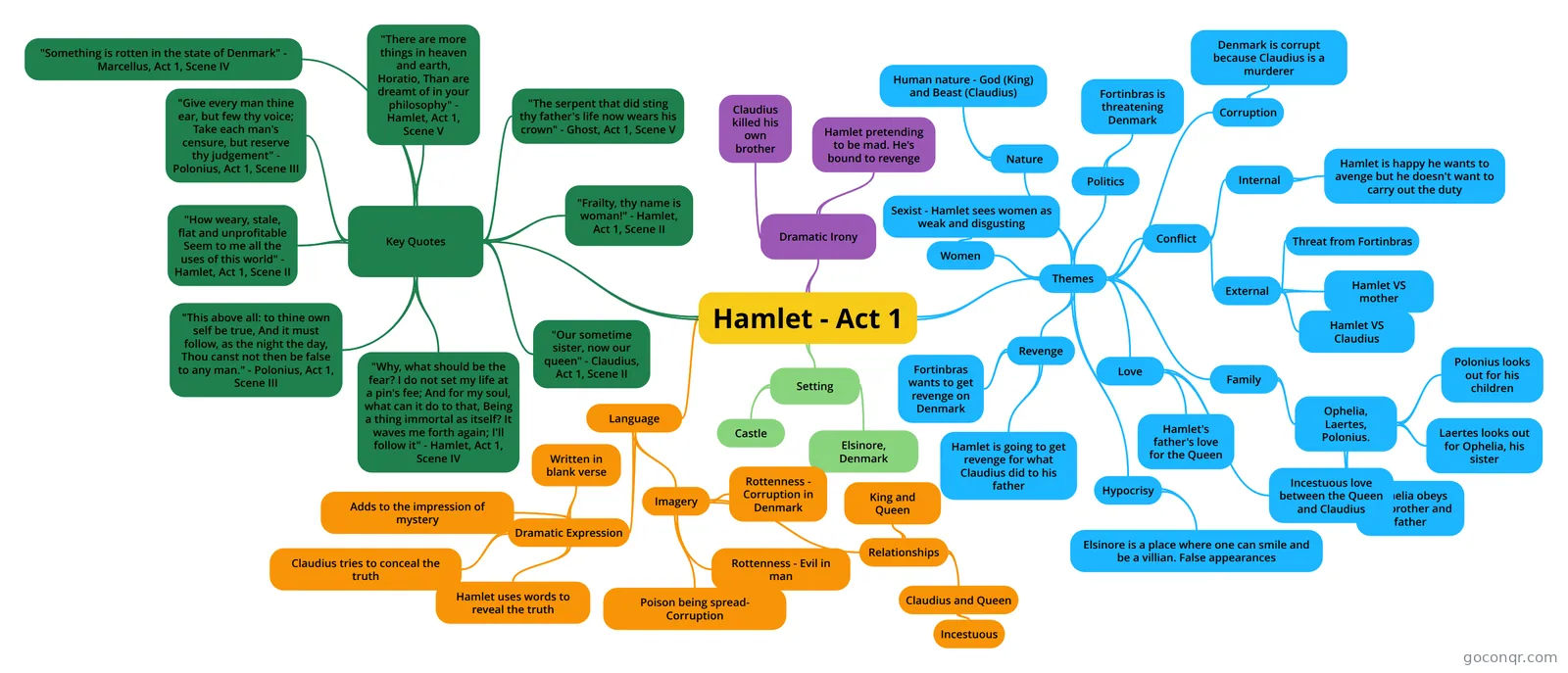 Mind map Hamlet - Act 1 My mind map for Hamlet, Act1
-
6 cardsHamlet Quotations Key quotations from "Hamlet" to remember for the critical essay exam.
-
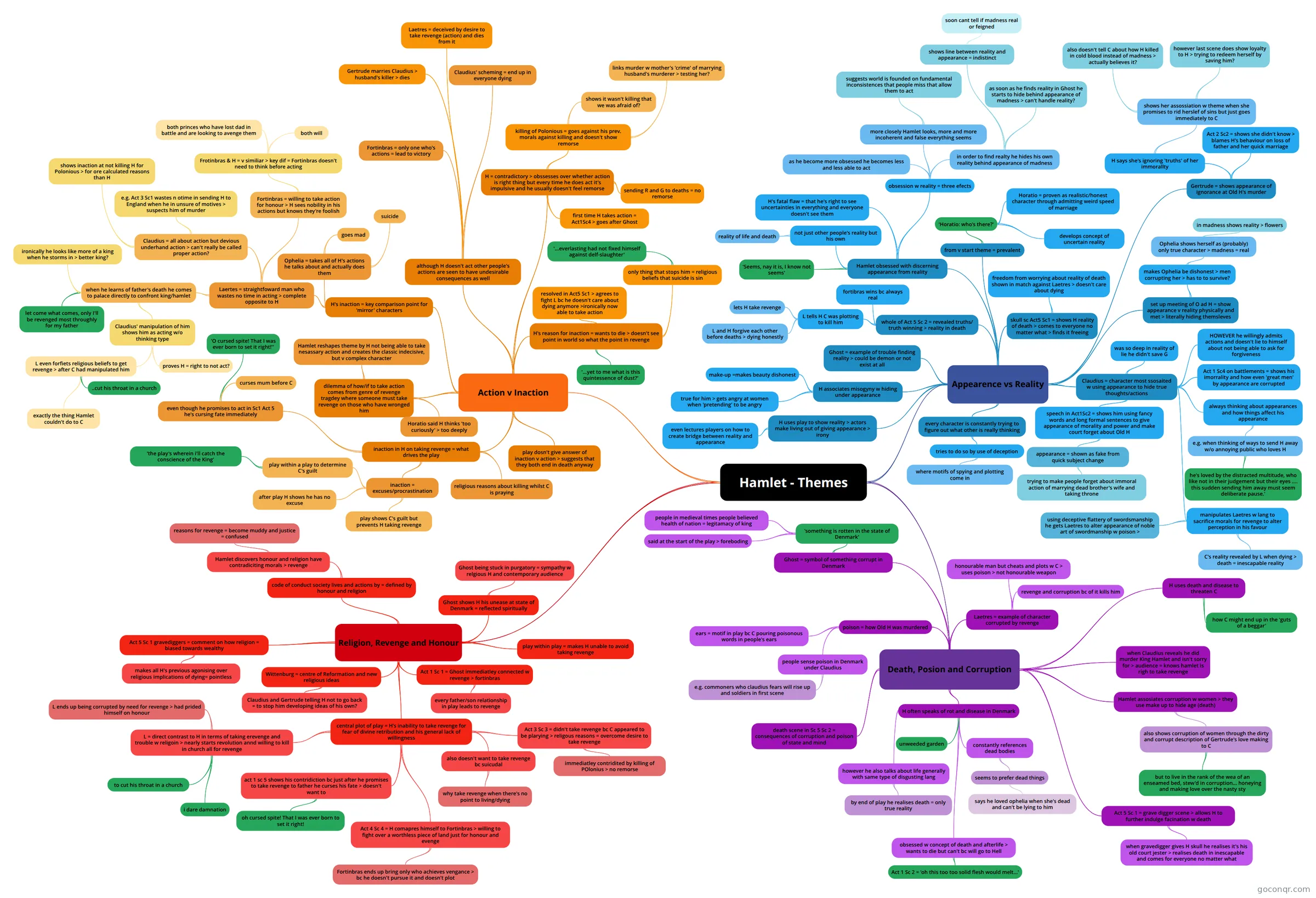 Mind map Hamlet - Themes
-
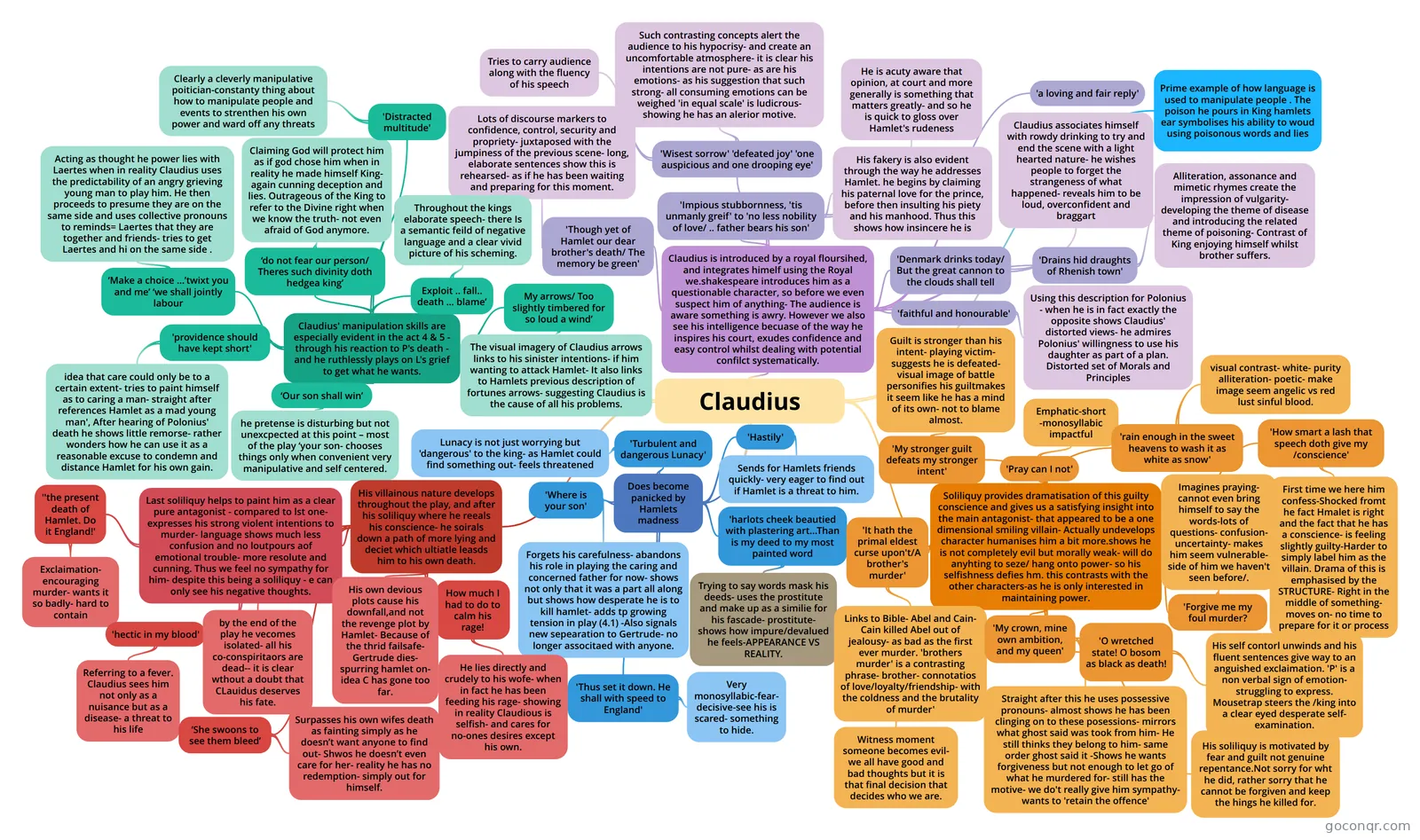 Mind map Claudius
-
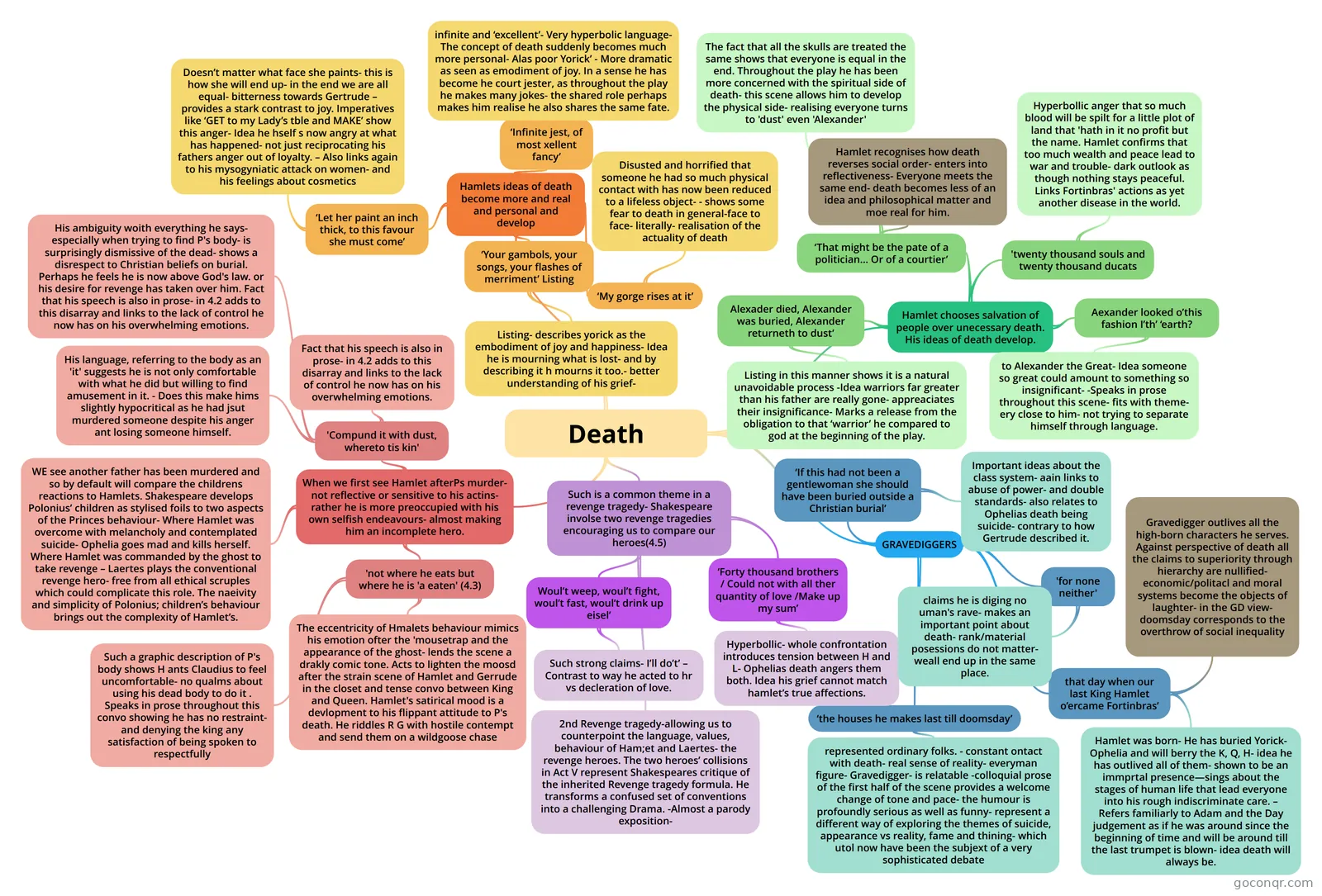 Mind map Death
-
Mind map Gertrude
-
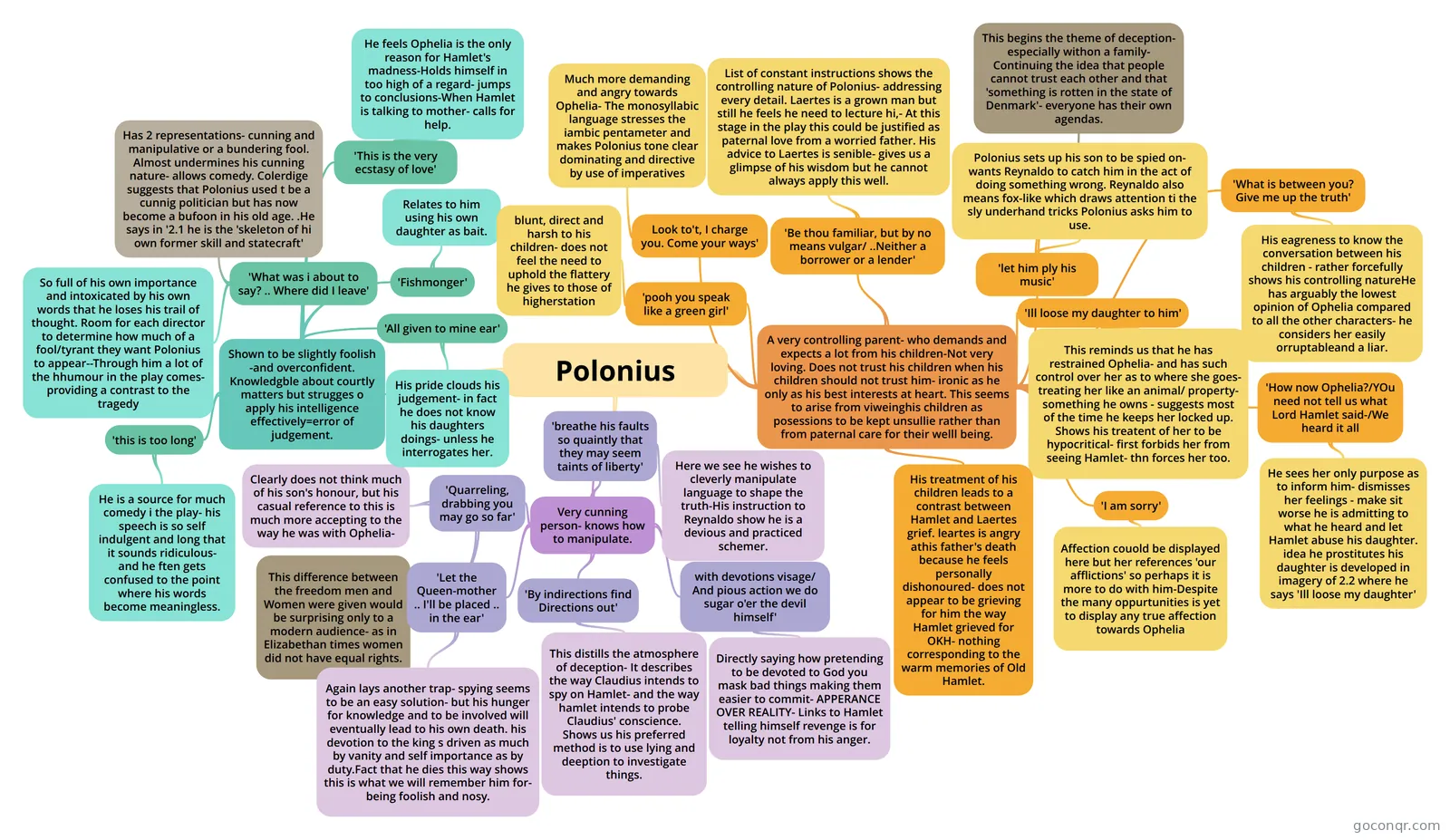 Mind map Polonius
Quizzes
See all 15 quizzes-
12 questions"Hamlet" by William Shakespeare. Hamlet is overjoyed at the celebrations of a new king, so soon after his father's death.
-
5 questionsHamlet quiz Ophelia was Hamlet's girlfriend.
-
15 questionsenglish practice test If Shakespeare kills the character of Hamlet, what dramatic convention would he be using?
-
15 questionsenglish practice test If Shakespeare kills the character of Hamlet, what dramatic convention would he be using?
-
14 questionsUntitled
-
12 questionsEnglish Literature - Hamlet In what year was Hamlet written?
-
23 questionsWomen "I obey my lord"...."I do not know my lord...
-
8 questionsUntitled What do Polonius and Claudius overhear Hamlet discussing?
Mind maps
See all 327 mind maps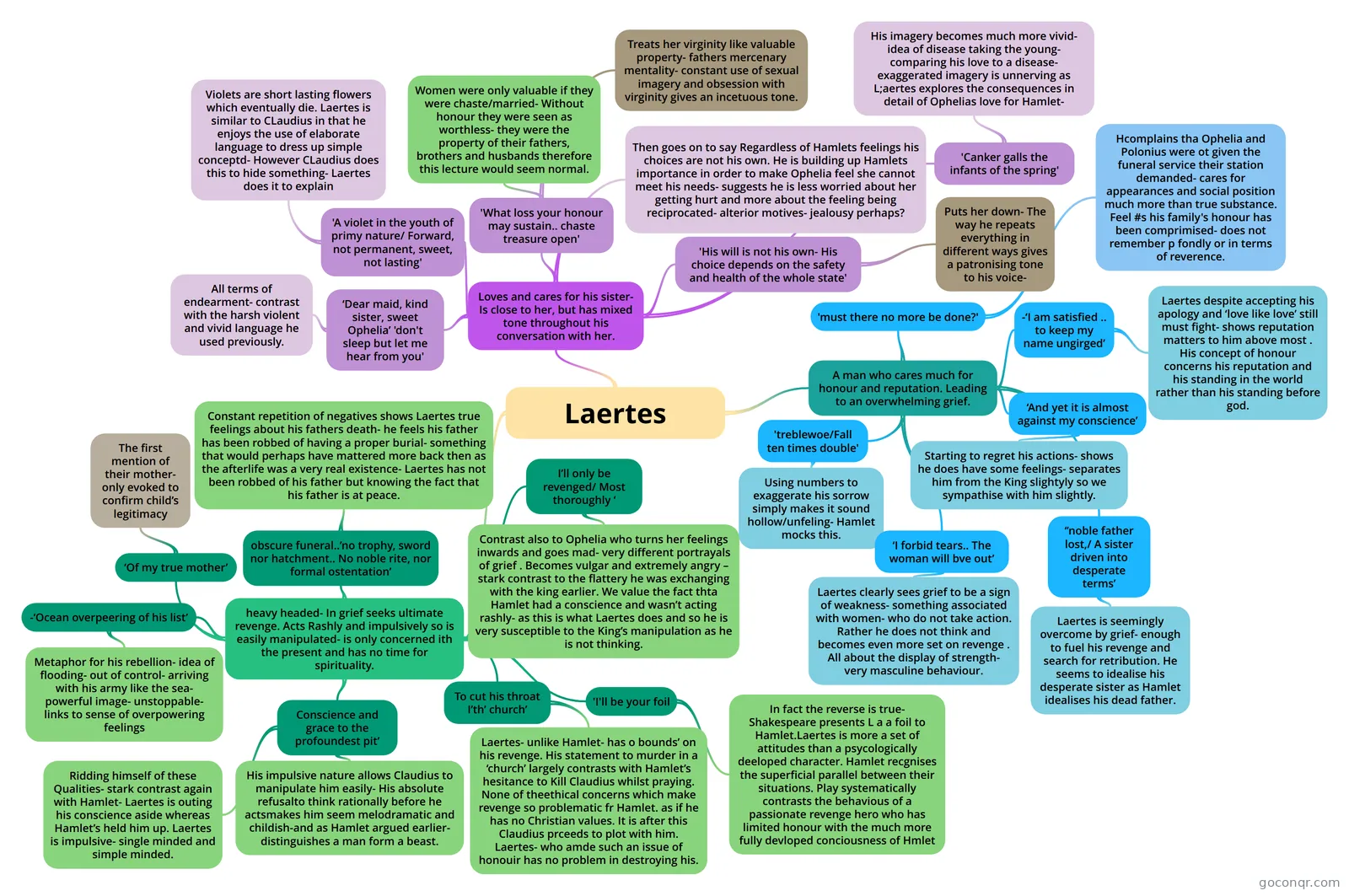
Flashcards
See all 73 flashcards-
37 cardsShakespeare - Hamlet Critics SHAKESPEARE HAMLET CRITICS
-
6 cardsHamlet Quotations Key quotations from "Hamlet" to remember for the critical essay exam.
-
7 cardsACT 2 SCENE 2 Line 20-21 (Relationship between Hamlet and R+G)
-
6 cardsACT 1 SCENE 5 Line 25 (Telling Hamlet to avenge him)
-
29 cardsHamlet quotes- Act 5 'She should have been buried out of Christian burial'
-
35 cardsHamlet quotes Act 1 'Thou art a scholar'
-
17 cardsCritical Interpretations Multiple interpretations on Shakespeare's Hamlet
-
13 cards'Hamlet' Critical Quotes ‘Much evidence in the play that Hamlet deliberately feigned fits of madness’
Flowcharts
Notes
See all 16 notes-
Hamlet - Plot Hamlet Plot - Act 1 Act 1 Scene 1 The setting is Elsinore, the seat of the Danish royal court. On the battlements, the soldiers - Barnardo and Francisco - are talking. Horatio and Marcellus enter. They question the gu...
-
CRITICAL APPRECIATION - by E.K. CHAMBERS CRITICAL APPRECIATION OF HAMLET by: E.K. Chambers The following article was originally published in The Tragedy of Hamlet Prince of Denmark. Ed. E.K. Chambers. Boston: D.C. Heath & Co., 1895. The criticism of&nbs...
-
Hamlet: appearance vs. reality - created from Mind Map the importance of VISION H: “Seem, madam? Nay it is. I know not ‘seems...These indeed ‘seem’,/ For they are actions that a man might play;/ But I have that within which passeth show—/ These but the trappings and the s...
-
Ophelia + nature Imagery and Symbols - Flowers Shakespeare weaves in flower imagery (which is suitable and synergizes well with his “garden” imagery) but what is particular about flowers in the play is that...
-
Hamlet critical essay There is, perhaps, no well-known passage in Shakespeare that has been found so perplexing as that in which Hamlet communes with himself between the preparation of the play to catch the conscience of the king and its p...
-
Hamlet Act Summaries Hamlet Act 1 Scene 1 The scene opens with Barnardo and Fransisco confronting each other; there is clearly tension, and the first line of 'who's there' raises questions not only about the state of Denmark (is it in dan...
-
JUSTICE - created from Mind Map DELAY OF JUSTICE = Collateral suffering while Hamlet achieves revenge = unjust. C: “Revenge should have no bounds”/ play demonstrates that it should. Justice in revenge + controversial notions of revenge Pursuit of ci...
-
HAMLET CRITICS "Hamlet's world," Maynard Mack says, "is pre-eminently in the interrogative mood." Harry Levin quotes this, going on to say: "... the word 'question' occurs in Hamlet no less than seventeen times, much more ...
Slides
See all 15 slidesTopics in Hamlet
More Literature topics
About Hamlet
GoConqr OriginalWhat the resources cover
The page follows the play from the opening scenes to the final one. Mind maps such as Hamlet - Act 1 - Characters list the court at Elsinore, from Claudius, Ophelia and Horatio to the Ghost, Polonius and Laertes. Hamlet - Act 1 brings together themes, key quotes, conflict, language and setting, and notes Claudius killing his own brother and Hamlet pretending to be mad.
Themes and characters
Hamlet - Themes starts with action versus inaction and the revenge tragedy genre. Madness in Hamlet collects the lines that show unnatural behaviour, such as the fishmonger exchange. Hamlet Act 4 Characters contrasts Fortinbras, a man of action, with Rosencrantz and Guildenstern. There are also maps on Ophelia, Gertrude, Claudius, Polonius, Horatio, Laertes, appearance versus reality, death, corruption and revenge.
Quotes and critics
Flashcard decks are organised by act, with sets such as Hamlet Act 2 quotes and Hamlet quotes Act 1, plus scene-by-scene decks for several scenes. The critics decks, including Shakespeare - Hamlet Critics, gather views from names such as Bradley, Johnson and C. S. Lewis, which is handy for essay work.
A sensible order
- Begin with a character map to get the cast clear.
- Read the act map for the section you are studying.
- Learn the quotes with the matching flashcard deck.
- Take a quiz, such as Hamlet quiz, and note what you missed.
- Return to the theme maps and critics decks to shore up weak spots.
Where it sits
This unit belongs to the Shakespeare strand of Literature. Most of the material is aimed at secondary level, and the resources mention GCSE English Literature, A-level English Literature and A-level English. Teachers can use the slide sets and notes as ready-made starting points.
Ready to begin? Choose an act, open a map and see how much you can recall.
Frequently asked questions
Where should I start with Hamlet?
Begin with Hamlet - Act 1 - Characters to see who is who, then open the Act 1 map for themes and quotes. After that, move through the acts in order, using the matching flashcard decks and a quiz to check what has stuck.
What do the mind maps cover?
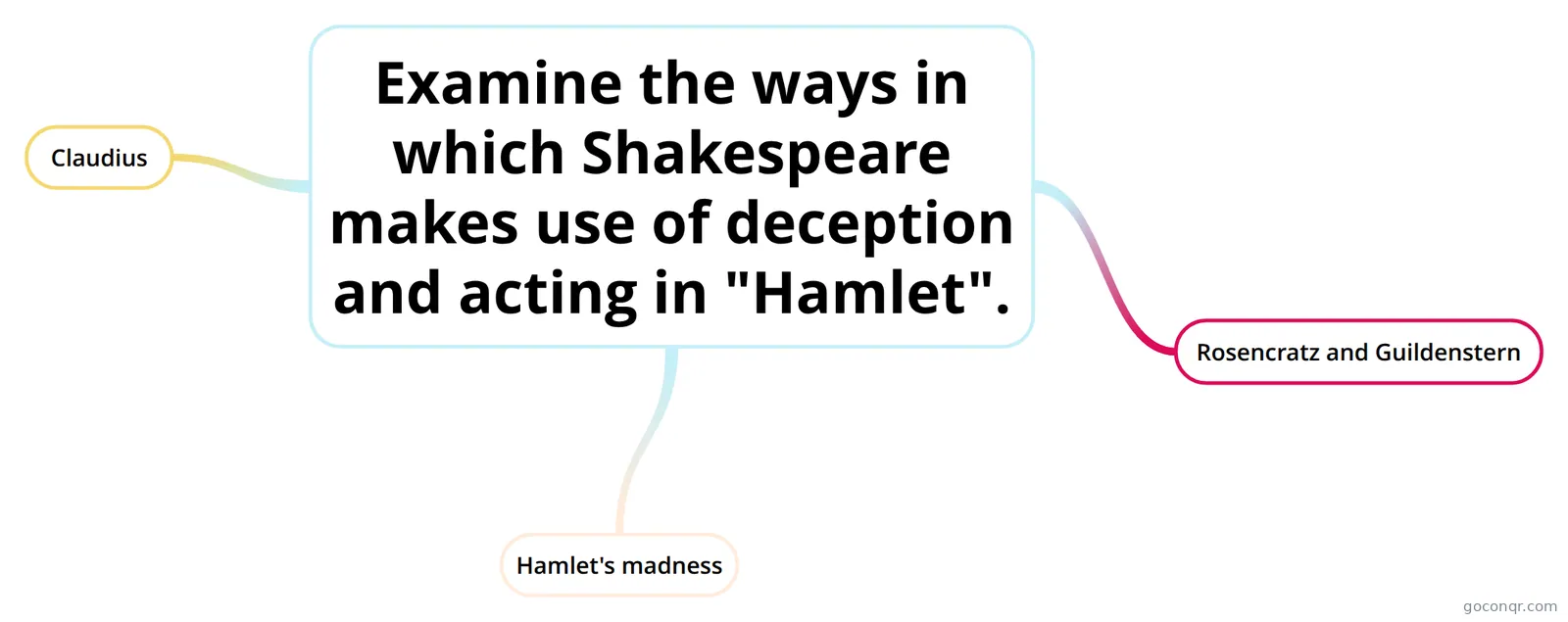
They cover characters, act-by-act themes, key quotes, language and setting. There are also maps on madness, revenge, corruption, appearance versus reality, the ghost, context and the seven soliloquies, so you can revise by act or by topic.
Are the resources free to use?
Yes. Every resource listed here is free to open, study and take, with no account needed. A free account also saves your quiz scores and lets you make your own quizzes, mind maps, flashcards and notes.
Which exams do these resources suit?
The listed resources mention GCSE English Literature, A-level English Literature, A-level Literature and A-level English. Nearly all of the material is at secondary level, so it suits school students studying the play.
Who made these resources?
They were made by GoConqr users, not by GoConqr itself. Over 200 contributors have added maps, flashcards, notes, slides and quizzes, so styles and depth vary. Compare a few on the same topic and keep the ones that suit you.
Are there resources on the critics?
Yes. Several flashcard decks gather critical views, including Shakespeare - Hamlet Critics and Critical Interpretations. There are also mind maps and notes on critic quotes and examples, useful when you want to support an argument in an essay.