
Mindmap
Digital Systems
Inhalt der Mindmap
Digital Systems
Foundations
- real world
- analogue
- measurable
- theoretically infinite precision
- digital world
- discrete sets of values
- binary digital systems
- only 2 possible values
- 0/1
- True/False
- High/Low
- only 2 possible values
- real world
Fundamental mathematics principles
- operators
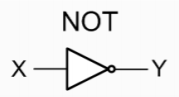
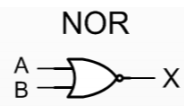
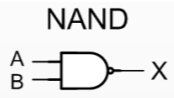
- AND OR NOT
- Laws
- Associativity –Commutativity –Distributivity –Identity & Annihilation –Complementation
- Logic Gates
- Gates combined to form larger circuits
- equations
- Truth tables
- Gates combined to form larger circuits
- operators
Types
- Combinational Logic
- – Implements a block of logic. E.g. a function
- – The output depends entirely on the current value of the inputs
- – Can capture the functionality using maths, truth tables, K ‐maps • Can be: Logical, e.g. and, or; arithmetic, e.g. add, absolute
- – The output depends entirely on the current value of the inputs
- – Implements a block of logic. E.g. a function
- Sequential Logic
- – Feedback (or storage) is introduced so output also depends on previous values
- – Can capture more complex behaviour •Latches, flip ‐flops, counters, shift registers
- – Synchronous logic is clock edge-driven – Synchronous logic is easier to analyse than asynchronous
- – Can capture more complex behaviour •Latches, flip ‐flops, counters, shift registers
- – Feedback (or storage) is introduced so output also depends on previous values
- Combinational Logic
Building Computation –Two classes of operation
- Combinational
- –Arithmetic –Comparision
- Sequential
- • Take values in turn •Increment a counter •Store a result
- Computation is accomplished using an algorithm, --> a step by step procedure for calculation
- – Transformations/Functions: combinational functions that operate on input data and produce an output
- – Storage: a unit that stores a value or some state
- Combinational
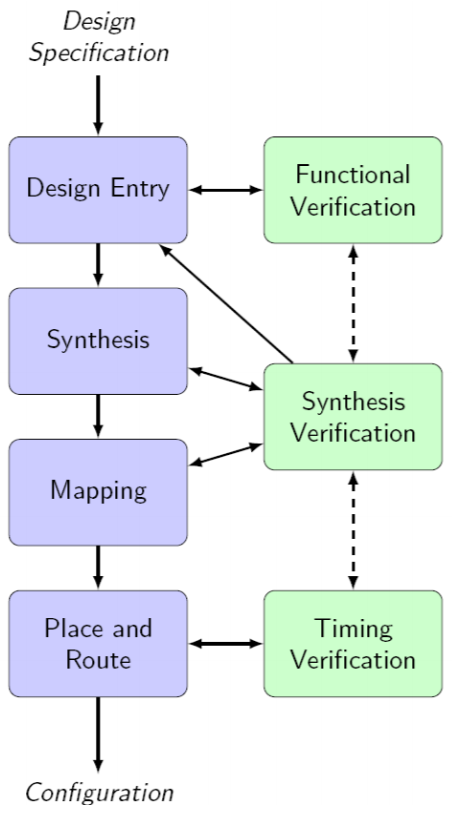
Understanding the Design Flow
- – The process of turning an HDL description into working hardware consists of a number of steps
- The input is correctly written synthesisable code
- The desired output is a bitstream that configures the FPGA to implement the circuit
- Architecture Design
- Requirements
- What technology to use
- What function(s) is required?
- time should be taken to compute the function?
- How large should the implemented circuit be?
- How much power should be consumed?
- How accurate do the results need to be?
- Requirements
- Check that the timing constraints have been met
- Analyse critical paths if there is a need to improve timing
- Simulate the final placed and routed design using the original testbench if desired
- Takes the mapped netlist generated by the Mapper
- Assigns each instance of a basic block to a location on the FPGA
- Configures the routing to connect those blocks as per the netlist
- Iterates this process multiple times to find a placement and set of routes that meet the timing requirements
- decides how to implement the components on the target architecture:
- Combinational logic is converted into look ‐up tables (LUTs)
- Synchronous components are mapped to the registers inside CLBs
- Arithmetic operators are mapped to logic
- Memories are mapped to either Block RAMs or distributed logic
- Logic that can be implemented using hard blocks in the FPGA is mapped to them
- Check that the circuit fits the target device
- Obtain an initial estimate of the timing performance
- Ensure all the code we entered is synthesisable
- Ensure no logic has been trimmed off unintentionally
- where the tools process the HDL description
- The behavioural description is translated into hardware blocks
- Combinational logic is simplified and minimised
- Basic structures such as multiplexers and memories are inferred
- result is a netlist: a low ‐level representation of the circuit using basic building blocks
- Arithmetic operations are expanded into simple representations
- Test individual components, moving up the hierarchy
- Check that the design implements the required behaviour
- Architecture Design
- – The process of turning an HDL description into working hardware consists of a number of steps
Bilder und Dateien der Mindmap
Informationen
- Beschreibung
- Mindmap am Digital Systems, erstellt von SANJUSHA 001 am 12/02/2019.
- Erstellt von
- SANJUSHA 001
- Aufrufe
- 0
- Bewertung