
Digital Logic and Digital Design
151 resources created by 111 users
This Digital Logic and Digital Design page on GoConqr gathers community-made mind maps, flashcards, quizzes and notes, from Boolean algebra and logic gates to CMOS circuits, flip-flops, FPGAs and ASIC design. It's built for university students and school students practising gates, truth tables and sequential design, and for teachers after ready-made material. There are over 130 resources here, including more than 40 mind maps, over 50 flashcard sets and 10 quizzes. Pick a topic, try a quiz to find your gaps, then build your own.
Select topic
- Boolean Algebra15
- Logic Gates and Truth Tables34
- Karnaugh Maps and Logic Simplification5
- CMOS Logic and Logic Families10
- Combinational Logic Circuits6
- Latches and Flip-Flops7
- Sequential Circuits and State Machines12
- Registers and Counters6
- Verilog and VHDL6
- Programmable Logic Devices and FPGAs7
- Digital IC Design and Timing8
Top Digital Logic and Digital Design resources
-
Mind map Boolean Algebra & Logic Gates
-
40 questionsPLC - Chapter 3: Number Systems and Codes A quiz by Allison for her Joey
-
3 questionsCMOS Inverter Circuit CMOS Inverter Circuit
-
3 questionsCMOS Logic Gate CMOS Logic Circuit consists of two networks, one Pull Down Network (PDN) and, one Pull Up Network (PUN). PD...
-
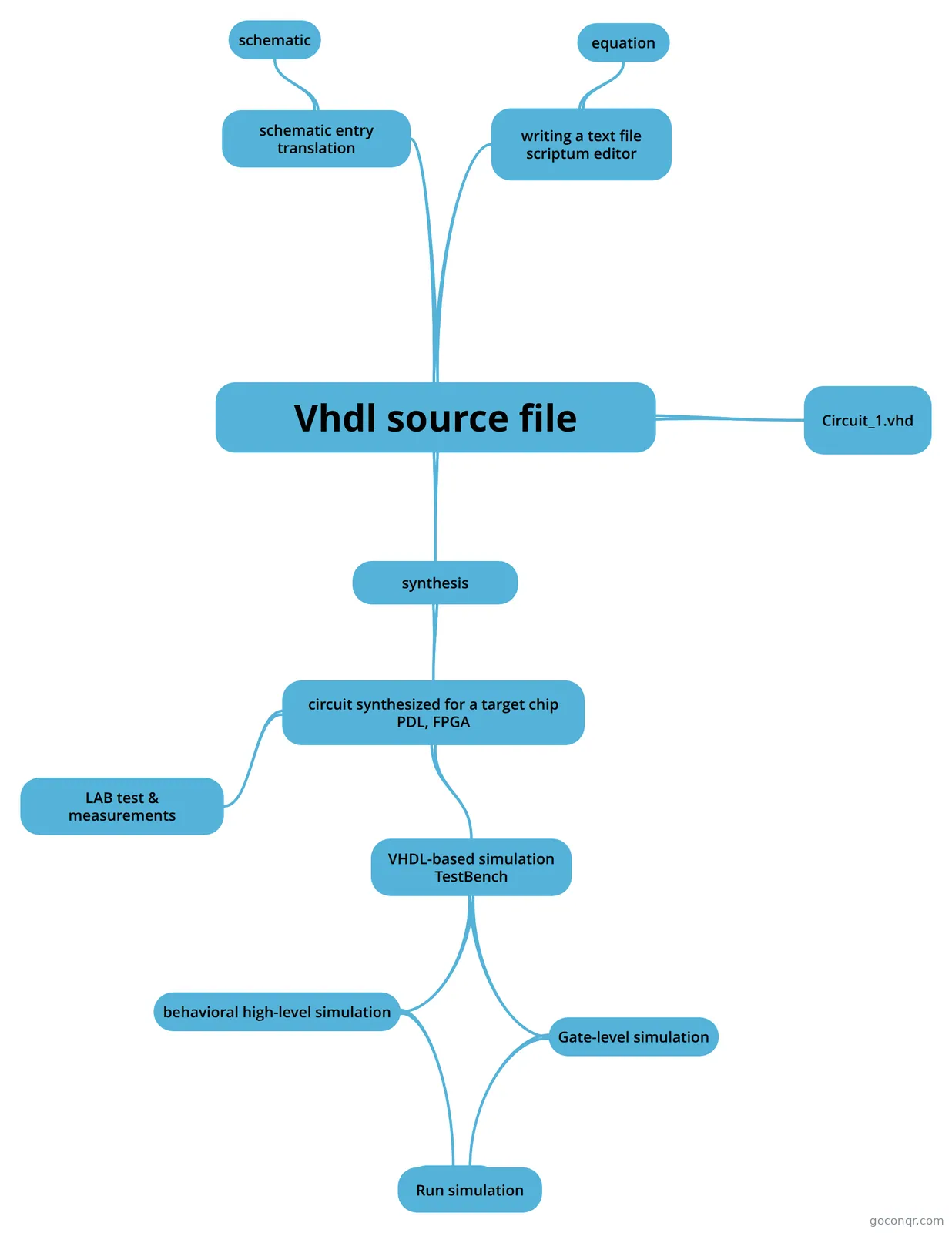 Mind map Vhdl source file CSD project_1 (EX1A)
-
5 cardsNAND Equivalence Identify the equivalent gate from the NAND-gate circuits
-
Mind map Digital Systems
-
131 cardsCS219 - Midterm 2 What will be the output voltage if we apply A = Vcc and B = 0 (ground)?
Quizzes
See all 12 quizzes-
40 questionsPLC - Chapter 3: Number Systems and Codes A quiz by Allison for her Joey
-
3 questionsCMOS Inverter Circuit CMOS Inverter Circuit
-
3 questionsCMOS Logic Gate CMOS Logic Circuit consists of two networks, one Pull Down Network (PDN) and, one Pull Up Network (PUN). PD...
-
20 questionsEndArchi Which of the following can be described using Verilog?
-
12 questionsQuiz on fundamentals of Digital Circuits Which of the figures (a to d) is the DeMorgan equivalent of Figure (e)?
-
2 questionsCMOS Inverter switching characteristics CMOS Inverter switching characteristics
-
200 questionsTecnicas digitales 2 What is the purpose of intermediate production breaks in ARINC 429 or 629 Data cables?. &n...
-
9 questionsUntitled A NOR gate is equivalent to
Mind maps
See all 53 mind maps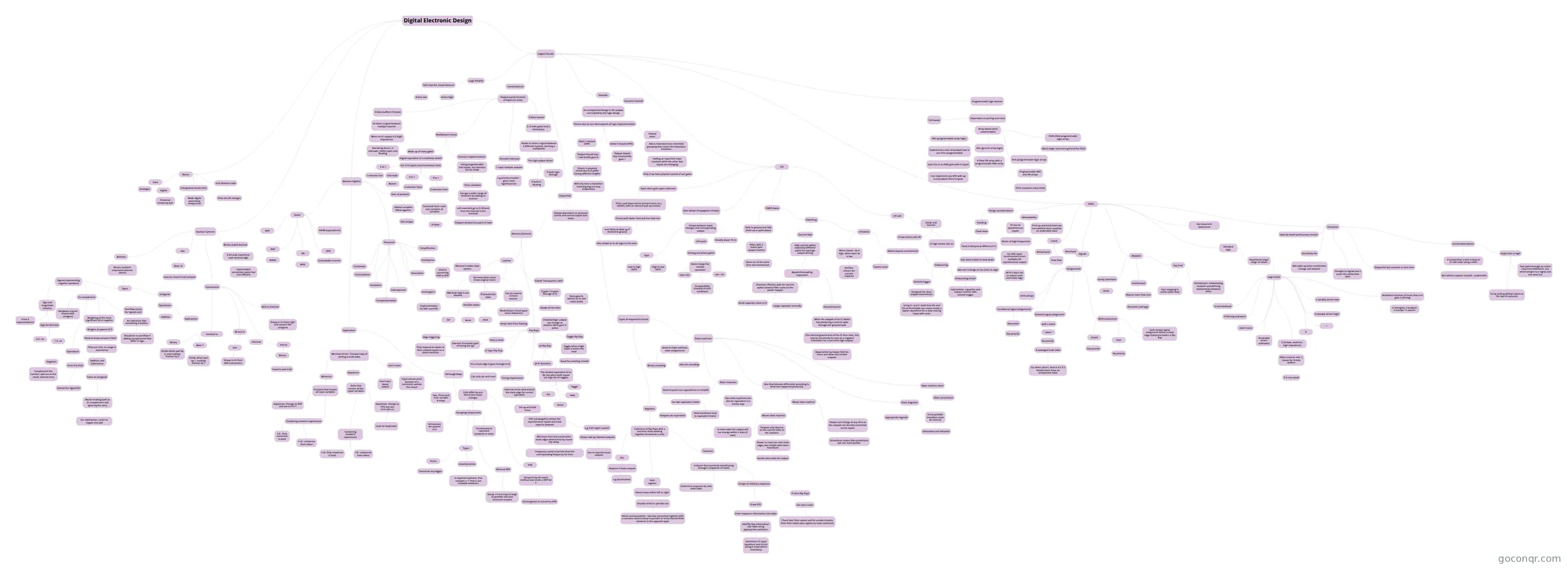
Flashcards
See all 67 flashcards-
5 cardsNAND Equivalence Identify the equivalent gate from the NAND-gate circuits
-
131 cardsCS219 - Midterm 2 What will be the output voltage if we apply A = Vcc and B = 0 (ground)?
-
47 cards06 handout 1 is a circuit that has multiple inputs (sources) and a single output (destination).
-
41 cards01Handout01 is a set of notations, similar to software programming languages, used for modeling the logical function of...
-
34 cards02Handout01 is designed by using some IC. The input to any digital circuit is in binary form. These circuits can be rep...
-
17 cardsDigital Design Flashcards What are the 7 stages of ASIC Design Flow?
-
48 cardsDTEC S1 Flashcards What is the Least Significant Bit (LSB)?
-
36 cards19: Logic Circuits and Boolean Algebra What does chapter introduce?
Flowcharts
Notes
-
HLS Introduction to HLS A behavioural description (i.e., functional specifications) is used as the starting point for HLS. It specifies the behaviour in terms of operations, assignment statements, and control constructs i...
-
Computer Org. 2019.01.25 Qwickly Attendance #: 9412 Boolean Algebra and Digital Logic Gates We call propositions 'variables' Variables can only have values 1 or 0 instead of True / False George Boole, 1815-1864 Some laws of Bool...
-
Untitled
-
Untitled 1.Domino logic is used to facilitate the cascading between the dynamic logic gates2. Why is Dynamic logic gates used.Dynamic logic gates are used in high performance datapaths and they areglitch free.Glitches do not o...
-
Untitled AND functions: Input A Input B Output Z 1 1 1 1 0 0 0 0 0 0 1 0 OR Functions: Input A Input B Output Y 0 0 0 0 1 1 1 0 1 1 1 1 NOT Functions: Input A Output X 1 0 0 1 New Page
-
truth table orInput A Input B output 0 0 0 0 1 1 1 0 1 1 1 1 andInput A Input B output 0 0 0 0 1 0 1 0 0 1 1 1 notinput output 0 1 1 0
-
Advantages of digital signals digital noises can be decoded to give the original image all signals pick up noise during transmission digital signal can be recovered despite interference digital information can be stored in a computer's memory digi...
-
NAND Only
Slides
Topics in Digital Logic and Digital Design
More Electrical and electronic engineering topics
About Digital Logic and Digital Design
GoConqr OriginalWhat the page covers
The resources follow digital design from first principles to hardware. Early topics are binary numbers, truth tables and logic gates. Later ones reach CMOS circuits, timing, programmable logic and chip design flows. Most of the material is university level, with a smaller share for school students.
Where to start
Begin with the mind map Boolean Algebra & Logic Gates. It sets out NOT, AND and OR, then the commutative, associative and distributive laws, De Morgan and absorption. Next, the mind map Digital Systems explains why binary systems use only two values, 0 and 1, instead of the continuous values of analogue signals.
Then test the basics with the quiz PLC - Chapter 3: Number Systems and Codes, which asks about bases and binary conversion. The flashcard deck NAND Equivalence is a handy drill for building Not, And, Or, Nor and Xor from one gate type.
Moving into circuits and design
- The quizzes CMOS Logic Gate and CMOS Inverter Circuit cover pull-down and pull-up networks and noise margins.
- The mind maps on synchronous sequential logic, registers and counters, and memory and programmable logic cover the storage side.
- The Vhdl source file mind map follows a design from text file to synthesis on a target chip.
- The CAD Notes flashcards ask about top-down design, synthesis and the design cycle.
Using quizzes and maps together
Read a mind map first to see how the ideas connect. Then take a quiz on the same topic and note what you missed. Go back to the map for those branches, and use flashcards for the terms that keep slipping. Repeat until the quiz feels easy.
Where this unit sits
This unit belongs to the strand Digital Electronics and Computer Systems, within Electrical and electronic engineering. The resources were made by GoConqr users, so styles and course codes vary. Choose a map or quiz that matches your course, then add your own flashcards for the gaps.
Frequently asked questions
Which resource should I open first?
Start with the mind map Boolean Algebra & Logic Gates. It lists the basic gates and the main laws, including De Morgan and absorption. Once that feels familiar, try the quiz PLC - Chapter 3: Number Systems and Codes to check binary and decimal basics.
What do the quizzes cover?
There are 10 quizzes. Several look at CMOS circuits, such as the CMOS Logic Gate quiz on pull-down and pull-up networks and the CMOS Inverter Circuit quiz on noise margins. Others cover number systems, digital fundamentals and general logic.
Are the resources free to use?
Yes. Every resource listed here is free to open, study and take, with no account needed. They were made by GoConqr users rather than by GoConqr itself, so you may see different styles and course references from one resource to the next.
Who are these resources for?
Most are at university level, with a smaller share suited to school students. University students can use them for gates, sequential logic, FPGAs and design flows. School students can practise truth tables and basic gates, and teachers can pick ready-made material.
Can I make my own versions?
Yes. A free account lets you save quiz scores and create your own quizzes, mind maps, flashcards and notes. That is useful if a topic you need is thin here, such as a specific course's lecture content.
Is there anything on hardware design tools?
Yes. The Vhdl source file mind map covers writing a text file and synthesising it for a target chip. There are also flashcards on FPGA architecture and Xilinx FPGA, and a mind map on ASIC design.