
Mindmap
Problem Solving
Inhalt der Mindmap
Problem Solving
Algorithms
- set of step-by-step instructions to solve a problem
- For improved efficiency
- Algorithms can be reused a number of times
Sequence, selection and iteration
- Sequence
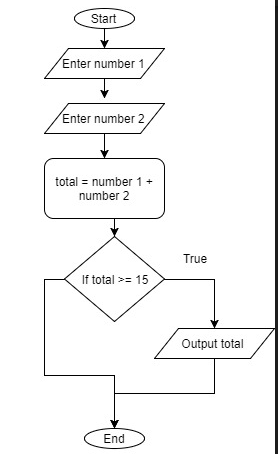
- Selection (if statements)
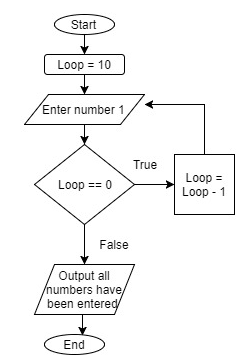
- Iteration (Loops)
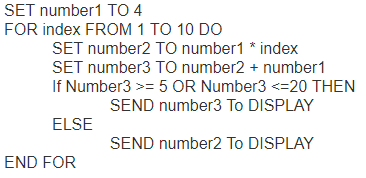
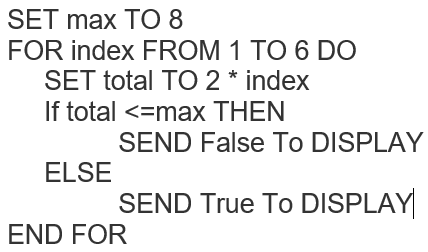
Pseudo-Code
- Way to show an algorithm in English
- Uses keywords and commands without syntax rules of programming languages
- Helps developers create a solution in a high level programming language
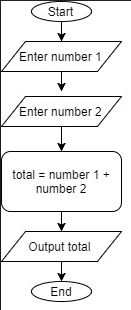
Flowcharts
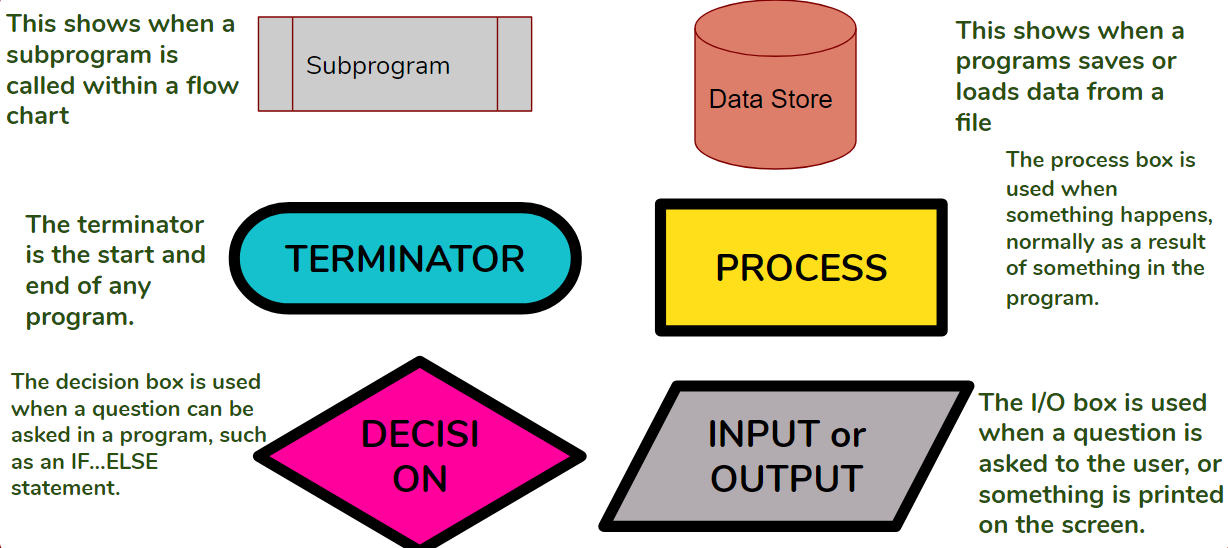
- Algorithms can be displayed as flow charts
- Flow chart shapes
Debugging Algorithms
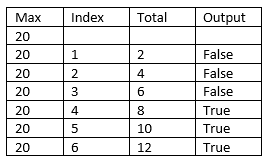
- Dry Runs
- is a way of running through an algorithms one step at a time, looking for inputs, processing and outputs to identify any errors within the code
- Trace tables
- This is a visual way of writing down each variable, input and output within the algorithm to show an errors
- https://www.bbc.co.uk/education/guides/z8n3d2p/revision/8
- Dry Runs
Searching algorithms
- Searching needs to be efficient to find data.
- Linear Search
- https://www.youtube.com/watch?v=TwsgCHYmbbA
- http://www.teach-ict.com/2016/GCSE_Computing/AQA_8520/3_1_fundamentals_of_algorithms/searching/miniweb/pg3.php
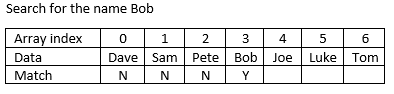
- This is a sequential algorithm which start at the beginning of the list and moves through one item at a time until it finds a match or gets to the end of the list
- This is an example of brute force algorithm as it only uses row computing power to do the task
- This is not very efficient way of finding the answer
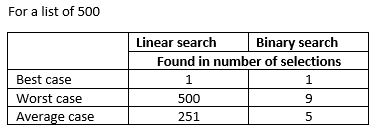
- For the list on the left with 7 items of data the best case would be the first item there is a match. However the worst case would be the last item in the list. The average would be 7 + 1 / 2 = 4 item in the list.
- This is not very efficient way of finding the answer
- Binary Searches
- https://www.youtube.com/watch?v=T98PIp4omUA
- https://www.bbc.co.uk/education/guides/zywmyrd/revision/5
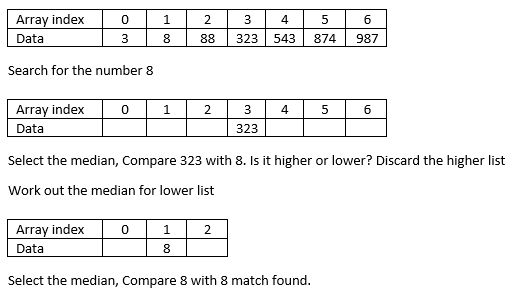
- For a binary search the data mush be sorted first into ascending order. This search method uses a divide and conquer method to find items.
- 1. Select the median 2. Compare it with the search item 3. If it is lower than discard the median and the higher items or if it is higher than discard the median and the lower items. 4. Recalculate the new median 5. Repeat until the item has been found
- Comparing linear and binary searches
- Binary searches are more efficient than a linear search but the list has to be sorted first
- Linear Search
- Searching needs to be efficient to find data.
Decomposition and Abstraction
- Decomposition
- Breaking a problem doing into a list of sub problems, so that it is easier to solve a problem.
- Abstraction
- Identify the essential elements that must be included within a program e.g. for a dice throw within a game you would need to generate a random number between 1 and 6.
- Must also identify, input, outputs and processing needed within a solution
- Decomposition
Sorting algorithms
- Bubble sort
- https://www.youtube.com/watch?v=RT-hUXUWQ2I
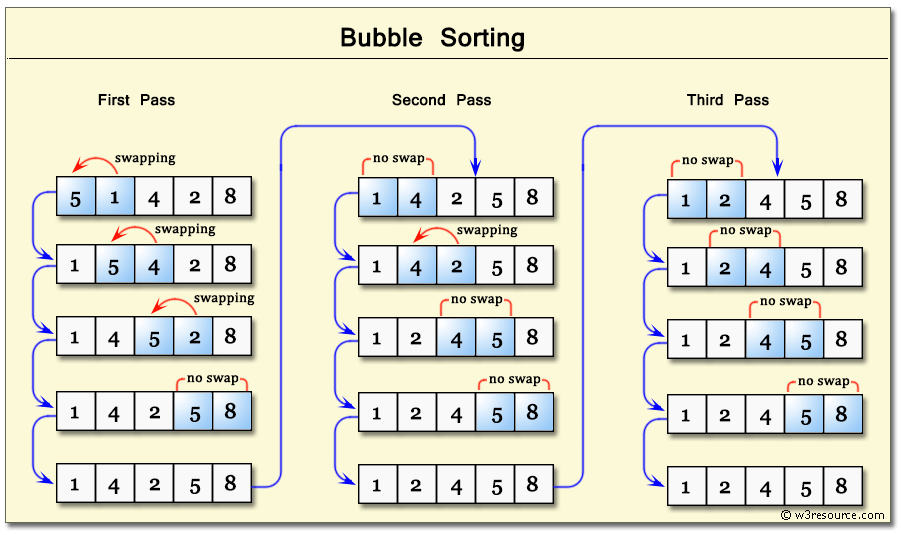
- A bubble sort starts at the begging of the list and compares each value with the one next to it
- This process is repeats via a Pass until the list has been sorted into ascending or descending order
- Merge sort
- https://www.youtube.com/watch?v=Pr2Jf83_kG0
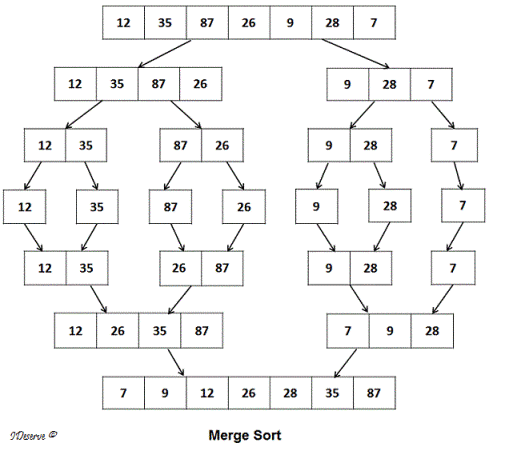
- 1- break the list into 2, then repeat until you have a list of 1 item
- 2 - reassemble the list in the same way as you broke it apart, by comparing each value putting the flower value first
- 3 - compare the first vale of each list putting the smaller value first in the new joint list
- 4 - Combine the list in the same way to form a sorted list
- https://www.bbc.co.uk/education/guides/z22wwmn/revision/3
- Bubble sort
Bilder und Dateien der Mindmap
Informationen
- Beschreibung
- GCSE Computing Mindmap am Problem Solving, erstellt von Mehwish Khan am 23/04/2019.
- Erstellt von
- Mehwish Khan
- Aufrufe
- 0
- Verlauf
-
- Erstellt von Simon Howe · 17 Nov 2017
- Kopiert von Mehwish Khan · 23 Apr 2019
- Bewertung