
Mindmap
Utilitarianism
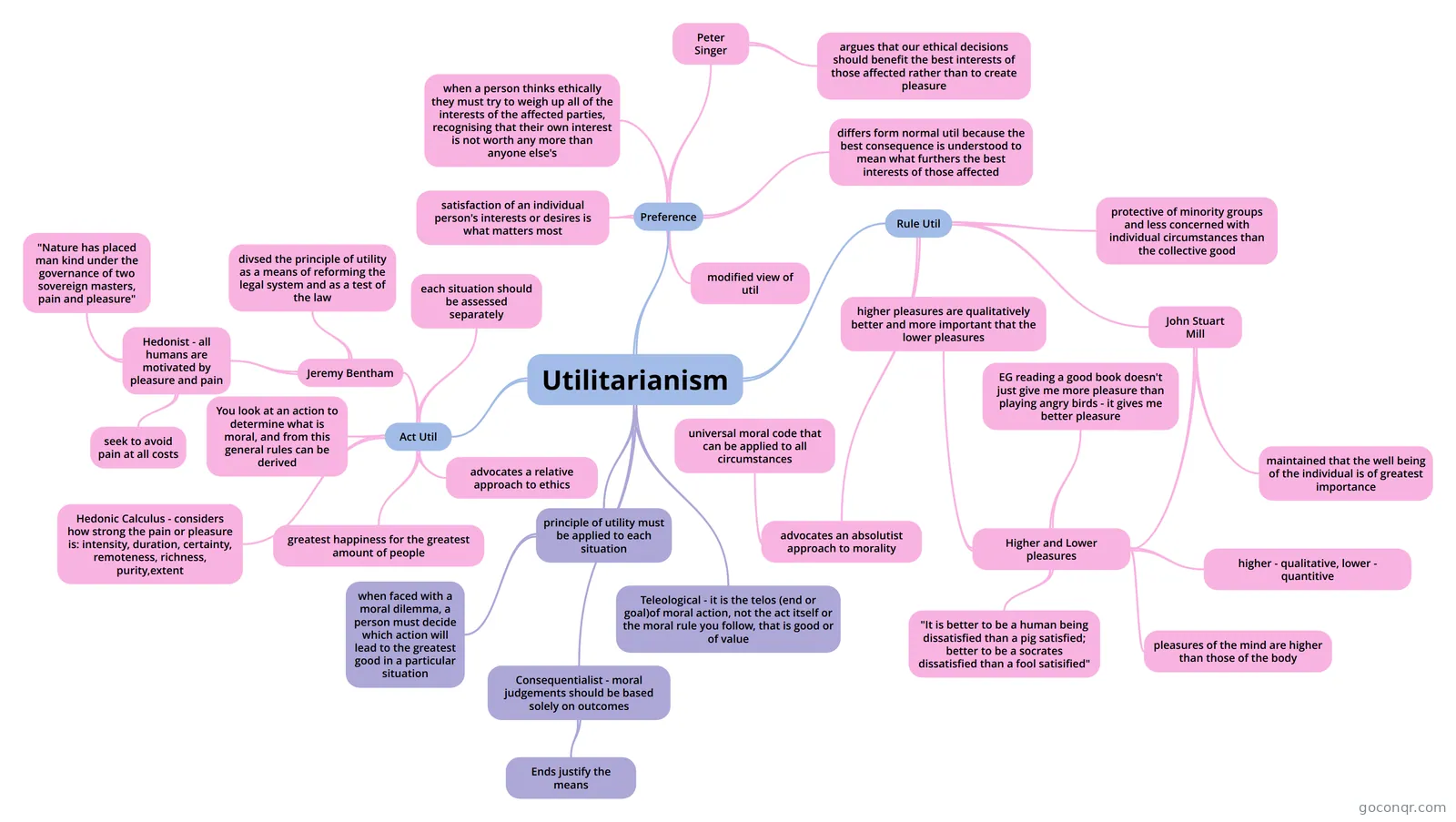
Mind map: Utilitarianism ethics
Inhalt der Mindmap
Utilitarianism
Act Util
- greatest happiness for the greatest amount of people
- Jeremy Bentham
- Hedonist - all humans are motivated by pleasure and pain
- seek to avoid pain at all costs
- "Nature has placed man kind under the governance of two sovereign masters, pain and pleasure"
- divsed the principle of utility as a means of reforming the legal system and as a test of the law
- Hedonist - all humans are motivated by pleasure and pain
- each situation should be assessed separately
- You look at an action to determine what is moral, and from this general rules can be derived
- Hedonic Calculus - considers how strong the pain or pleasure is: intensity, duration, certainty, remoteness, richness, purity,extent
- advocates a relative approach to ethics
principle of utility must be applied to each situation
- when faced with a moral dilemma, a person must decide which action will lead to the greatest good in a particular situation
Teleological - it is the telos (end or goal)of moral action, not the act itself or the moral rule you follow, that is good or of value
Consequentialist - moral judgements should be based solely on outcomes
- Ends justify the means
Rule Util
- John Stuart Mill
- maintained that the well being of the individual is of greatest importance
- Higher and Lower pleasures
- higher pleasures are qualitatively better and more important that the lower pleasures
- "It is better to be a human being dissatisfied than a pig satisfied; better to be a socrates dissatisfied than a fool satisified"
- EG reading a good book doesn't just give me more pleasure than playing angry birds - it gives me better pleasure
- pleasures of the mind are higher than those of the body
- higher - qualitative, lower - quantitive
- advocates an absolutist approach to morality
- universal moral code that can be applied to all circumstances
- protective of minority groups and less concerned with individual circumstances than the collective good
- John Stuart Mill
Preference
- Peter Singer
- argues that our ethical decisions should benefit the best interests of those affected rather than to create pleasure
- modified view of util
- differs form normal util because the best consequence is understood to mean what furthers the best interests of those affected
- satisfaction of an individual person's interests or desires is what matters most
- when a person thinks ethically they must try to weigh up all of the interests of the affected parties, recognising that their own interest is not worth any more than anyone else's
- Peter Singer
Informationen
- Beschreibung
- A Level Religious Studies Mindmap am Utilitarianism, erstellt von mirasmith am 23/01/2015.
- Erstellt von
- mirasmith
- Aufrufe
- 314
- Tags
- Bewertung