
Mindmap
Data Types
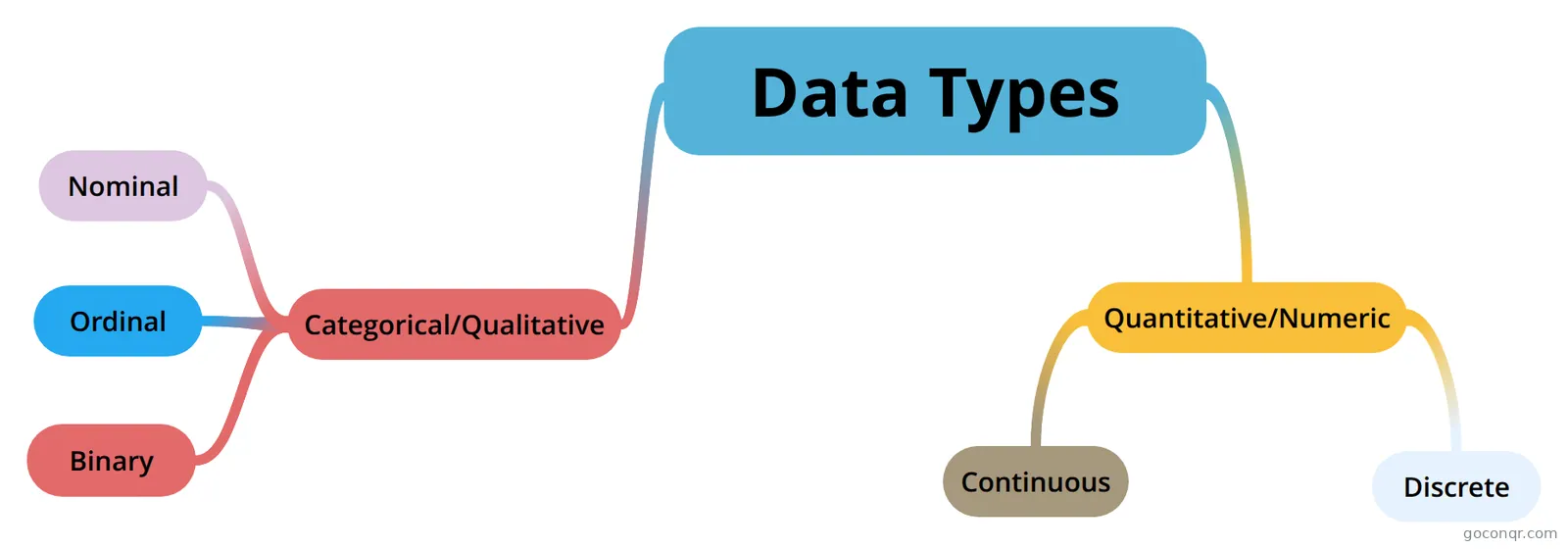
Mind map: Data types
Inhalt der Mindmap
Data Types
Quantitative/Numeric
- Quantitative data deals with numbers and things you can measure objectively: dimensions such as height, width, and length. Temperature and humidity. Prices. Area and volume. Broadly speaking, when you measure something and give it a number value, you create quantitative data.
- Continuous
- Continuous – things that you measure like height, weight or income. Continuous data could be divided and reduced to finer and finer levels. For example, you can measure the height of your kids at progressively more precise scales—meters, centimeters, millimeters, and beyond—so height is continuous data.
- Discrete
- Discrete – things that you count like number of family members or the number of items sold for a particular product in a business. Discrete data is a count that can't be made more precise. Typically it involves integers. For instance, the number of children (or adults, or pets) in your family is discrete data, because you are counting whole, indivisible entities: you can't have 2.5 kids, or 1.3 pets.
Categorical/Qualitative
- Qualitative data deals with characteristics and descriptors that can't be easily measured, but can be observed subjectively—such as smells, tastes, textures, attractiveness, and color. When you classify or judge something, you create qualitative data. There are three main kinds of qualitative data. Binomial Data, Nominal Data, and Ordinal Data
- Nominal
- Categorical is usually nominal in that as it has no order - for instance house color.
- Ordinal
- We also can have ordered or ordinal data, in which items are assigned to categories that do have some kind of implicit or natural order, such as "Short, Medium, or Tall." Another example is a survey question that asks us to rate an item on a 1 to 10 scale, with 10 being the best. This implies that 10 is better than 9, which is better than 8, and so on.
- Binary
- Binary data place things in one of two mutually exclusive categories: right/wrong, true/false, or accept/reject.
Informationen
- Beschreibung
- https://blog.minitab.com/blog/understanding-statistics/understanding-qualitative-quantitative-attribute-discrete-and-continuous-data-types
- Erstellt von
- Zahid Sheikh
- Aufrufe
- 22
- Bewertung