
Mindmap
Global development
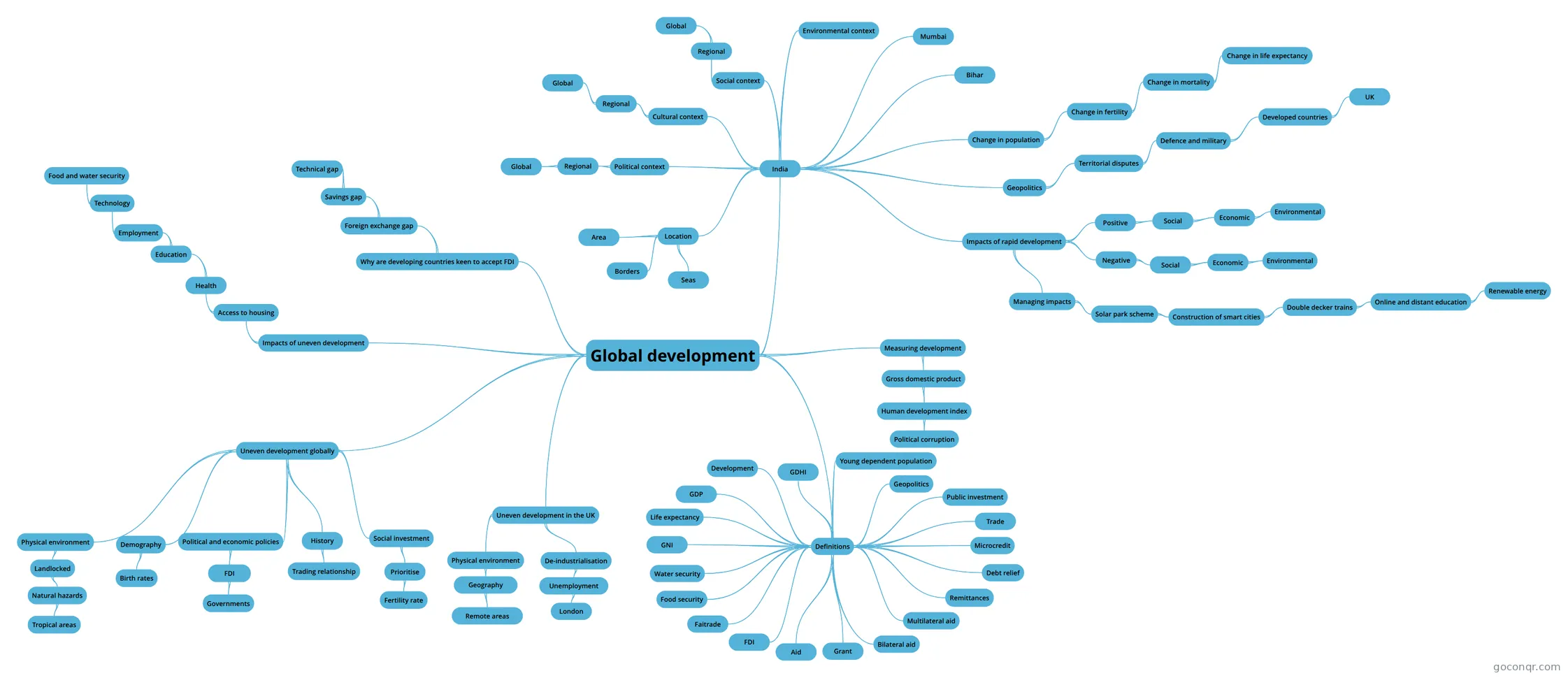
Mind map: Global development
Inhalt der Mindmap
Global development
Measuring development
- Gross domestic product
- This is the total value of goods and services produced in a country in a year
- Human development index
- Life expectancy at birth Mean years of schooling for adults Expected years of schooling for children Gross national income per capita
- Political corruption
- Less developed countries have a corrupt government
- Gross domestic product
Definitions
- Development
- The process where people, a place or a country change or make economic or social progress
- GDP
- Total value of goods and services produced within a country in a year
- Life expectancy
- A measure of the average time someone is expected to live, based on the year of its birth and gender and many other factors
- GNI
- The GDP plus overseas earnings
- Water security
- Having sufficient access to enough water for consumption
- Faitrade
- A movement that aims to create direct long trading links with producers in developing countries to ensure they receive a fair and guaranteed price for their products
- FDI
- Overseas investment in physical investment by TNCs to accelerate globalisation
- Aid
- Assistance in the form of grants or loans at below market rates
- Grant
- Free money that doesn't need to be payed back
- Bilateral aid
- From official governments to official sources
- Multilateral aid
- From governments to multilateral agencies such as Oxfam
- Remittances
- Money sent back by migrants to their family in the home community
- Debt relief
- The partial or total removal of debt especially those owed by developing countries
- Microcredit
- the granting of a small loan to poor people especially women so that they can start up small businesses
- Trade
- The exchange of goods and services
- Public investment
- Investment by the government for the public
- Geopolitics
- Refers to how power is distributed and is politics across borders
- GDHI
- Gross disposable household income
- Food security
- Having sufficient access to enough food for consumption
- Young dependent population
- Children under 15 years who are economically inactive and so depend on the older members of the community
- Development
Uneven development in the UK
- Physical environment
- Geography
- Areas in Scotland and Wales developed more slowly
- Remote areas
- Areas where communication was weak and transport
- Geography
- De-industrialisation
- Unemployment
- Industries closed or relocated leaving people unemployed
- London
- Factories moved to London where they experienced economic activity
- Unemployment
- Physical environment
Uneven development globally
- Physical environment
- Landlocked
- Landlocked countries develop slower
- Natural hazards
- Causes deaths and costs money
- Tropical areas
- Hard to grow crops
- Landlocked
- Demography
- Birth rates
- Lower birth rates mean faster development
- Birth rates
- Political and economic policies
- FDI
- More FDI means more development
- Governments
- Bad governments leads to corruption
- FDI
- History
- Trading relationship
- Developed countries dominate poorer countries and exploit others
- Trading relationship
- Social investment
- Prioritise
- developed countries prioritise health and education
- Fertility rate
- Lower fertility rates means more development
- Prioritise
- Physical environment
Impacts of uneven development
- Access to housing
- over 30% of world's population lives in slums
- Health
- Many people die due to not enough access to healthcare and this leads to uneven development
- Education
- Those with the least education have large families, so malnutrition and debt and saving is impossible
- Employment
- Opportunities for employment are limited in developing countries
- Technology
- Better technology means better development
- Food and water security
- Poor countries lack water and food
- Access to housing
Why are developing countries keen to accept FDI
- Foreign exchange gap
- They don't have enough money for trade
- Savings gap
- Increase in population puts pressure on putting money into industry and infrastructure
- Technical gap
- There is a shortage of the skills needed for development
- Foreign exchange gap
India
- Location
- Area
- South Asia and is the biggest country in the Indian sub-continent and has a population of 1.2 billion. Separated by the Thar desert and the Himalayas
- Borders
- Borders 6 countries - Pakistan, China, Nepal, Bhutan, Bangladesh, Myanmar
- Seas
- surrounded by the Arabian Sea, Bay of Bengal and the Indian ocean
- Area
- Political context
- Regional
- Largest country in the Indian sub-continent and most of India's population live in the states of Maharashta, Madhya Pradesh and Uttar Pradesh
- Global
- It's a member of many global groups like the UN and commonwealth and is the 7th largest country by size and the 2nd largest population after china
- Regional
- Cultural context
- Regional
- Bollywood makes 1600 films annually and has the 3rd largest Muslim population
- Global
- Over 80% are Hindus and has Christians, Muslims, Sikhs, Buddhists and Jainism
- Regional
- Social context
- Regional
- Caste system and social ranks are given at birth with the untouchables being the poorest
- Global
- 20 million people who make up Indian diaspora are scatter over 100 countires
- Regional
- Environmental context
- Experiences 2 monsoon seasons
- Mumbai
- A core state and is the main destination for FDI and some TNCs so increases job available
- Bihar
- A periphery region and is quite isolated so develops slowly and is doesn't have good infrastructure so transport is difficult
- Change in population
- Increase in working age Decrease in infants Increase in elderly
- Change in fertility
- Fertility fell from 4.5 to 2.4 due to increase in contraception and health education
- Change in mortality
- Death rates have fallen due to better healthcare and education
- Change in life expectancy
- Has increased from 56 to 68
- Geopolitics
- Territorial disputes
- Pakistan over Kashmir and has fought 3 wars China due to water from Himalayas
- Defence and military
- USA for defence agreement Russia for military pack
- Developed countries
- To increase FDI
- UK
- High English speaking workforce so more investment
- Territorial disputes
- Impacts of rapid development
- Positive
- Social
- More money to spend on healthcare and leisure and TNCs run programmes to help local people
- Economic
- More jobs so more income so more tax and an increase in tourism
- Environmental
- Higher income means more people will spend on protecting environment and the potential to invest in renewable energy
- Social
- Negative
- Social
- Pressure on housing, some jobs can be dangerous, exploitation and pollution
- Economic
- 'Brain drain' on rural areas as educated people move to the cities, profits made from TNCs leave India, TNCs take advantage of local government incentives
- Environmental
- Energy consumption has increased leading to more pollution, waste from TNCs aren't disposed easily and land, water and air pollution and chemicals from factories reduce biodiversity
- Social
- Managing impacts
- Solar park scheme
- Construction of smart cities
- Double decker trains
- Online and distant education
- Renewable energy
- Online and distant education
- Double decker trains
- Construction of smart cities
- Solar park scheme
- Positive
- Location
Informationen
- Beschreibung
- GCSE Geography Mindmap am Global development, erstellt von Fxxxxxx Hxxxx Rxxxxx am 18/10/2019.
- Erstellt von
- Fxxxxxx Hxxxx Rxxxxx
- Aufrufe
- 1
- Bewertung