
Mindmap
Water Conflicts
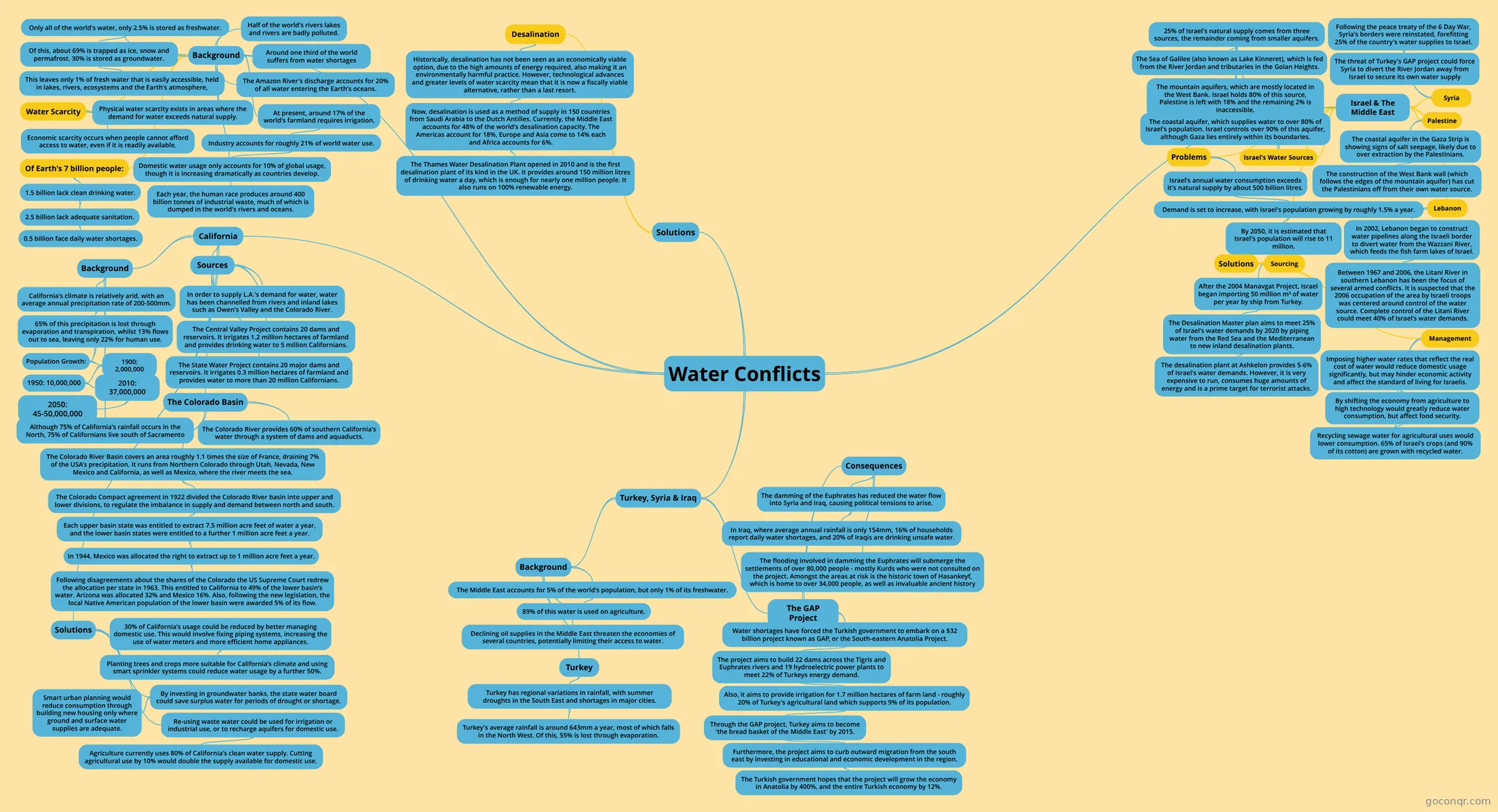
Mind map: Water conflicts
Inhalt der Mindmap
Water Conflicts
Israel & The Middle East
- Palestine
- The coastal aquifer in the Gaza Strip is showing signs of salt seepage, likely due to over extraction by the Palestinians.
- The construction of the West Bank wall (which follows the edges of the mountain aquifer) has cut the Palestinians off from their own water source.
- The coastal aquifer in the Gaza Strip is showing signs of salt seepage, likely due to over extraction by the Palestinians.
- Israel's Water Sources
- 25% of Israel's natural supply comes from three sources, the remainder coming from smaller aquifers.
- The Sea of Galilee (also known as Lake Kinneret), which is fed from the River Jordan and tributaries in the Golan Heights.
- The mountain aquifers, which are mostly located in the West Bank. Israel holds 80% of this source, Palestine is left with 18% and the remaining 2% is inaccessible.
- The coastal aquifer, which supplies water to over 80% of Israel's population. Israel controls over 90% of this aquifer, although Gaza lies entirely within its boundaries.
- 25% of Israel's natural supply comes from three sources, the remainder coming from smaller aquifers.
- Syria
- Following the peace treaty of the 6 Day War, Syria's borders were reinstated, forefitting 25% of the country's water supplies to Israel.
- The threat of Turkey's GAP project could force Syria to divert the River Jordan away from Israel to secure its own water supply
- Following the peace treaty of the 6 Day War, Syria's borders were reinstated, forefitting 25% of the country's water supplies to Israel.
- Lebanon
- In 2002, Lebanon began to construct water pipelines along the Israeli border to divert water from the Wazzani River, which feeds the fish farm lakes of Israel.
- Between 1967 and 2006, the Litani River in southern Lebanon has been the focus of several armed conflicts. It is suspected that the 2006 occupation of the area by Israeli troops was centered around control of the water source. Complete control of the Litani River could meet 40% of Israel's water demands.
- In 2002, Lebanon began to construct water pipelines along the Israeli border to divert water from the Wazzani River, which feeds the fish farm lakes of Israel.
- Problems
- Israel's annual water consumption exceeds it's natural supply by about 500 billion litres.
- Demand is set to increase, with Israel's population growing by roughly 1.5% a year.
- By 2050, it is estimated that Israel's population will rise to 11 million.
- Demand is set to increase, with Israel's population growing by roughly 1.5% a year.
- Israel's annual water consumption exceeds it's natural supply by about 500 billion litres.
- Solutions
- Management
- Recycling sewage water for agricultural uses would lower consumption. 65% of Israel's crops (and 90% of its cotton) are grown with recycled water.
- By shifting the economy from agriculture to high technology would greatly reduce water consumption, but affect food security.
- Imposing higher water rates that reflect the real cost of water would reduce domestic usage significantly, but may hinder economic activity and affect the standard of living for Israelis.
- By shifting the economy from agriculture to high technology would greatly reduce water consumption, but affect food security.
- Recycling sewage water for agricultural uses would lower consumption. 65% of Israel's crops (and 90% of its cotton) are grown with recycled water.
- Sourcing
- After the 2004 Manavgat Project, Israel began importing 50 million m³ of water per year by ship from Turkey.
- The Desalination Master plan aims to meet 25% of Israel's water demands by 2020 by piping water from the Red Sea and the Mediterranean to new inland desalination plants.
- The desalination plant at Ashkelon provides 5-6% of Israel's water demands. However, it is very expensive to run, consumes huge amounts of energy and is a prime target for terrorist attacks.
- The Desalination Master plan aims to meet 25% of Israel's water demands by 2020 by piping water from the Red Sea and the Mediterranean to new inland desalination plants.
- After the 2004 Manavgat Project, Israel began importing 50 million m³ of water per year by ship from Turkey.
- Management
- Palestine
Turkey, Syria & Iraq
- Background
- The Middle East accounts for 5% of the world's population, but only 1% of its freshwater.
- 89% of this water is used on agriculture.
- Declining oil supplies in the Middle East threaten the economies of several countries, potentially limiting their access to water.
- Turkey
- Turkey has regional variations in rainfall, with summer droughts in the South East and shortages in major cities.
- Turkey's average rainfall is around 643mm a year, most of which falls in the North West. Of this, 55% is lost through evaporation.
- Turkey has regional variations in rainfall, with summer droughts in the South East and shortages in major cities.
- The Middle East accounts for 5% of the world's population, but only 1% of its freshwater.
- The GAP Project
- Water shortages have forced the Turkish government to embark on a $32 billion project known as GAP, or the South-eastern Anatolia Project.
- The project aims to build 22 dams across the Tigris and Euphrates rivers and 19 hydroelectric power plants to meet 22% of Turkeys energy demand.
- Also, it aims to provide irrigation for 1.7 million hectares of farm land - roughly 20% of Turkey's agricultural land which supports 9% of its population.
- Through the GAP project, Turkey aims to become 'the bread basket of the Middle East' by 2015.
- Furthermore, the project aims to curb outward migration from the south east by investing in educational and economic development in the region.
- The Turkish government hopes that the project will grow the economy in Anatolia by 400%, and the entire Turkish economy by 12%.
- Furthermore, the project aims to curb outward migration from the south east by investing in educational and economic development in the region.
- Through the GAP project, Turkey aims to become 'the bread basket of the Middle East' by 2015.
- Also, it aims to provide irrigation for 1.7 million hectares of farm land - roughly 20% of Turkey's agricultural land which supports 9% of its population.
- The project aims to build 22 dams across the Tigris and Euphrates rivers and 19 hydroelectric power plants to meet 22% of Turkeys energy demand.
- Consequences
- The damming of the Euphrates has reduced the water flow into Syria and Iraq, causing political tensions to arise.
- In Iraq, where average annual rainfall is only 154mm, 16% of households report daily water shortages, and 20% of Iraqis are drinking unsafe water.
- The flooding involved in damming the Euphrates will submerge the settlements of over 80,000 people - mostly Kurds who were not consulted on the project. Amongst the areas at risk is the historic town of Hasankeyf, which is home to over 34,000 people, as well as invaluable ancient history
- The damming of the Euphrates has reduced the water flow into Syria and Iraq, causing political tensions to arise.
- Water shortages have forced the Turkish government to embark on a $32 billion project known as GAP, or the South-eastern Anatolia Project.
- Background
California
- Background
- California's climate is relatively arid, with an average annual precipitation rate of 200-500mm.
- 65% of this precipitation is lost through evaporation and transpiration, whilst 13% flows out to sea, leaving only 22% for human use.
- Population Growth:
- 1900: 2,000,000
- 1950: 10,000,000
- 2010: 37,000,000
- 2050: 45-50,000,000
- 2010: 37,000,000
- 1950: 10,000,000
- 1900: 2,000,000
- Population Growth:
- 65% of this precipitation is lost through evaporation and transpiration, whilst 13% flows out to sea, leaving only 22% for human use.
- Although 75% of California's rainfall occurs in the North, 75% of Californians live south of Sacramento
- California's climate is relatively arid, with an average annual precipitation rate of 200-500mm.
- Sources
- In order to supply L.A.'s demand for water, water has been channelled from rivers and inland lakes such as Owen's Valley and the Colorado River.
- The State Water Project contains 20 major dams and reservoirs. It irrigates 0.3 million hectares of farmland and provides water to more than 20 million Californians.
- The Central Valley Project contains 20 dams and reservoirs. It irrigates 1.2 million hectares of farmland and provides drinking water to 5 million Californians.
- The Colorado Basin
- The Colorado River provides 60% of southern California's water through a system of dams and aquaducts.
- The Colorado River Basin covers an area roughly 1.1 times the size of France, draining 7% of the USA's precipitation. It runs from Northern Colorado through Utah, Nevada, New Mexico and California, as well as Mexico, where the river meets the sea.
- The Colorado Compact agreement in 1922 divided the Colorado River basin into upper and lower divisions, to regulate the imbalance in supply and demand between north and south.
- Each upper basin state was entitled to extract 7.5 million acre feet of water a year, and the lower basin states were entitled to a further 1 million acre feet a year.
- In 1944, Mexico was allocated the right to extract up to 1 million acre feet a year.
- Following disagreements about the shares of the Colorado the US Supreme Court redrew the allocation per state in 1963. This entitled to California to 49% of the lower basin's water. Arizona was allocated 32% and Mexico 16%. Also, following the new legislation, the local Native American population of the lower basin were awarded 5% of its flow.
- In 1944, Mexico was allocated the right to extract up to 1 million acre feet a year.
- Each upper basin state was entitled to extract 7.5 million acre feet of water a year, and the lower basin states were entitled to a further 1 million acre feet a year.
- The Colorado Compact agreement in 1922 divided the Colorado River basin into upper and lower divisions, to regulate the imbalance in supply and demand between north and south.
- Solutions
- 30% of California's usage could be reduced by better managing domestic use. This would involve fixing piping systems, increasing the use of water meters and more efficient home appliances.
- Planting trees and crops more suitable for California's climate and using smart sprinkler systems could reduce water usage by a further 50%.
- By investing in groundwater banks, the state water board could save surplus water for periods of drought or shortage.
- Smart urban planning would reduce consumption through building new housing only where ground and surface water supplies are adequate.
- Re-using waste water could be used for irrigation or industrial use, or to recharge aquifers for domestic use.
- Agriculture currently uses 80% of California's clean water supply. Cutting agricultural use by 10% would double the supply available for domestic use.
- 30% of California's usage could be reduced by better managing domestic use. This would involve fixing piping systems, increasing the use of water meters and more efficient home appliances.
- Background
Background
- Only all of the world's water, only 2.5% is stored as freshwater.
- Of this, about 69% is trapped as ice, snow and permafrost. 30% is stored as groundwater.
- This leaves only 1% of fresh water that is easily accessible, held in lakes, rivers, ecosystems and the Earth's atmosphere,
- Of this, about 69% is trapped as ice, snow and permafrost. 30% is stored as groundwater.
- The Amazon River's discharge accounts for 20% of all water entering the Earth's oceans.
- Of Earth's 7 billion people:
- 1.5 billion lack clean drinking water.
- 2.5 billion lack adequate sanitation.
- 0.5 billion face daily water shortages.
- 2.5 billion lack adequate sanitation.
- 1.5 billion lack clean drinking water.
- Half of the world's rivers lakes and rivers are badly polluted.
- Water Scarcity
- Physical water scarcity exists in areas where the demand for water exceeds natural supply.
- Economic scarcity occurs when people cannot afford access to water, even if it is readily available.
- Around one third of the world suffers from water shortages
- At present, around 17% of the world's farmland requires irrigation.
- Industry accounts for roughly 21% of world water use.
- Domestic water usage only accounts for 10% of global usage, though it is increasing dramatically as countries develop.
- Industry accounts for roughly 21% of world water use.
- Each year, the human race produces around 400 billion tonnes of industrial waste, much of which is dumped in the world's rivers and oceans.
- Only all of the world's water, only 2.5% is stored as freshwater.
Solutions
- Desalination
- Historically, desalination has not been seen as an economically viable option, due to the high amounts of energy required, also making it an environmentally harmful practice. However, technological advances and greater levels of water scarcity mean that it is now a fiscally viable alternative, rather than a last resort.
- Now, desalination is used as a method of supply in 150 countries from Saudi Arabia to the Dutch Antilles. Currently, the Middle East accounts for 48% of the world's desalination capacity. The Americas account for 18%, Europe and Asia come to 14% each and Africa accounts for 6%.
- The Thames Water Desalination Plant opened in 2010 and is the first desalination plant of its kind in the UK. It provides around 150 million litres of drinking water a day, which is enough for nearly one million people. It also runs on 100% renewable energy.
- Now, desalination is used as a method of supply in 150 countries from Saudi Arabia to the Dutch Antilles. Currently, the Middle East accounts for 48% of the world's desalination capacity. The Americas account for 18%, Europe and Asia come to 14% each and Africa accounts for 6%.
- Historically, desalination has not been seen as an economically viable option, due to the high amounts of energy required, also making it an environmentally harmful practice. However, technological advances and greater levels of water scarcity mean that it is now a fiscally viable alternative, rather than a last resort.
- Desalination
Informationen
- Beschreibung
- A-level Geography (A2) Mindmap am Water Conflicts, erstellt von Callum Dwyer am 20/02/2015.
- Erstellt von
- Callum Dwyer
- Aufrufe
- 3
- Bewertung