
Mindmap
Learning Aim B: Cyber Security
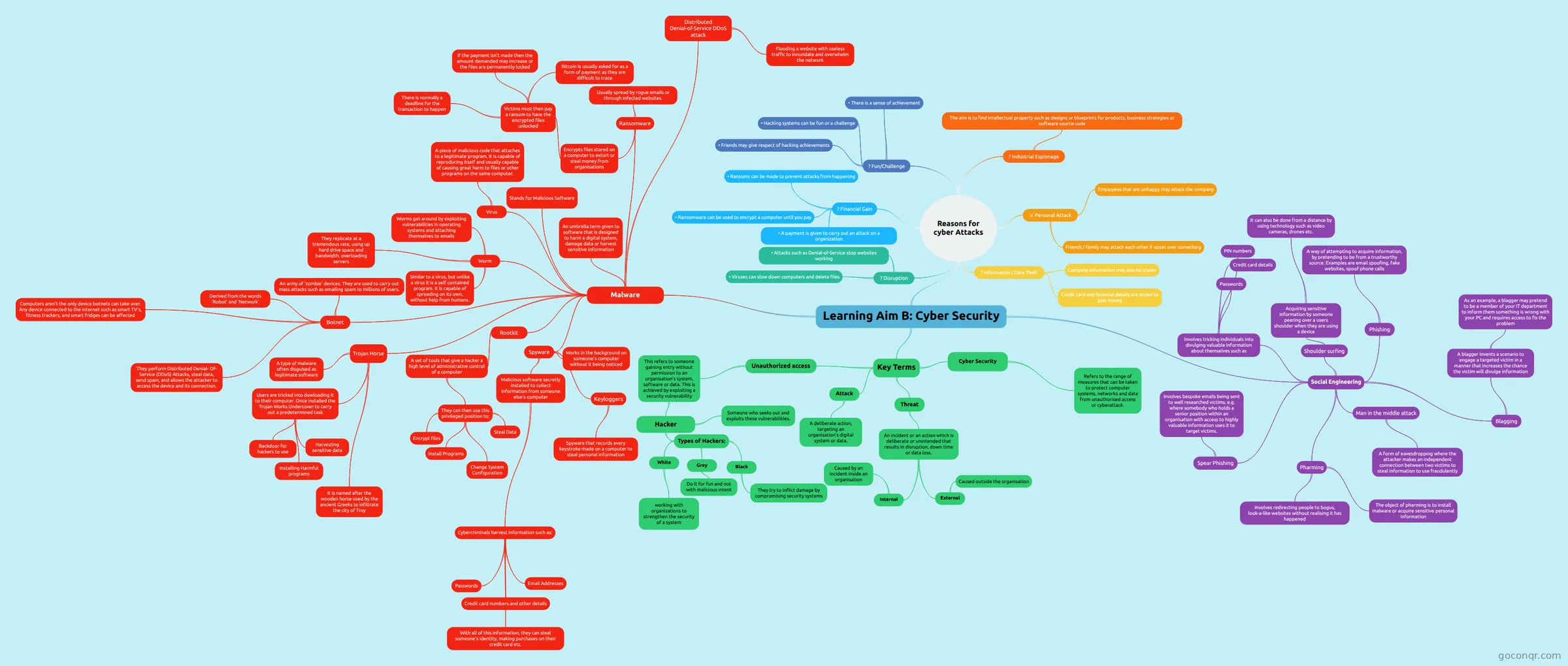
Mind map: Learning Aim B: Cyber Security
Inhalt der Mindmap
Learning Aim B: Cyber Security
Key Terms
- Unauthorized access
- This refers to someone gaining entry without permission to an organisation’s system, software or data. This is achieved by exploiting a security vulnerability
- Hacker
- Someone who seeks out and exploits these vulnerabilities.
- Types of Hackers:
- White
- working with organizations to strengthen the security of a system
- Grey
- Do it for fun and not with malicious intent
- Black
- They try to inflict damage by compromising security systems
- White
- Hacker
- This refers to someone gaining entry without permission to an organisation’s system, software or data. This is achieved by exploiting a security vulnerability
- Cyber Security
- Refers to the range of measures that can be taken to protect computer systems, networks and data from unauthorised access or cyberattack.
- Threat
- An incident or an action which is deliberate or unintended that results in disruption, down time or data loss.
- Internal
- Caused by an incident inside an organisation
- External
- Caused outside the organisation
- Internal
- An incident or an action which is deliberate or unintended that results in disruption, down time or data loss.
- Attack
- A deliberate action, targeting an organisation’s digital system or data.
- Unauthorized access
Reasons for cyber Attacks
- ? Fun/Challenge
- • Hacking systems can be fun or a challenge
- • There is a sense of achievement
- • Friends may give respect of hacking achievements
- ? Financial Gain
- • Ransoms can be made to prevent attacks from happening
- • Ransomware can be used to encrypt a computer until you pay
- • A payment is given to carry out an attack on a organization
- ? Disruption
- • Attacks such as Denial-of-Service stop websites working
- • Viruses can slow down computers and delete files
- ?️ Industrial Espionage
- The aim is to find intellectual property such as designs or blueprints for products, business strategies or software source code
- ⚔ Personal Attack
- Employees that are unhappy may attack the company
- Friends / family may attack each other if upset over something
- ? Information / Data Theft
- Credit card and financial details are stolen to gain money
- Company information may also be stolen
- ? Fun/Challenge
Malware
- Stands for Malicious Software
- An umbrella term given to software that is designed to harm a digital system, damage data or harvest sensitive information
- Virus
- A piece of malicious code that attaches to a legitimate program. It is capable of reproducing itself and usually capable of causing great harm to files or other programs on the same computer.
- Worm
- Similar to a virus, but unlike a virus it is a self contained program. It is capable of spreading on its own, without help from humans.
- Worms get around by exploiting vulnerabilities in operating systems and attaching themselves to emails
- They replicate at a tremendous rate, using up hard drive space and bandwidth, overloading servers
- Trojan Horse
- A type of malware often disguised as legitimate software
- Users are tricked into dowloading it to their computer. Once installed the Trojan Works Undercover to carry out a predetermined task
- Backdoor for hackers to use
- Installing Harmful programs
- Harvesting sensitive data
- It is named after the wooden horse used by the ancient Greeks to infiltrate the city of Troy
- Rootkit
- A set of tools that give a hacker a high level of administrative control of a computer
- They can then use this privileged position to:
- Encrypt files
- Install Programs
- Change System Configuration
- Steal Data
- They can then use this privileged position to:
- A set of tools that give a hacker a high level of administrative control of a computer
- Ransomware
- Encrypts files stored on a computer to extort or steal money from organisations
- Victims must then pay a ransom to have the encrypted files unlocked
- There is normally a deadline for the transaction to happen
- Bitcoin is usually asked for as a form of payment as they are difficult to trace
- If the payment isn't made then the amount demanded may increase or the files are permanently locked
- Victims must then pay a ransom to have the encrypted files unlocked
- Usually spread by rogue emails or through infected websites.
- Encrypts files stored on a computer to extort or steal money from organisations
- Spyware
- Malicious software secretly installed to collect information from someone else's computer
- Cybercriminals harvest information such as:
- Passwords
- Credit card numbers and other details
- Email Addresses
- With all of this information, they can steal someone's identity, making purchases on their credit card etc.
- Cybercriminals harvest information such as:
- Works in the background on someone's computer without it being noticed
- Keyloggers
- Spyware that records every keystroke made on a computer to steal personal information
- Malicious software secretly installed to collect information from someone else's computer
- Botnet
- An army of 'zombie' devices. They are used to carry out mass attacks such as emailing spam to millions of users.
- Derived from the words 'Robot' and 'Network'
- They perform Distributed Denial- Of- Service (DDoS) Attacks, steal data, send spam, and allows the attacker to access the device and its connection.
- Computers aren't the only device botnets can take over. Any device connected to the internet such as smart TV's, fitness trackers, and smart fridges can be affected
- Distributed Denial-of-Service DDoS attack
- Flooding a website with useless traffic to innundate and overwhelm the network
Social Engineering
- Involves tricking individuals into divulging valuable information about themselves such as
- Passwords
- PIN numbers
- Credit card details
- Phishing
- A way of attempting to acquire information, by pretending to be from a trustworthy source. Examples are email spoofing, fake websites, spoof phone calls
- Spear Phishing
- Involves bespoke emails being sent to well researched victims. e.g. where somebody who holds a senior position within an organisation with access to highly valuable information uses it to target victims.
- Blagging
- A blagger invents a scenario to engage a targeted victim in a manner that increases the chance the victim will divulge information
- As an example, a blagger may pretend to be a member of your IT department to inform them something is wrong with your PC and requires access to fix the problem
- A blagger invents a scenario to engage a targeted victim in a manner that increases the chance the victim will divulge information
- Shoulder surfing
- Acquiring sensitive information by someone peering over a users shoulder when they are using a device
- It can also be done from a distance by using technology such as video cameras, drones etc.
- Acquiring sensitive information by someone peering over a users shoulder when they are using a device
- Pharming
- Involves redirecting people to bogus, look-a-like websites without realising it has happened
- The object of pharming is to install malware or acquire sensitive personal information
- Man in the middle attack
- A form of eavesdropping where the attacker makes an independent connection between two victims to steal information to use fraudulently
- Involves tricking individuals into divulging valuable information about themselves such as
Informationen
- Beschreibung
- GCSE IT Mindmap am Learning Aim B: Cyber Security, erstellt von Brett TOLBERT am 01/05/2020.
- Erstellt von
- Brett TOLBERT
- Aufrufe
- 10
- Bewertung