
Mindmap
Introduction of Gamification 101
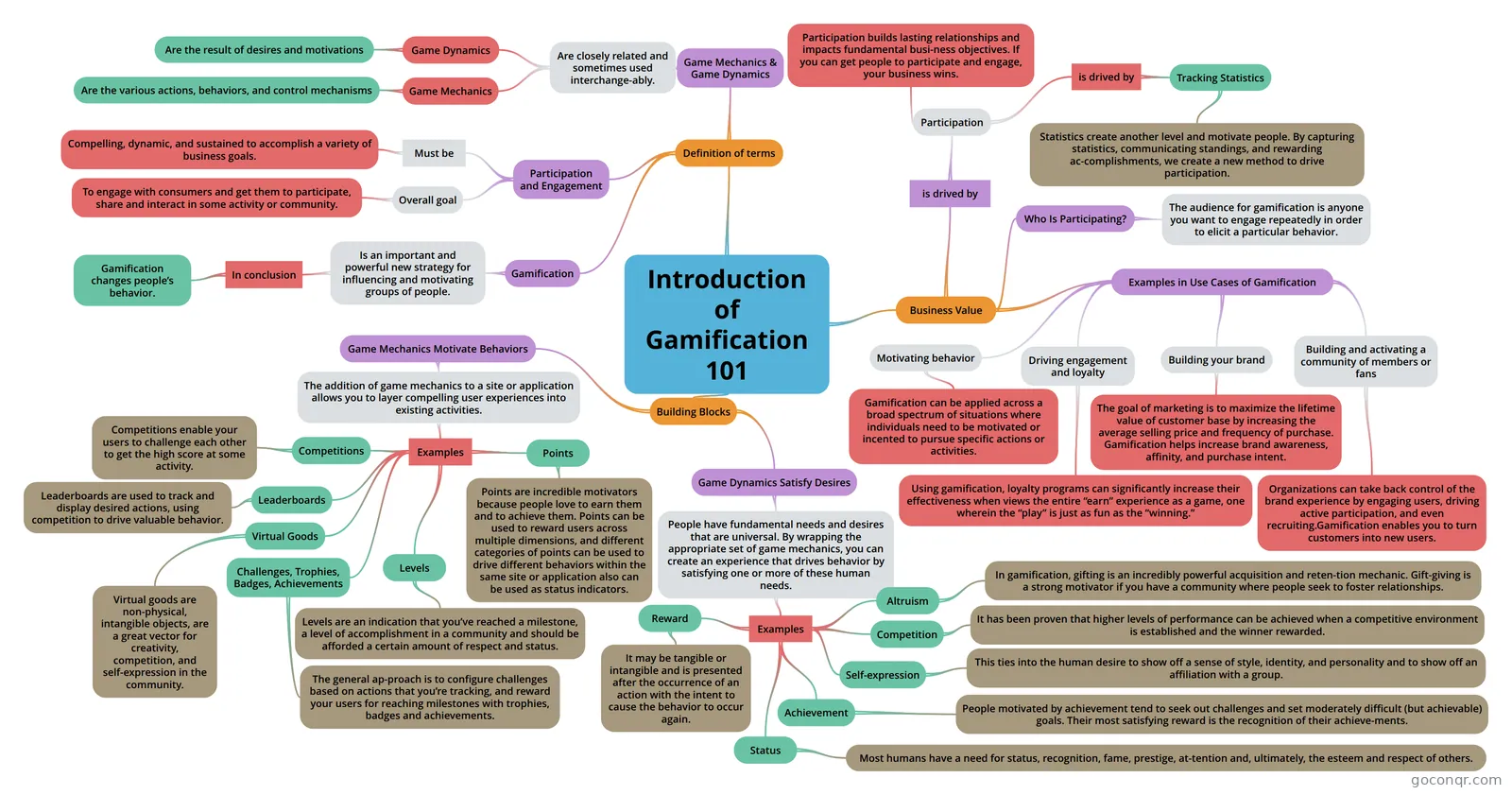
Mind map: Introduction of gamification 101
Inhalt der Mindmap
Introduction of Gamification 101
Definition of terms
- Gamification
- Is an important and powerful new strategy for influencing and motivating groups of people.
- In conclusion
- Gamification changes people’s behavior.
- In conclusion
- Is an important and powerful new strategy for influencing and motivating groups of people.
- Participation and Engagement
- Must be
- Compelling, dynamic, and sustained to accomplish a variety of business goals.
- Overall goal
- To engage with consumers and get them to participate, share and interact in some activity or community.
- Must be
- Game Mechanics & Game Dynamics
- Are closely related and sometimes used interchange-ably.
- Game Mechanics
- Are the various actions, behaviors, and control mechanisms
- Game Dynamics
- Are the result of desires and motivations
- Game Mechanics
- Are closely related and sometimes used interchange-ably.
- Gamification
Business Value
- is drived by
- Participation
- Participation builds lasting relationships and impacts fundamental busi-ness objectives. If you can get people to participate and engage, your business wins.
- is drived by
- Tracking Statistics
- Statistics create another level and motivate people. By capturing statistics, communicating standings, and rewarding ac-complishments, we create a new method to drive participation.
- Tracking Statistics
- Participation
- Examples in Use Cases of Gamification
- Building and activating a community of members or fans
- Organizations can take back control of the brand experience by engaging users, driving active participation, and even recruiting.Gamification enables you to turn customers into new users.
- Building your brand
- The goal of marketing is to maximize the lifetime value of customer base by increasing the average selling price and frequency of purchase. Gamification helps increase brand awareness, affinity, and purchase intent.
- Driving engagement and loyalty
- Using gamification, loyalty programs can significantly increase their effectiveness when views the entire “earn” experience as a game, one wherein the “play” is just as fun as the “winning.”
- Motivating behavior
- Gamification can be applied across a broad spectrum of situations where individuals need to be motivated or incented to pursue specific actions or activities.
- Building and activating a community of members or fans
- Who Is Participating?
- The audience for gamification is anyone you want to engage repeatedly in order to elicit a particular behavior.
- is drived by
Building Blocks
- Game Mechanics Motivate Behaviors
- The addition of game mechanics to a site or application allows you to layer compelling user experiences into existing activities.
- Examples
- Points
- Points are incredible motivators because people love to earn them and to achieve them. Points can be used to reward users across multiple dimensions, and different categories of points can be used to drive different behaviors within the same site or application also can be used as status indicators.
- Levels
- Levels are an indication that you’ve reached a milestone, a level of accomplishment in a community and should be afforded a certain amount of respect and status.
- Challenges, Trophies, Badges, Achievements
- The general ap-proach is to configure challenges based on actions that you’re tracking, and reward your users for reaching milestones with trophies, badges and achievements.
- Virtual Goods
- Virtual goods are non-physical, intangible objects, are a great vector for creativity, competition, and self-expression in the community.
- Leaderboards
- Leaderboards are used to track and display desired actions, using competition to drive valuable behavior.
- Competitions
- Competitions enable your users to challenge each other to get the high score at some activity.
- Points
- Examples
- The addition of game mechanics to a site or application allows you to layer compelling user experiences into existing activities.
- Game Dynamics Satisfy Desires
- People have fundamental needs and desires that are universal. By wrapping the appropriate set of game mechanics, you can create an experience that drives behavior by satisfying one or more of these human needs.
- Examples
- Reward
- It may be tangible or intangible and is presented after the occurrence of an action with the intent to cause the behavior to occur again.
- Status
- Most humans have a need for status, recognition, fame, prestige, at-tention and, ultimately, the esteem and respect of others.
- Achievement
- People motivated by achievement tend to seek out challenges and set moderately difficult (but achievable) goals. Their most satisfying reward is the recognition of their achieve-ments.
- Self-expression
- This ties into the human desire to show off a sense of style, identity, and personality and to show off an affiliation with a group.
- Competition
- It has been proven that higher levels of performance can be achieved when a competitive environment is established and the winner rewarded.
- Altruism
- In gamification, gifting is an incredibly powerful acquisition and reten-tion mechanic. Gift-giving is a strong motivator if you have a community where people seek to foster relationships.
- Reward
- Examples
- People have fundamental needs and desires that are universal. By wrapping the appropriate set of game mechanics, you can create an experience that drives behavior by satisfying one or more of these human needs.
- Game Mechanics Motivate Behaviors
Informationen
- Beschreibung
- Future of Transport Informática Mindmap am Introduction of Gamification 101, erstellt von Ingrid A am 31/05/2020.
- Erstellt von
- Ingrid A
- Aufrufe
- 0
- Bewertung