
Mindmap
Religious Experience
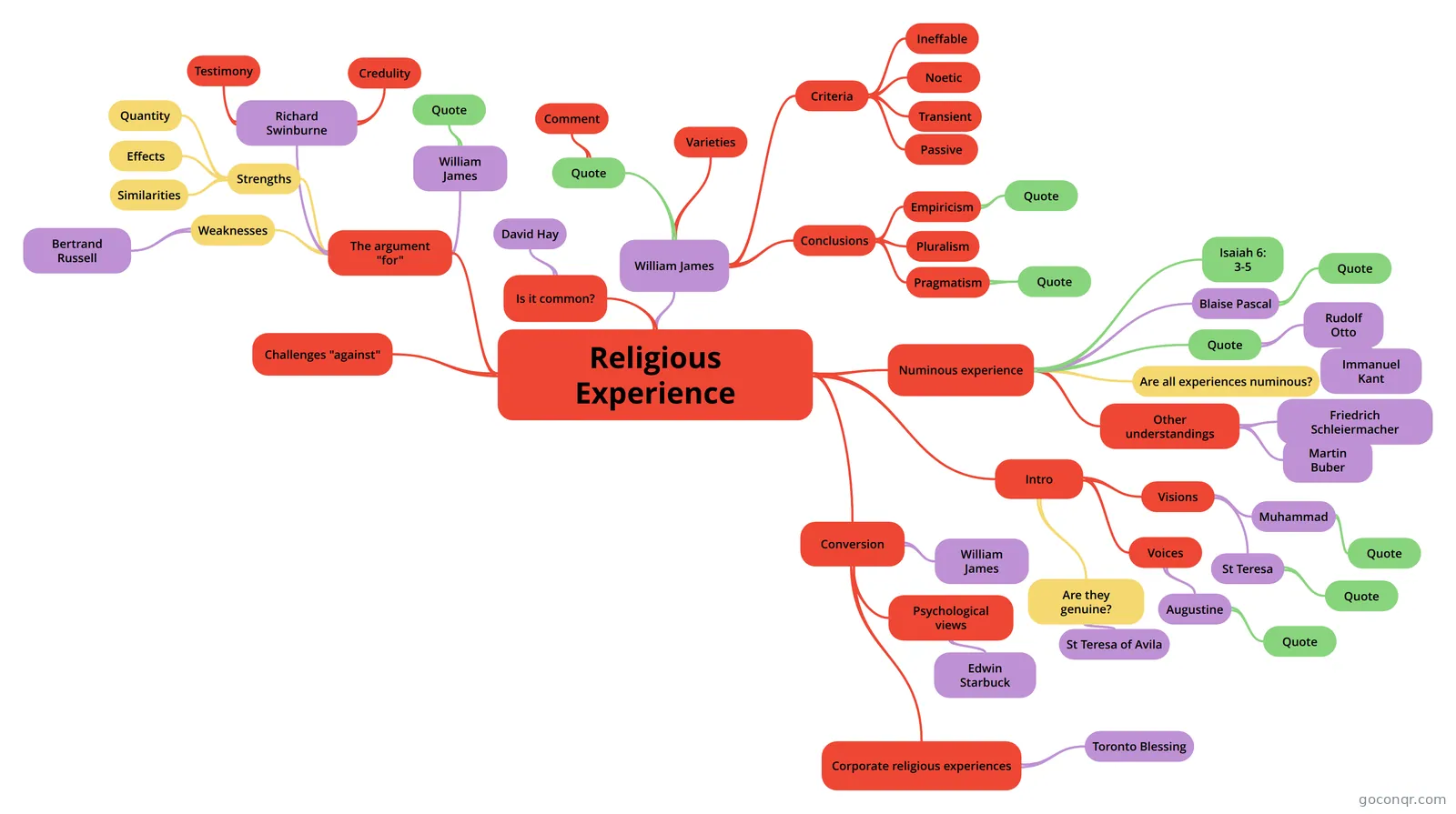
Mind map: Religious experience
Inhalt der Mindmap
Religious Experience
- The traditional arguments for the existence of God are at best inconclusive. Most philosophers would agree that the existence of a God cannot be proved or demonstrated to others.
- The phenomena of religious experience are different because, for those who have such experiences, these phenomena have authority and convince them that their religious beliefs are true or, in some cases, persuade them to change their religious beliefs.
Is it common?
- The Religious Experience Research Unit was founded in 1969 in order to discover more about religious experience.
- Some of its findings were presented in David Hay's book "Religious Experience Today."
- It is also clear that there is a huge variety of different religious experiences. These include mystical experiences, numinous experiences, visions, voices, conversion experiences, miracles and corporate experiences.
- Each of these raises its own issues. Although, to some extent the argument from religious experience and its challenges are relevant to all types of religious experience.
- What, if anything, is shown by the phenomena of religious experience?
- David Hay
- These findings, based on a random sampling of the public, include:
- 31% of British people and 35% of Americans have "felt close to a powerful or spiritual force" or have had an experience that they might consider religious.
- The experiences may last for just a few seconds in many cases but can last a lot longer.
- Those having experiences speak of the experience as being very different to all other experiences.
- They generally give awareness that there is more to reality than this physical world.
- They can produce a change in both behaviour and attitudes. These include a sense of altruism, increased self-esteem and a feeling of purpose.
William James
- Philosopher and psychologist William James wrote a book called "The Varieties of Religious Experience: a study in human nature"
- It summaries the author's Gifford Lectures given in 1902 and aims to survey the various types of religious experience as a psychologist, and to present the findings of this survey and its implications for philosophy.
- Quote
- Religion is: "the feelings, acts, and experiences of individual men in their solitude, so far as they apprehend themselves to stand in relation to whatever they may consider the divine..."
- From Varieties: Lecture 2
- Comment
- For James, religious experience stands at the very heart of religion. Religious teachings, practices and attitudes are "second hand" religion.
- These develop later as individuals reflect on their common experience. It is the actual experiences themselves than can be regarded as true religion.
- Varieties
- James analyses various forms of religious experience including conversion, prayer and the phenomenon of saintliness (the idea of the holy man or woman).
- James viewed conversion as a transformation from a divided or imperfect self to a more unified consciousness.
- Much of his book concentrates on descriptions and first-hand accounts of experiences. Although sceptics viewed some of these as examples of psychological disorder, James disagreed and placed such accounts as central to any understanding of religion.
- Criteria
- The term "mystical experience" has many uses, including the everyday use which is little more than suggesting that the experience is strange or unexplained.
- In philosophical thought, mystical experiences refer to experience where God is revealed directly and there is a sense of oneness with the divine, or ultimate reality.
- James recognised the difficulty of providing a definition of mystical experiences and proposed that the following four criteria were the characteristics of all mystical experiences.
- Ineffable
- The experience is beyond proper description. No adequate description can be given in words.
- Noetic
- Despite the ineffability, mystical states are not just feelings. The experience gives the mystic a deep and direct knowledge of God.
- Transient
- The experience is a temporary on that cannot be sustained, although its effects may last a long time. It can develop and deepen with each subsequent experience.
- Passive
- The experience is not initiated by the mystic but rather they have a sense that something is acting upon them.
- Conclusions
- James draws on his knowledge of psychology and neurology in accepting that religious experiences are psychological phenomena that occur in our brains.
- However, this does not mean that they are just psychological phenomena. James argues that these experiences may well have a supernatural element as well as a physical element.
- James' consclusions rest on three key principles: empiricism, pluralism and pragmatism.
- Empiricism
- James is committed to an empirical approach. The many case studies he produces are empirical evidence of the effects of religious experience.
- This evidence provides us with clues as to the reality beyond what we see and hear. In response to those who might object that he is interpreting the date, James argues that we interpret all our experiences.
- Quote
- I think it may be asserted that there are religious experiences of a specific nature... I think that they point with reasonable probability to the continuity of our consciousness with a wider, spiritual environment from which the ordinary man is shut off.
- From "The Varieties of Religious Experience"
- Pragmatism
- This concept is vital to an understanding of James' work. As a pragmatist, James believed that truth was not fixed and that what is true is whatever has great value for us. Therefore, on observing the effects of religious experience, we have to conclude that there is truth to be found in religion.
- Quote
- "Be ready now to judge the religious life by its results exclusively."
- Pluralism
- James' research into experiences in different faiths led him to conclude that they were similar. Those having experiences may be experiencing the same ultimate reality, which is then interpreted into the "second hand" religious belief structure that is most familiar to them.
- A Christian might interpret an experience as the presence of the Holy Spirit, whereas a Hindu might interpret it differently.
Numinous experience
- Numinous religious experiences are experiences of awe and wonder in the presence of an almighty and transcendent God.
- It is an awareness of human nothingness when faced with a holy and powerful being. The name comes from the Latin "numen" which means to bow the head.
- Isaiah 6: 3-5
- Many cases of numinous religious experience appear in religious texts, for example, Isaiah's experience recorded in the Bible.
- "Holy, holy, holy is the Lord Almighty; the whole earth is full of his glory." At the sound of their voices the doorposts and thersholds shook and the temple was filled with smoke. "Woe to me" I cried. "I am ruined! For I am a man of unclean lips, and I live among a people of unclean lips, and my eyes have seen the King, the Lord Almighty."
- Blaise Pascal
- Other numinous experiences have been documented right up to the present day. The philosopher and mathematician Blaise Pascal wrote of his numinous experience.
- Quote
- "From about half past ten in the evening until half past midnight, Fire!... "God of Abraham, God of Isaac, God of Jacob," not of philosophers and scholars. Certainty, certainty, heartfelt, joy, peace. God of Jesus Christ..."
- "Joy, joy, joy, tears of joy... I have cut myself off from him, shunned him, denied him, crucified him. Let me never be cut off from him! Sweet and total renunciation. Total submission to Jesus Christ and my director."
- Caillet and Blankenagel, from "Great Shorter Works of Pascal"
- Quote
- "It is an experience of being acted upon by something outside of ourselves, a "Wholly other." It makes us aware that we are creatures of an almighty God. This contrasts with a "mystical experience" which tends to seek the unity of all things."
- In "The Idea of the Holy" Otto argued that all religious experience was numinous in nature.
- Rudolf Otto
- It is described by Otto as being "mysterium; tremendum." Mysterium because of the mystery of the experience, it is felt but cannot be described.
- Tremendum because of the awe-inspiring terror, almost a sense of dread in the presence of an overwhelming being.
- Yet, despite this, it is fascinans, we are drawn to the experience with a strange fascination.
- These experiences provide a reference point. From then on, believers interpret the world through the experience and the beliefs attached to it.
- Ideas about God may be developed when believers reflect on their experiences but ultimately the encounter with God is inexpressible.
- The numinous experience is key to understanding the spirituality of many religions. Otto claimed that "there is no religion in which it does not live as the innermost core and without it no religion would be worthy of the name."
- Immanuel Kant
- Otto was greatly influenced by Kant's philosophy. Otto recognised that God could not be known via sensory experience or logical argument. For Otto, God is "wholly Other."
- He is a being that is completely different and distinct to human beings. We are not able to know God unless he chooses to reveal himself.
- However, the numinous experience is where God reveals himself and his revelation is felt on an emotional level.
- Are all experiences numinous?
- Otto's account may be seen as confusing regarding the issue of whether knowledge of God is gained through the experience.
- He states that the experiences come from the "deepest cognitive apprehension." Yet he also states that the theological ideas come after the experience.
- Otto seems to imply that the numinous experience is a "once and for all" experience, which implies there can be no further religious experience.
- To suggest that all religious experience is numinous it too simplistic. Other types of experience are well documented.
- Other understandings
- Friedrich Schleiermacher
- Schleiermacher agreed with Otto that religious experiences are primarily emotional. These emotions are deeper than reason.
- For him, the experiences are not numinous but are at their core a feeling of absolute dependence upon the divine.
- It is this awareness of absolute dependence upon "a source of power that is distinct from the world" that is at the heart of religion.
- Theology arises afterwards as people reflect on their experiences.
- Martin Buber
- Buber viewed religious experiences as being analogous to intimate personal relationships that he called I-thou relationships.
- This differs from the I-it relationship that we have with objects or when we treat people as objects.
- The I-thou relationship is a mutual interaction. We may experience such I-thou relationships when we encounter nature, in deep friendships and most importantly, by experiencing God.
- Friedrich Schleiermacher
Intro
- We live in a world of sights and sounds. We observe and hear the things around us. When we are unsure of whether to believe our eyes and ears, we can usually check our perceptions by asking a friend.
- What is unusual about the religious experience of visions and voices is that they are often described in terms of ordinary perceptions using the phrases "I saw" or "I heard."
- However, usually the sights and sounds are not public or shared by others.
- Both visions and voices share certain characteristics with other experiences and descriptions tend to overlap. For instance, Isaiah's experience is a vision and is numinous.
- St Teresa's visions is also a mystical experience.
- Visions
- Visions occur in a variety of forms and in various faiths.
- Some thinkers refer to these examples as intellectual visions. The vision is not the same as seeing an external object with the eyes.
- It is instead a clear vision in the mind's eye. Religious believers who have these types of vision would argue that they are far too profound to be confused with the imagination.
- Muhammad
- The Muslim celebration of Lailat-ul-Qadr (Night of Power) remembers the experience of the Propher Muhammad (pbuh) who had a vision of the Angel Jibril (Gabriel).
- The Angel gave the Propher messages to recite and proclaim to the people of Makkah. This visions gives Muhammad a purpose and calling.
- Quote
- Proclaim! In the name of they Lord and Cherisher, Who created - Created man, out of a clot of blood. Proclaim! And they Lord is Most Bountiful - He Who taught the use of the pen - Taught man that which he knew not.
- From Surah 96:2-5
- St Teresa
- Some types of visions are "inner visions" as described by St Teresa of Avila (1515-82)
- Quote
- I saw Christ at my side - or, to put it better, I was conscious of Him, for neither with the eyes of the body or of the soul did I see anything.
- From The life of Teresa of Jesus, ed. E.A. Peers
- Voices
- One dramatic type of religious experience is the hearing of voices. These are usually the voice of God or, in the case of the revelation to Muhammad (pbuh), the voice of an angel mediating the words of God or Paul's conversion in Acts 9.
- As with visions, the experiences of voices carry authority and have a profound effect. It is also worth noting that the voice heard need not be an audible voice as in Paul's case.
- Some Christians refer to the "still small voice" of the Holy Spirit which speaks in the mind of the believer.
- Augustine
- The conversion of Augustine is an unusual example of voices.
- In Augustine's case, the voice may have been the natural voice of a child playing. (This is uncertain even to Augustine.)
- However Augustine interprets this to be a means of God communicating with him. This shows that religious experiences may not always be supernatural. They may be natural events that we interpret as having religious significance.
- Quote
- "I was asking myself these questions, weeping all the while with the most bitter sorrow in my heart, when all at once I heard the sing-song voice of a child in a nearby house...
- "it repeated the refrain "Take it and read, take it and read." At this I looked up, thinking hard whether there was any kind of game in which children used to chant words like these.
- "I stemmed my flood of tears and stood up telling myself that this could only be a divine command to open my book of scripture."
- From Confessions, by Augustine
- Are they genuine?
- Some thinkers have raised the issue of how we might prove that an experience is from God. For instance, some schizophrenics hear voices telling them to kill people, which they believe are genuine messages from God.
- Also, some thinkers have observed that experience such as visions and voices are often linked to physical factors such as fasting.
- Could putting the body into a weakened state lead a person to have an auditory or visual experience they believe to be a genuine religious experience?
- St Teresa of Avila
- St Teresa offered two tests to determine whether an experience was genuine.
- Does it fit in with Christian teaching?
- Does the experience leave the individual feeling at peace?
Conversion
- Examples of conversion experiences recorded in scriptures and in the modern day raise interesting issues.
- Although the inner experience is not empirically detectable, the resulting changes in behaviour are something that can be empirically observed.
- Had the profound changes described here occurred slowly over a period of 20 years, no one would think it unusual.
- For such change to occur so dramatically over days and weeks is for many believers a powerful piece of evidence for the existence of God.
- William James
- He argued that, as with all religious experience, its truth was to be found in the results.
- Hence dramatic changes in the character and lifestyle of an individual does count as empirical evidence in favour of spiritual claims.
- Psychological views
- However, some thinkers saw the process of conversion in different terms.
- Transformations in terms of our priorities and ideas do occur for all of us as we go through life.
- The changes are usually gradual. Sometimes "crisis" type events can cause rapid transformation, so conversion could be seen in the same psychological light.
- Edwin Starbuck
- His study of conversion prompted him to draw parallels with the normal process of finding our identity in adolescence.
- Most religious conversion occur to people between the ages of 15 and 24.
- However what is worth noting in Starbuck's study is that non-religious adolescents appear to go through similar stages of anxiety and depression before finding "happy relief" and a sense of identity.
- Not everyone agrees with Starbuck's conclusions. Although in conversion, there is a sense of the individual choosing to believe and follow God, there is also an element of "passivity."
- Believers speak of a sense that someone or something is acting upon them. Although some theists recognise that there are psychological aspects of conversion experiences but argue that to reduce conversion to just a psychological phenomenon fails to address the question of the cause of the experience.
- Corporate religious experiences
- One of the most intriguing phenomena in religious experience is a corporate religious experience that happens simultaneously to a number of people.
- Corporate experiences may seem more impressive as there are a number of people having the experience. All other experiences are private and impossible to verify.
- Ultimately such experiences should be judged on what effects are produced. Are the experiences life changing in a positive way?
- Critics of corporate experiences such as the Toronto Blessing examine sacred texts such as the Bible and question whether the experiences fits in with what is revealed of God's nature elsewhere.
- Toronto Blessing
- In1994, large numbers of believers reported being affected by the Holy Spirit.
- Some of the subsequent phenomena in these meetings included uncontrollable weeping, laughing, rolling on the floor and animal noises.
- Supports of the blessing took these events as a sign of a "new move" of God. eptics suggested that the explanation was more likely to be mass hysteria.
The argument "for"
- "If there is a God there are likely to be experiences of him. There religious experiences, therefore there is a God."
- This argument seems plausible at a glance but unfortunately the two sentences are not logically connected.
- Let's assume the first sentence is correct and that if there were a God, he would interact with us in some way thus causing religious experiences.
- If we swap the sentences around, we are committing the error known as "affirming the consequent." Religious experiences may be caused by God but they may not.
- It's a little bit like saying "If I drink too much wine I will fall over: I have fallen over therefore I drank too much wine."
- Just as there may be other explanations for falling over, there may be other possible explanations for experiences that we call religious.
- William James
- He took a psychological approach to religious experience. He believed that all religious experiences indicated the probability of God, although as a pluralist James does not directly speak of God but of "the spiritual" and "higher aspects" of the world and the self.
- James was particularly interested in the effects of religious experience on people's lives.
- The validity of a religious experience rests upon the effects it produces, e.g. are lives changed?
- His concern was more "Does it work?" as opposed to "Is it True?" so James offers an argument for God in very general terms, the phenomena of religious experiences point to a higher order of reality.
- Quote
- "I think it may be asserted that there are religious experiences of a specific nature..."
- "I think that they point with reasonable probability to the continuity of our consciousness with a wider, spiritual environment from which the ordinary man is shut off."
- From The Varieties of Religious Experience, by James
- Richard Swinburne
- He has come up with an interesting and some would say brave defence of religious experience.
- He suggests that there is no reason why claims to religious experience should be treated any differently to ordinary perceptual claims.
- Swinburne offers two principles to support this: Credulity and Testimony.
- Credulity
- The Principle of Credulity states that we must accept what appears to be the case unless we have clear evidence to the contrary.
- The clear evidence to the contrary might mean that you have good reason to doubt the person, you prove that God does not exist, or you show that the experience was not caused by God.
- Testimony
- The Principle of Testimony states that, unless we have positive evidence that they are misremembering or are untrustworthy, we should believe the testimony of the experience.
- Swinburne claims that "other things being equal, we usually think that what other s tell us that they perceived, probably happened."
- Strengths
- Quantity
- Religion, based on the experience of its founders, has been a powerful force in history.
- Recent research such as that of David Hay suggests it is widespread.
- Effects
- The effects of these experiences are powerful and positive. They change the lives of individuals and communities in a way that is very difficult to explain without reference to outside agency such as God.
- Similarities
- There are considerable similarities between descriptions of religious experiences that would not be present if these experiences were made up.
- Quantity
- Weaknesses
- There are various alternative explanations of religious experience found in psychology, physiology and sociology.
- If we can explain experiences naturally, then the force of the argument may be limited.
- Religious experiences are usually private experiences. An experience may convince the experiencer of God's existence but do nothing for those nearby.
- Believers tend to interpret experiences in the light of their religious beliefs and traditions.
- Believers in different faiths claim their experiences prove the truth of their faith. They cannot all be right.
- Bertrand Russell
- This led Bertrand Russell to reject the argument as it is impossible to confirm or deny what is happening inside someone else.
Challenges "against"
Informationen
- Beschreibung
- A2 Level Religious Studies (Philosophy of Religion) Mindmap am Religious Experience, erstellt von manda_chapman am 01/05/2015.
- Erstellt von
- manda_chapman
- Aufrufe
- 14
- Bewertung