
Mindmap
Scientific Methods
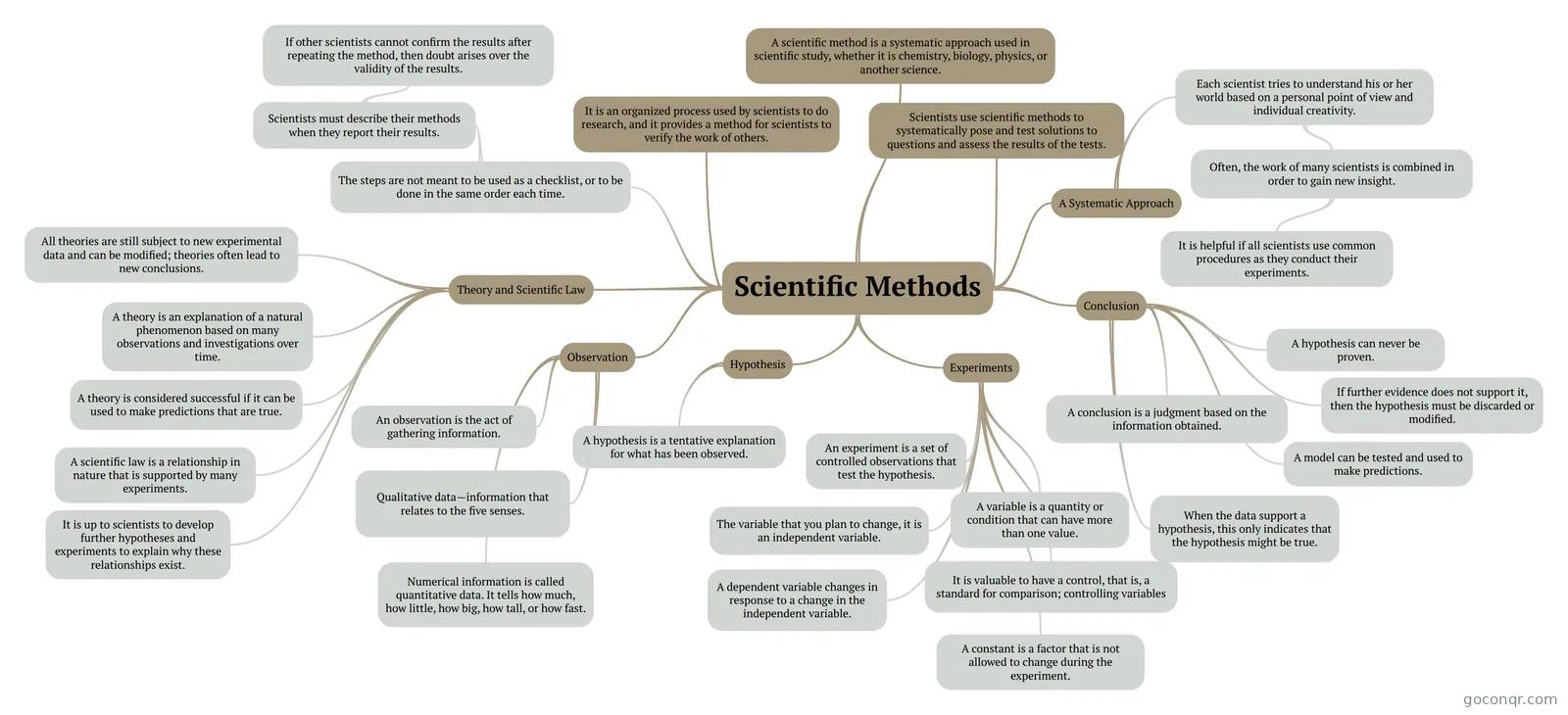
Mind map: Scientific methods
Inhalt der Mindmap
Scientific Methods
Scientists use scientific methods to systematically pose and test solutions to questions and assess the results of the tests.
A Systematic Approach
- Each scientist tries to understand his or her world based on a personal point of view and individual creativity.
- Often, the work of many scientists is combined in order to gain new insight.
- It is helpful if all scientists use common procedures as they conduct their experiments.
- Often, the work of many scientists is combined in order to gain new insight.
- Each scientist tries to understand his or her world based on a personal point of view and individual creativity.
A scientific method is a systematic approach used in scientific study, whether it is chemistry, biology, physics, or another science.
It is an organized process used by scientists to do research, and it provides a method for scientists to verify the work of others.
The steps are not meant to be used as a checklist, or to be done in the same order each time.
- Scientists must describe their methods when they report their results.
- If other scientists cannot confirm the results after repeating the method, then doubt arises over the validity of the results.
- Scientists must describe their methods when they report their results.
Observation
- An observation is the act of gathering information.
- Qualitative data—information that relates to the five senses.
- Numerical information is called quantitative data. It tells how much, how little, how big, how tall, or how fast.
Hypothesis
- A hypothesis is a tentative explanation for what has been observed.
Experiments
- An experiment is a set of controlled observations that test the hypothesis.
- A variable is a quantity or condition that can have more than one value.
- The variable that you plan to change, it is an independent variable.
- A dependent variable changes in response to a change in the independent variable.
- A constant is a factor that is not allowed to change during the experiment.
- It is valuable to have a control, that is, a standard for comparison; controlling variables
Conclusion
- A conclusion is a judgment based on the information obtained.
- A model can be tested and used to make predictions.
- A hypothesis can never be proven.
- When the data support a hypothesis, this only indicates that the hypothesis might be true.
- If further evidence does not support it, then the hypothesis must be discarded or modified.
Theory and Scientific Law
- A theory is an explanation of a natural phenomenon based on many observations and investigations over time.
- A scientific law is a relationship in nature that is supported by many experiments.
- All theories are still subject to new experimental data and can be modified; theories often lead to new conclusions.
- A theory is considered successful if it can be used to make predictions that are true.
- It is up to scientists to develop further hypotheses and experiments to explain why these relationships exist.
Informationen
- Beschreibung
- Mindmap am Scientific Methods, erstellt von Ana Sofía Pullin García am 05/03/2021.
- Erstellt von
- Ana Sofía Pullin García
- Aufrufe
- 0
- Bewertung