
Mindmap
Gerald Croft
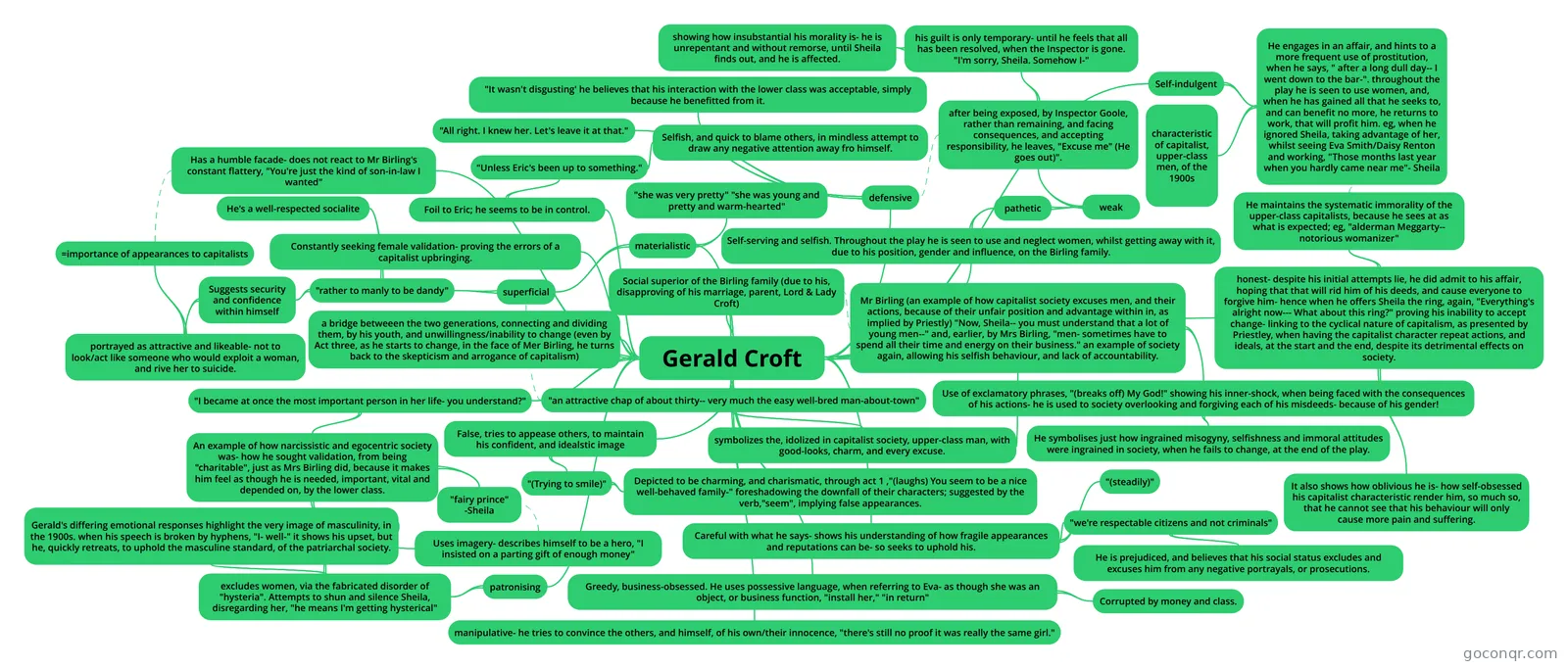
Mind map: Gerald Croft
Inhalt der Mindmap
Gerald Croft
"an attractive chap of about thirty-- very much the easy well-bred man-about-town"
- symbolizes the, idolized in capitalist society, upper-class man, with good-looks, charm, and every excuse.
- Mr Birling (an example of how capitalist society excuses men, and their actions, because of their unfair position and advantage within in, as implied by Priestly) "Now, Sheila-- you must understand that a lot of young men--" and, earlier, by Mrs Birling, "men- sometimes have to spend all their time and energy on their business." an example of society again, allowing his selfish behaviour, and lack of accountability.
- Use of exclamatory phrases, "(breaks off) My God!" showing his inner-shock, when being faced with the consequences of his actions- he is used to society overlooking and forgiving each of his misdeeds- because of his gender!
- He symbolises just how ingrained misogyny, selfishness and immoral attitudes were ingrained in society, when he fails to change, at the end of the play.
- Use of exclamatory phrases, "(breaks off) My God!" showing his inner-shock, when being faced with the consequences of his actions- he is used to society overlooking and forgiving each of his misdeeds- because of his gender!
- Mr Birling (an example of how capitalist society excuses men, and their actions, because of their unfair position and advantage within in, as implied by Priestly) "Now, Sheila-- you must understand that a lot of young men--" and, earlier, by Mrs Birling, "men- sometimes have to spend all their time and energy on their business." an example of society again, allowing his selfish behaviour, and lack of accountability.
- symbolizes the, idolized in capitalist society, upper-class man, with good-looks, charm, and every excuse.
Social superior of the Birling family (due to his, disapproving of his marriage, parent, Lord & Lady Croft)
a bridge betweeen the two generations, connecting and dividing them, by his youth, and unwillingness/inability to change (even by Act three, as he starts to change, in the face of Mer Birling, he turns back to the skepticism and arrogance of capitalism)
Self-serving and selfish. Throughout the play he is seen to use and neglect women, whilst getting away with it, due to his position, gender and influence, on the Birling family.
- pathetic
- weak
- after being exposed, by Inspector Goole, rather than remaining, and facing consequences, and accepting responsibility, he leaves, "Excuse me" (He goes out)".
- his guilt is only temporary- until he feels that all has been resolved, when the Inspector is gone. "I'm sorry, Sheila. Somehow I-"
- showing how insubstantial his morality is- he is unrepentant and without remorse, until Sheila finds out, and he is affected.
- his guilt is only temporary- until he feels that all has been resolved, when the Inspector is gone. "I'm sorry, Sheila. Somehow I-"
- after being exposed, by Inspector Goole, rather than remaining, and facing consequences, and accepting responsibility, he leaves, "Excuse me" (He goes out)".
- weak
- pathetic
materialistic
- superficial
- "rather to manly to be dandy"
- Suggests security and confidence within himself
- portrayed as attractive and likeable- not to look/act like someone who would exploit a woman, and rive her to suicide.
- =importance of appearances to capitalists
- portrayed as attractive and likeable- not to look/act like someone who would exploit a woman, and rive her to suicide.
- He's a well-respected socialite
- Suggests security and confidence within himself
- "rather to manly to be dandy"
- "she was very pretty" "she was young and pretty and warm-hearted"
- superficial
Constantly seeking female validation- proving the errors of a capitalist upbringing.
False, tries to appease others, to maintain his confident, and idealstic image
- "(Trying to smile)"
- Depicted to be charming, and charismatic, through act 1 ,"(laughs) You seem to be a nice well-behaved family-" foreshadowing the downfall of their characters; suggested by the verb,"seem", implying false appearances.
- "(Trying to smile)"
Foil to Eric; he seems to be in control.
- "Unless Eric's been up to something."
- Selfish, and quick to blame others, in mindless attempt to draw any negative attention away fro himself.
- "Unless Eric's been up to something."
defensive
- "All right. I knew her. Let's leave it at that."
- "It wasn't disgusting' he believes that his interaction with the lower class was acceptable, simply because he benefitted from it.
"I became at once the most important person in her life- you understand?"
- An example of how narcissistic and egocentric society was- how he sought validation, from being "charitable", just as Mrs Birling did, because it makes him feel as though he is needed, important, vital and depended on, by the lower class.
- "fairy prince" -Sheila
- Uses imagery- describes himself to be a hero, "I insisted on a parting gift of enough money"
- An example of how narcissistic and egocentric society was- how he sought validation, from being "charitable", just as Mrs Birling did, because it makes him feel as though he is needed, important, vital and depended on, by the lower class.
Self-indulgent
- He engages in an affair, and hints to a more frequent use of prostitution, when he says, " after a long dull day-- I went down to the bar-". throughout the play he is seen to use women, and, when he has gained all that he seeks to, and can benefit no more, he returns to work, that will profit him. eg, when he ignored Sheila, taking advantage of her, whilst seeing Eva Smith/Daisy Renton and working, "Those months last year when you hardly came near me"- Sheila
- characteristic of capitalist, upper-class men, of the 1900s
- He engages in an affair, and hints to a more frequent use of prostitution, when he says, " after a long dull day-- I went down to the bar-". throughout the play he is seen to use women, and, when he has gained all that he seeks to, and can benefit no more, he returns to work, that will profit him. eg, when he ignored Sheila, taking advantage of her, whilst seeing Eva Smith/Daisy Renton and working, "Those months last year when you hardly came near me"- Sheila
honest- despite his initial attempts lie, he did admit to his affair, hoping that that will rid him of his deeds, and cause everyone to forgive him- hence when he offers Sheila the ring, again, "Everything's alright now--- What about this ring?" proving his inability to accept change- linking to the cyclical nature of capitalism, as presented by Priestley, when having the capitalist character repeat actions, and ideals, at the start and the end, despite its detrimental effects on society.
- It also shows how oblivious he is- how self-obsessed his capitalist characteristic render him, so much so, that he cannot see that his behaviour will only cause more pain and suffering.
- He maintains the systematic immorality of the upper-class capitalists, because he sees at as what is expected; eg, "alderman Meggarty-- notorious womanizer"
Careful with what he says- shows his understanding of how fragile appearances and reputations can be- so seeks to uphold his.
- "(steadily)"
- "we're respectable citizens and not criminals"
- He is prejudiced, and believes that his social status excludes and excuses him from any negative portrayals, or prosecutions.
Has a humble facade- does not react to Mr Birling's constant flattery, "You're just the kind of son-in-law I wanted"
Greedy, business-obsessed. He uses possessive language, when referring to Eva- as though she was an object, or business function, "install her," "in return"
- Corrupted by money and class.
patronising
- excludes women, via the fabricated disorder of "hysteria". Attempts to shun and silence Sheila, disregarding her, "he means I'm getting hysterical"
- misogynistic
- Gerald's differing emotional responses highlight the very image of masculinity, in the 1900s. when his speech is broken by hyphens, "I- well-" it shows his upset, but he, quickly retreats, to uphold the masculine standard, of the patriarchal society.
- excludes women, via the fabricated disorder of "hysteria". Attempts to shun and silence Sheila, disregarding her, "he means I'm getting hysterical"
manipulative- he tries to convince the others, and himself, of his own/their innocence, "there's still no proof it was really the same girl."
Informationen
- Beschreibung
- Mindmap am Gerald Croft, erstellt von Charlotte Bartlett am 21/10/2022.
- Erstellt von
- Charlotte Bartlett
- Aufrufe
- 0
- Bewertung