
Mindmap
sociology- identity
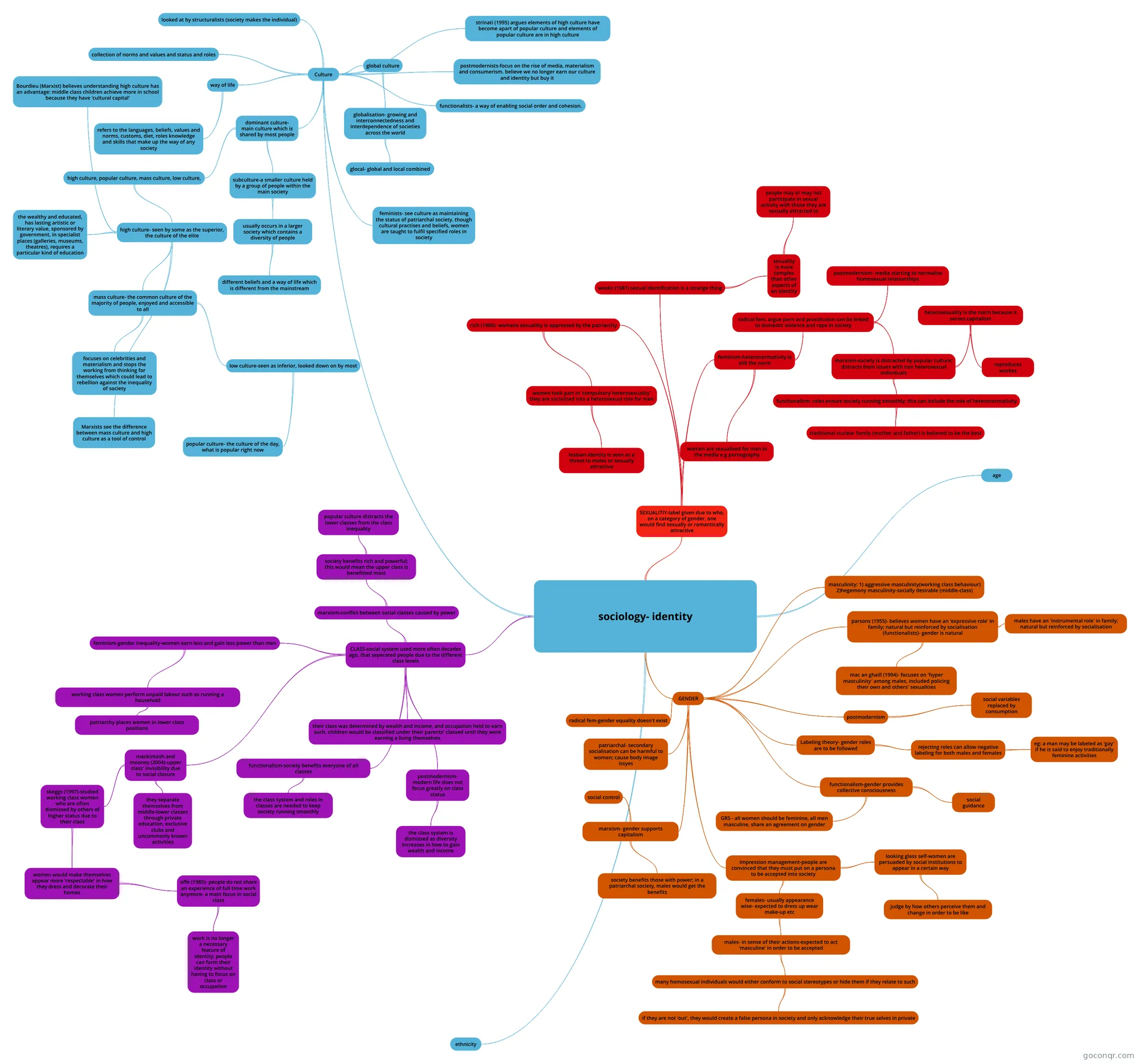
Mind map: Sociology identity
Inhalt der Mindmap
sociology- identity
Culture
- looked at by structuralists (society makes the individual)
- way of life
- refers to the languages, beliefs, values and norms, customs, diet, roles knowledge and skills that make up the way of any society
- collection of norms and values and status and roles
- global culture
- globalisation- growing and interconnectedness and interdependence of societies across the world
- glocal- global and local combined
- globalisation- growing and interconnectedness and interdependence of societies across the world
- dominant culture- main culture which is shared by most people
- subculture-a smaller culture held by a group of people within the main society
- usually occurs in a larger society which contains a diversity of people
- different beliefs and a way of life which is different from the mainstream
- usually occurs in a larger society which contains a diversity of people
- high culture, popular culture, mass culture, low culture,
- high culture- seen by some as the superior, the culture of the elite
- mass culture- the common culture of the majority of people, enjoyed and accessible to all
- low culture-seen as inferior, looked down on by most
- popular culture- the culture of the day, what is popular right now
- focuses on celebrities and materialism and stops the working from thinking for themselves which could lead to rebellion against the inequality of society
- low culture-seen as inferior, looked down on by most
- the wealthy and educated, has lasting artistic or literary value, sponsored by government, in specialist places (galleries, museums, theatres), requires a particular kind of education
- Marxists see the difference between mass culture and high culture as a tool of control
- Bourdieu (Marxist) believes understanding high culture has an advantage: middle class children achieve more in school because they have 'cultural capital'
- mass culture- the common culture of the majority of people, enjoyed and accessible to all
- high culture- seen by some as the superior, the culture of the elite
- subculture-a smaller culture held by a group of people within the main society
- strinati (1995) argues elements of high culture have become apart of popular culture and elements of popular culture are in high culture
- postmodernists-focus on the rise of media, materialism and consumerism. believe we no longer earn our culture and identity but buy it
- functionalists- a way of enabling social order and cohesion.
- feminists- see culture as maintaining the status of patriarchal society. though cultural practises and beliefs, women are taught to fulfil specified roles in society
GENDER
- radical fem-gender equality doesn't exist
- functionalism-gender provides collective consciousness
- GRS - all women should be feminine, all men masculine, share an agreement on gender
- social guidance
- patriarchal- secondary socialisation can be harmful to women; cause body image issyes
- marxism- gender supports capitalism
- society benefits those with power; in a patriarchal society, males would get the benefits
- social control
- postmodernism
- social variables replaced by consumption
- Labeling theory- gender roles are to be followed
- rejecting roles can allow negative labeling for both males and females
- eg: a man may be labeled as 'gay' if he is said to enjoy traditionally feminine activities
- rejecting roles can allow negative labeling for both males and females
- impression management-people are convinced that they must put on a persona to be accepted into society
- females- usually appearance wise- expected to dress up wear make-up etc
- males- in sense of their actions-expected to act 'masculine' in order to be accepted
- many homosexual individuals would either conform to social stereotypes or hide them if they relate to such
- if they are not 'out', they would create a false persona in society and only acknowledge their true selves in private
- many homosexual individuals would either conform to social stereotypes or hide them if they relate to such
- males- in sense of their actions-expected to act 'masculine' in order to be accepted
- looking glass self-women are persuaded by social institutions to appear in a certain way
- judge by how others perceive them and change in order to be like
- females- usually appearance wise- expected to dress up wear make-up etc
- masculinity: 1) aggressive masculinity(working class behaviour) 2)hegemony masculinity-socially desirable (middle-class)
- parsons (1955)- believes women have an 'expressive role' in family; natural but reinforced by socialisation (functionalists)- gender is natural
- mac an ghaill (1994)- focuses on 'hyper masculinity' among males, included policing their own and others' sexualities
- males have an 'instrumental role' in family; natural but reinforced by socialisation
SEXUALITIY-label given due to who, on a category of gender, one would find sexually or romantically attractive
- feminism-heteronormativity is still the norm
- women are sexualised for men in the media e.g pornography
- radical fem. argue porn and prostitution can be linked to domestic violence and rape in society
- marxism-society is distracted by popular culture; distracts from issues with non heterosexual individuals
- functionalism- roles ensure society running smoothly; this can include the role of heteronormativity
- traditional nuclear family (mother and father) is believed to be the best
- heterosexuality is the norm because it serves capitalism
- reproduces workes
- functionalism- roles ensure society running smoothly; this can include the role of heteronormativity
- postmodernism- media starting to normalise homosexual relationships
- marxism-society is distracted by popular culture; distracts from issues with non heterosexual individuals
- weeks (1981) sexual identification is a strange thing
- sexuality is more complex than other aspects of an identity
- people may or may not participate in sexual activity with those they are sexually attracted to
- sexuality is more complex than other aspects of an identity
- rich (1980)- womens sexualitiy is oppressed by the patriarchy
- women took part in 'compulsory heterosexuality' they are socialised into a heterosexual role for men
- lesbian identity is seen as a threat to males or sexually attractive
- women took part in 'compulsory heterosexuality' they are socialised into a heterosexual role for men
- feminism-heteronormativity is still the norm
CLASS-social system used more often decades ago, that seperated people due to the different class levels
- their class was determined by wealth and income, and occupation held to earn such. children would be classified under their parents' classed until they were earning a living themselves
- feminism-gender inequality-women earn less and gain less power than men
- working class women perform unpaid labour such as running a household
- patriarchy places women in lower class positions
- working class women perform unpaid labour such as running a household
- marxism-conflict between social classes caused by power
- society benefits rich and powerful; this would mean the upper class is benefitted most
- popular culture distracts the lower classes from the class inequality
- society benefits rich and powerful; this would mean the upper class is benefitted most
- functionalism-society benefits everyone of all classes
- the class system and roles in classes are needed to keep society running smoothly
- postmodernism- modern life does not focus greatly on class status
- the class system is dismissed as diversity increases in how to gain wealth and income
- mackintosh and mooney (2004)-upper class' invisibility due to social closure
- skeggs (1997)-studied working class women who are often dismissed by others of higher status due to their class
- women would make themselves appear more 'respectable' in how they dress and decorate their homes
- offe (1985)- people do not share an experience of full time work anymore- a main focus in social class
- work is no longer a necessary feature of identity; people can form their identity without having to focus on class or occupation
- offe (1985)- people do not share an experience of full time work anymore- a main focus in social class
- women would make themselves appear more 'respectable' in how they dress and decorate their homes
- they separate themselves from middle-lower classes through private education, exclusive clubs and uncommonly known activities
- skeggs (1997)-studied working class women who are often dismissed by others of higher status due to their class
age
ethnicity
Informationen
- Beschreibung
- notes on gender, class, age, sexuality, ethnicity, culture
- Erstellt von
- lailla__
- Aufrufe
- 8
- Tags
- Bewertung
Mehr zu Social Class and Identity