
Mindmap
US Supreme Court Cases
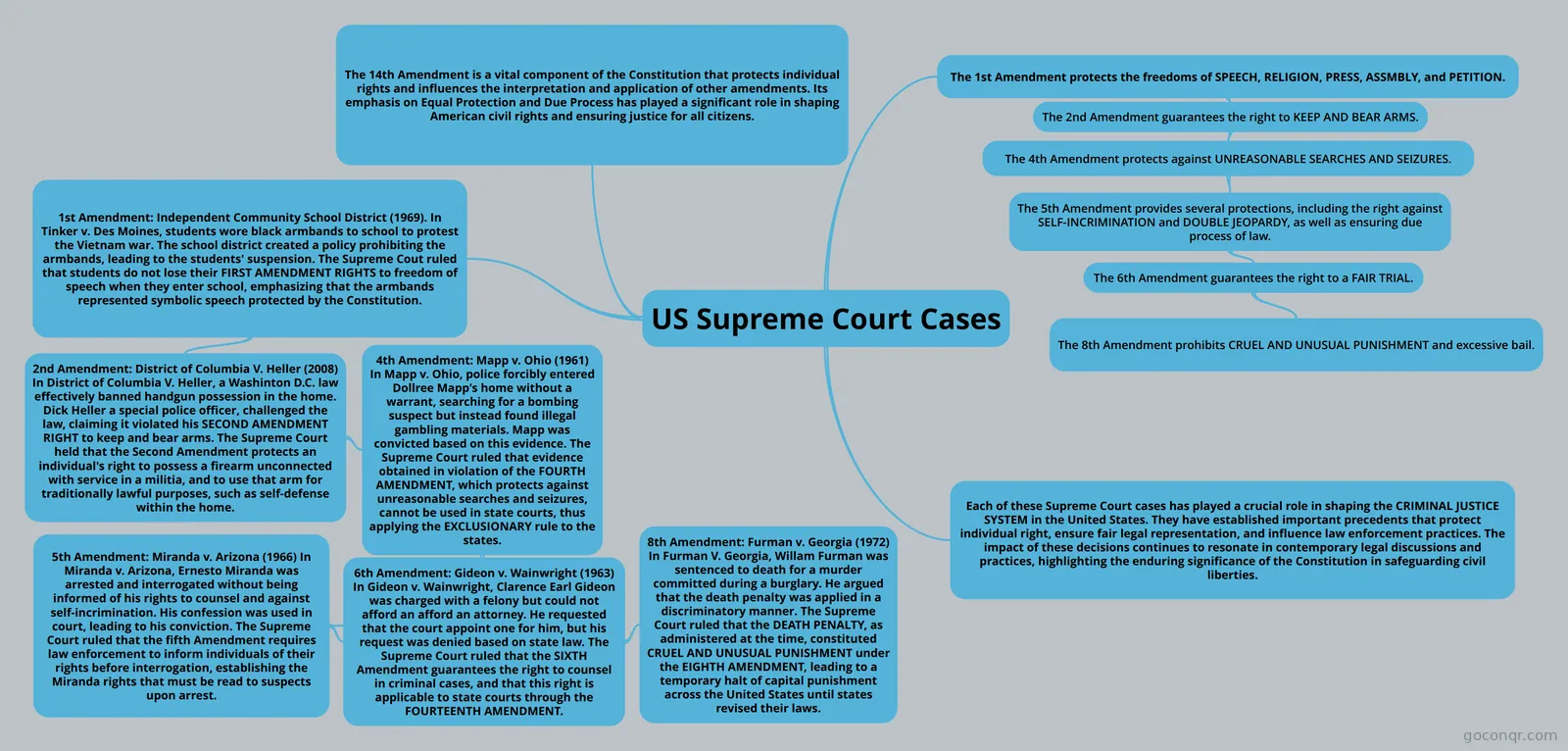
Mind map: US Supreme Court cases
Inhalt der Mindmap
US Supreme Court Cases
The 14th Amendment is a vital component of the Constitution that protects individual rights and influences the interpretation and application of other amendments. Its emphasis on Equal Protection and Due Process has played a significant role in shaping American civil rights and ensuring justice for all citizens.
The 1st Amendment protects the freedoms of SPEECH, RELIGION, PRESS, ASSMBLY, and PETITION.
- The 2nd Amendment guarantees the right to KEEP AND BEAR ARMS.
- The 4th Amendment protects against UNREASONABLE SEARCHES AND SEIZURES.
- The 5th Amendment provides several protections, including the right against SELF-INCRIMINATION and DOUBLE JEOPARDY, as well as ensuring due process of law.
- The 6th Amendment guarantees the right to a FAIR TRIAL.
- The 8th Amendment prohibits CRUEL AND UNUSUAL PUNISHMENT and excessive bail.
- The 6th Amendment guarantees the right to a FAIR TRIAL.
- The 5th Amendment provides several protections, including the right against SELF-INCRIMINATION and DOUBLE JEOPARDY, as well as ensuring due process of law.
- The 4th Amendment protects against UNREASONABLE SEARCHES AND SEIZURES.
- The 2nd Amendment guarantees the right to KEEP AND BEAR ARMS.
1st Amendment: Independent Community School District (1969). In Tinker v. Des Moines, students wore black armbands to school to protest the Vietnam war. The school district created a policy prohibiting the armbands, leading to the students' suspension. The Supreme Cout ruled that students do not lose their FIRST AMENDMENT RIGHTS to freedom of speech when they enter school, emphasizing that the armbands represented symbolic speech protected by the Constitution.
- 2nd Amendment: District of Columbia V. Heller (2008) In District of Columbia V. Heller, a Washinton D.C. law effectively banned handgun possession in the home. Dick Heller a special police officer, challenged the law, claiming it violated his SECOND AMENDMENT RIGHT to keep and bear arms. The Supreme Court held that the Second Amendment protects an individual's right to possess a firearm unconnected with service in a militia, and to use that arm for traditionally lawful purposes, such as self-defense within the home.
- 4th Amendment: Mapp v. Ohio (1961) In Mapp v. Ohio, police forcibly entered Dollree Mapp's home without a warrant, searching for a bombing suspect but instead found illegal gambling materials. Mapp was convicted based on this evidence. The Supreme Court ruled that evidence obtained in violation of the FOURTH AMENDMENT, which protects against unreasonable searches and seizures, cannot be used in state courts, thus applying the EXCLUSIONARY rule to the states.
- 5th Amendment: Miranda v. Arizona (1966) In Miranda v. Arizona, Ernesto Miranda was arrested and interrogated without being informed of his rights to counsel and against self-incrimination. His confession was used in court, leading to his conviction. The Supreme Court ruled that the fifth Amendment requires law enforcement to inform individuals of their rights before interrogation, establishing the Miranda rights that must be read to suspects upon arrest.
- 6th Amendment: Gideon v. Wainwright (1963) In Gideon v. Wainwright, Clarence Earl Gideon was charged with a felony but could not afford an afford an attorney. He requested that the court appoint one for him, but his request was denied based on state law. The Supreme Court ruled that the SIXTH Amendment guarantees the right to counsel in criminal cases, and that this right is applicable to state courts through the FOURTEENTH AMENDMENT.
- 8th Amendment: Furman v. Georgia (1972) In Furman V. Georgia, Willam Furman was sentenced to death for a murder committed during a burglary. He argued that the death penalty was applied in a discriminatory manner. The Supreme Court ruled that the DEATH PENALTY, as administered at the time, constituted CRUEL AND UNUSUAL PUNISHMENT under the EIGHTH AMENDMENT, leading to a temporary halt of capital punishment across the United States until states revised their laws.
- 6th Amendment: Gideon v. Wainwright (1963) In Gideon v. Wainwright, Clarence Earl Gideon was charged with a felony but could not afford an afford an attorney. He requested that the court appoint one for him, but his request was denied based on state law. The Supreme Court ruled that the SIXTH Amendment guarantees the right to counsel in criminal cases, and that this right is applicable to state courts through the FOURTEENTH AMENDMENT.
- 5th Amendment: Miranda v. Arizona (1966) In Miranda v. Arizona, Ernesto Miranda was arrested and interrogated without being informed of his rights to counsel and against self-incrimination. His confession was used in court, leading to his conviction. The Supreme Court ruled that the fifth Amendment requires law enforcement to inform individuals of their rights before interrogation, establishing the Miranda rights that must be read to suspects upon arrest.
- 4th Amendment: Mapp v. Ohio (1961) In Mapp v. Ohio, police forcibly entered Dollree Mapp's home without a warrant, searching for a bombing suspect but instead found illegal gambling materials. Mapp was convicted based on this evidence. The Supreme Court ruled that evidence obtained in violation of the FOURTH AMENDMENT, which protects against unreasonable searches and seizures, cannot be used in state courts, thus applying the EXCLUSIONARY rule to the states.
- 2nd Amendment: District of Columbia V. Heller (2008) In District of Columbia V. Heller, a Washinton D.C. law effectively banned handgun possession in the home. Dick Heller a special police officer, challenged the law, claiming it violated his SECOND AMENDMENT RIGHT to keep and bear arms. The Supreme Court held that the Second Amendment protects an individual's right to possess a firearm unconnected with service in a militia, and to use that arm for traditionally lawful purposes, such as self-defense within the home.
Each of these Supreme Court cases has played a crucial role in shaping the CRIMINAL JUSTICE SYSTEM in the United States. They have established important precedents that protect individual right, ensure fair legal representation, and influence law enforcement practices. The impact of these decisions continues to resonate in contemporary legal discussions and practices, highlighting the enduring significance of the Constitution in safeguarding civil liberties.
Informationen
- Beschreibung
- Law Mindmap am US Supreme Court Cases, erstellt von Charonlis Martinez am 09/02/2025.
- Erstellt von
- Charonlis Martinez
- Aufrufe
- 4
- Verlauf
-
- Erstellt von Charonlis Martinez · 9 Feb 2025
- Kopiert von Charonlis Martinez · 9 Feb 2025
- Bewertung
Mehr zu Landmark Supreme Court Cases