
461597


Methods of Government
Intervention to Correct
Distortions to Individual
Markets
- Pollution Permits
- POLLUTION PERMIT= a
permit sold to firms by the
government, allowing them to
pollute up to a certain limit
- A method using the
market to address the
problem, rather than
through regulation
- The permits can be traded,
creating an incentive for firms
to be relatively 'clean so that
if they don't use up their full
allocation of permits they can
sell any remaining allocation
to other less 'clean' firms
- This provides firms with an
incentive to reduce their
negative externalities and
consider external costs
- This provides firms with an
incentive to reduce their
negative externalities and
consider external costs
- System must be enforced
by factory inspectors and
government must decide
the level of fines sufficient
to penalise firms and deter
further pollution beyond the
permitted level
- POLLUTION PERMIT= a
permit sold to firms by the
government, allowing them to
pollute up to a certain limit
- State provision
- This is where the
government directly
provides goods and
services to
consumers, using
money from taxation.
- e.g. the government
pays private sector
firms to operate
prisons and maintain
our road network
- The main
state-owned
businesses in
the UK is
Network Rail,
strategically
publicised after
WW2
- This is where the
government directly
provides goods and
services to
consumers, using
money from taxation.
- Regulation
- Pass laws
- e.g. ban of smoking in public places
- e.g. prohibiting
the sale of
cigarettes to
under-18s
- Make it illegal
to do certain
things, this
should control
demand and
supply
- e.g. employment laws (to do with minimum wage)
- e.g. ban of smoking in public places
- Regulators
- Government appointed regulators
exist who can impose price controls
in most of the main utilities like gas
and electricity (Ofgem), water (Ofwat),
communications (Ofcom) and others
- Introduced in Margaret Thatcher's time
in parliament (1980s) when firms were
re-privatised after being in the public
sector after WW2
- oversee firms to
ensure they're
doing the right
thing
- Government appointed regulators
exist who can impose price controls
in most of the main utilities like gas
and electricity (Ofgem), water (Ofwat),
communications (Ofcom) and others
- Pass laws
- Financial Intervention
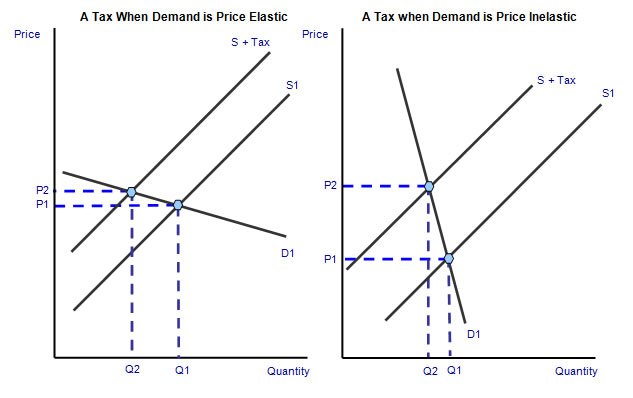
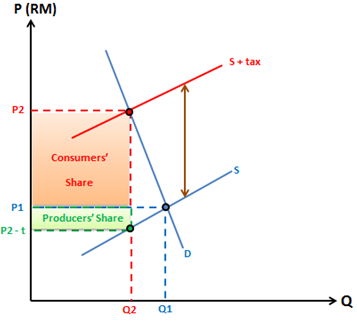
- Indirect Taxation
- INDIRECT TAX= a tax on spending
- Can be used to raise the price of demerit goods
and products that generate negative externalities
- This will reduce quantity demanded to a socially optimal level
- Imposed on producers (suppliers) by the government
- Examples~ excise duties (on cigarettes, alcohol and fuel) and VAT
- Examples~ excise duties (on cigarettes, alcohol and fuel) and VAT
- Imposed on producers (suppliers) by the government
- This will reduce quantity demanded to a socially optimal level
- effects supply
(leftward shift
when applied)
- Opposite to
a direct tax
(placed on
incomes)
- When demand is elastic, most is paid by the producer
- When demand is inelastic, most is paid by the consumer
- e.g. a minimum price
per unit of alcohol at
50p was requested in
Scotland in 2012
- Should ration demand
- Should ration demand
- INDIRECT TAX= a tax on spending
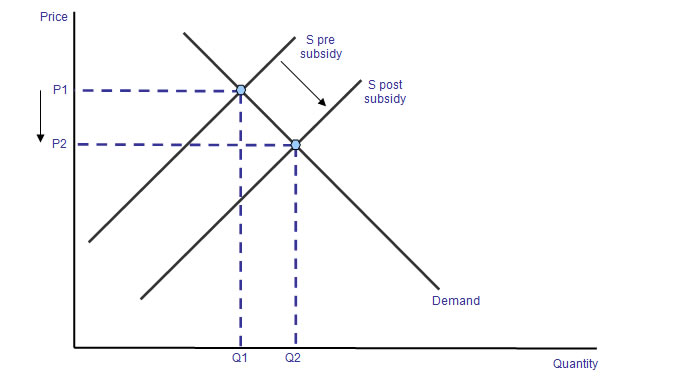
- Subsidies
- Will lower the price of merit goods to consumers
- e.g. EMA allowances to students
in further education to reduce
the private costs of education
- e.g. subsidies to companies
employing workers on the
New Deal programme
- Designed to boost consumption and output of products with positive externalities
- Designed to boost consumption and output of products with positive externalities
- e.g. subsidies to companies
employing workers on the
New Deal programme
- e.g. EMA allowances to students
in further education to reduce
the private costs of education
- effect supply
(rightward shift
when applied)
- Will lower the price of merit goods to consumers
- Indirect Taxation
- Price Intervention
- Price Controls
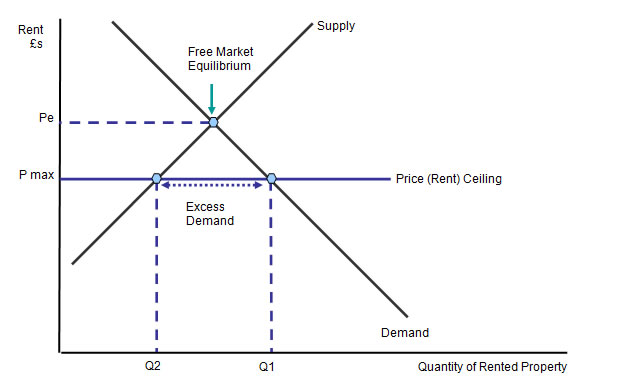
- Maximum prices
- 'price ceiling'
- Suppliers
cannot
exceed
this price
- It's an attempt to prevent the
market price from rising
above a certain level
- It's an attempt to prevent the
market price from rising
above a certain level
- Only have an effect
if set below the
equilibrium (below the
free market price)
- e.g. when shortage of essential foodstuffs
threatens large rises in the free market price
- e.g. rent controls still in place in Manhattan in the USA
- 'price ceiling'
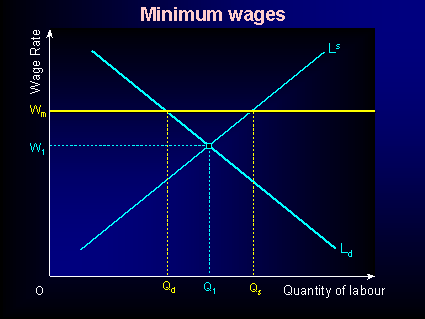
- Minimum prices
- 'price floor'
- Only have an
effect if set
above the
equilibrium
(above the free
market price)
- Suppliers cannot
go below this price
- e.g. national minimum wage, first imposed in the UK in 1999
- Intervention into the labour market designed to
increase the pay of lower-paid workers and therefore
influence the distribution of income in society
- Intervention into the labour market designed to
increase the pay of lower-paid workers and therefore
influence the distribution of income in society
- 'price floor'
- The government can set legally imposed
maximum or minimum prices on goods and
services
- Involves a
normative
judgement
on behalf
of the
government
about what
the price
should be
- Maximum prices
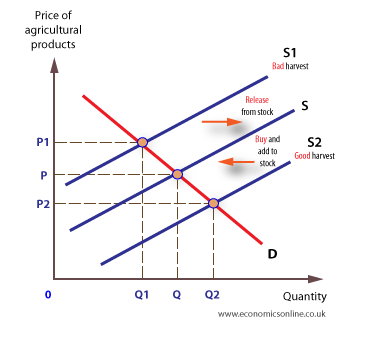
- Buffer Stocks
- Governments may intervene when
markets suffer from considerable
volatility in the free market price
- They'll try to manipulate the
free market price by the use
of buffer stock schemes
- They'll try to manipulate the
free market price by the use
of buffer stock schemes
- e.g. often used in agricultural
and commodity markets as
they're notorious for huge price
instability due to unpredictable
weather and relatively inelastic
demand and supply curves
- The method...
- Select a price to keep to (the
average long-term equilibrium price)
- Use a buffer stock; in years of a bumper (good) harvest, store
some stock away so that in years of poor harvest more stock
can be released, the government will buy up excess
supply (stock) so the income of farmers stays constant)
- this should avoid the price effects of fluctuating supply
- this should avoid the price effects of fluctuating supply
- Use a buffer stock; in years of a bumper (good) harvest, store
some stock away so that in years of poor harvest more stock
can be released, the government will buy up excess
supply (stock) so the income of farmers stays constant)
- Select a price to keep to (the
average long-term equilibrium price)
- Governments may intervene when
markets suffer from considerable
volatility in the free market price
- Price Controls
Medienanhänge
Möchten Sie kostenlos Ihre eigenen Mindmaps mit GoConqr erstellen? Mehr erfahren.