
Mindmap
15.1 The Chemistry of the Haloalkanes
Inhalt der Mindmap
15.1 The Chemistry of the Haloalkanes
Reactivity of The Haloalkanes
- Halogen atoms are more electronegative than carbon atoms
- This means the carbon-halogen bond is Polar
- Carbon atom has slightly positive charge
- Attract species that donate a pair of electrons = NUCLEOPHILES
- NUCLEOPHILE = Electron pair donor
- Hydroxide Ions = :OH-
- Water molecules = H2O:
- Ammonia Molecules = :NH3
- When a Haloalkane reacts with a nucleophile, the nucleophile replaces the hydrogen in a Substitution Reaction
- New Compound produced with a different functional group.
- NUCLEOPHILIC SUBSTITUTION
- New Compound produced with a different functional group.
- Attract species that donate a pair of electrons = NUCLEOPHILES
- Halogen atoms are more electronegative than carbon atoms
NUCLEOPHILIC SUBSTITUTION
- Hydrolysis
- Halogen atom is replaced by an -OH group.
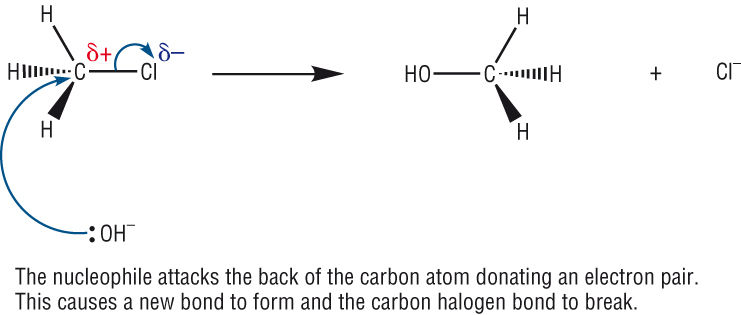
- 1) Nucleophile (OH-) approaches the C atom attached to the halogen on the OPPOSITE side of the molecule from the halogen atom
- 2) Direction of attack of OH- ion minimises repulsion between the nucleophile and the slightly negative halogen atom
- 3) Lone pair of electrons on the hydroxide ion are attracted and donated to the slightly positive carbon atom
- 4) New bond formed between the Oxygen atom of the hydroxide ion and the carbon atom
- 5) The carbon-halogen bond is broken by heterolytic fission
- 6) The new organic product is an alcohol (when OH- nucleophile used). A halide ion is also formed
- 5) The carbon-halogen bond is broken by heterolytic fission
- 4) New bond formed between the Oxygen atom of the hydroxide ion and the carbon atom
- 3) Lone pair of electrons on the hydroxide ion are attracted and donated to the slightly positive carbon atom
- 2) Direction of attack of OH- ion minimises repulsion between the nucleophile and the slightly negative halogen atom
- Haloalkanes can be converted to alcohols using aqueous sodium hydroxide
- Very slow reaction at Rtp so mixture is heated under reflux to obtain a good yield of product
- Hydrolysis
RATES of Hydrolysis
- The rate of hydrolysis depends upon the strength of the carbon-halogen bond in the haloalkane
- As you go down the group of halides, the further down you go, the weaker the bond between the halide and carbon. For example// C-F is stronger than C-I as Iodine if further down the group than flourine
- This means, the further down the group you go, the quicker the reaction as not as much energy is required to break the bonds
- As you go down the group of halides, the further down you go, the weaker the bond between the halide and carbon. For example// C-F is stronger than C-I as Iodine if further down the group than flourine
- Measuring the Rate of Hydrolysis of Primary Haloalkanes
- The rate of each reaction can be followed by carrying out the reaction in the presence of aqueous silver nitrate
- As the reaction occurs, halide ions that are produced (Cl-, Br-, I-) react with Ag+ ions to form a precipitate of the silver halide
- Ag+ ion (aq) + X- ion (aq) --> AgX precipitate (s)
- A Haloalkane of 1-CHLORObutane forms a white precipitate very slowly
- A Haloalkane of 1-BROMObutane forms a cream precipitate at medium speed
- A Haloalkane of 1-IODObutane forms a yellow precipitate rapidly
- Ag+ ion (aq) + X- ion (aq) --> AgX precipitate (s)
- The nucleophile used is water, which is present in (aq) AgNO3. However Haloalkanes are insoluble in water and the reaction is carried out in ethanol. allowing water and the Haloalkanes to mix and produce a single solution
- As the reaction occurs, halide ions that are produced (Cl-, Br-, I-) react with Ag+ ions to form a precipitate of the silver halide
- The rate of each reaction can be followed by carrying out the reaction in the presence of aqueous silver nitrate
- The rate of hydrolysis depends upon the strength of the carbon-halogen bond in the haloalkane
Hydrolysis of Primary, Secondary and Tertiary Haloalkanes
- Tertiary haloalkane hydrolyses fastest
- Two-Step Mechanism
- 1) Carbon-halogen bond of the tertiary haloalkane breaks by heterolyctic fission, forming a tertiary carbocation and a halide ion
- 2) A hydroxide ion attacks the carbocation to form the organic product
- 1) Carbon-halogen bond of the tertiary haloalkane breaks by heterolyctic fission, forming a tertiary carbocation and a halide ion
- Two-Step Mechanism
- Primary haloalkane is hydrolysed slowest
- One-step Mechanism
- Tertiary haloalkane hydrolyses fastest
Bilder und Dateien der Mindmap
Informationen
- Beschreibung
- AS - Level Chemistry (15 - Haloalkanes) Mindmap am 15.1 The Chemistry of the Haloalkanes, erstellt von Bee Brittain am 15/03/2016.
- Erstellt von
- Bee Brittain
- Aufrufe
- 20
- Bewertung