
5071362


Autobiographical
Memory
Anmerkungen:
- Semantic and episodic memory - very complex - Memory across the lifespan for specifc events and self related information - Social and directive functions
- Experimental
Methods
- Diary Studies
Anmerkungen:
- Wagnaar (1986) - 2 events every day, 5 years - Cues (what, who, where, when) - Rated frequency, salience, emotional intensity, pleasantness - Tested memory from cues Saliency - More salient = greater recall - Recent and remote events Emotional Involvement - More emotionally involving = greater recall - Recent and remote events
- Galton
Cuing
Technique
Anmerkungen:
- Robinson (1976) - Recall response - Fast to recall from Action and Object words, than Emotional word cues - AM not accessed by emotion - Organised/accessed through Action/Objects --> faster recall
- Personalised
Experimental
Materials
Anmerkungen:
- Conway & Bekerian (1987) - Personal memory questionnaire - Identify retrieval cues (life periods/general events) - Create materials - Effectiveness of different cues
- Priming
Anmerkungen:
- Exposure to one stimulus --> fast response in second stimulus - faster access to associated information - Faster to recall prime than no prime - Lifetime period - Primed retrieval in response to general event - No priming effect when semantic categories/primes are used - e.g. flower (prime), daisy (cue)
- Diary Studies
- Model of AM
Anmerkungen:
- Explains how we recall a specific memory of a specific event + ESK (event specific knowledge)
- Lifetime
Period
- General
event
- Specific
Memory
- ESK
- ESK
- Specific
Memory
- General
event
- Self Identity
Anmerkungen:
- Highlights relevance of personal information - Oneself engaging in event
- Development
of AM
- Lifespan AM
retrieval
Anmerkungen:
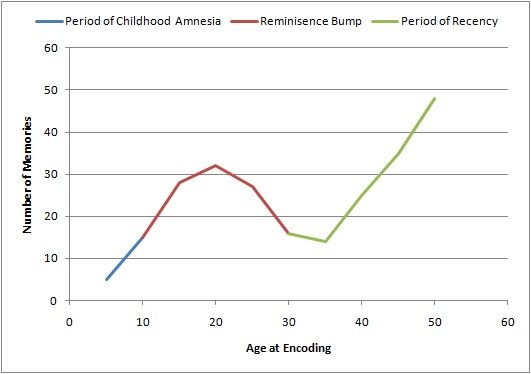
- Generate AMs - Galton Word Cues --> date the memories - Plot on graph Recency effect - recall more things from recent years
- Childhood Amnesia
Anmerkungen:
- - Adults remember few things from before 3-5 years - Development of self concept --> emergence of AM - Often events spoken about a lot or seen photos/videos
- 2-3 yrs - Can recall some specific events -- not detailed unless very salient 2 yrs - Could recall play events from 6m earlier (when 10m) (Sheffield & Hudson, 94) - Could recall specific miming movements they did 13m earlier (when 11m) (McDonagh & Mandler, 94) 4 yrs - Recalled salient event from 2.5 yrs (Fivush & Hammond, 1990)
- Wheeler, Struss
& Tulving (1997)
Anmerkungen:
- 25-32 m - recall specific events from 12m ago - Factual info - No conscious recollection - Therefore not AM
- Development of self concept/awareness --> 2-3 yrs - Cannot reflect upon selves and past experiences - Self concept emerges 18-24m Sufficiently developed - 3yrs
- Physical Self - 3m: discriminate own facial features from others - 18m: respond to smudge on face in mirror, embarrassed by own image - 22-24m: say name when see mirror image
- Psychological self - Recognise exist over time - Other things happen outside immediate existence - 4-5 yrs (but not 3 yo) --> show delayed recognition of their past self Povinelli & Simon (1998) 3, 4, 5 y/o - Placing sticker on head while filming playing - 3 yrs - fewer than 50% reached for sticker (in immediate and delayed) - Most 4/5 yrs - reached for sticker when watching current session, but not past session --> could distinguish between sessions - 4/5 yrs have developing sense of self that extends over time (mental time travel)
- Self concept = Physical self (self-recognition) Psychological self (temporally-extended self that exists over time)
- Reminiscence
Bump
Anmerkungen:
- - 15-30yrs - Remember more from this period - Due to nostalgia about our 'generation' from teens/early 20s (Sehulster, 1996) - Or development of stable self (Conway, 2005) - Observed across cultures- Robust finding
- Older Age
Anmerkungen:
- Older adults (60+) - Produce fewer specific details but more generic (schematic) info during AM retrieval, than younger adults (Ford, 2014) - Age related decline in specificity associated with increased likelihood of depression (Ramirez 2014) and reduced wellbeing/satisfaction (Latorre 2013) - Recent study showed small decline - young and older adults recalled large specific detail (Aizpurua & Koutstall, 2015)
- Rathbone (2015)
Anmerkungen:
- More positive semantic self-image (traits, roles, beliefs) = greater sense of wellbeing - Particularly for older adults
- Lifespan Study
Abram (2014)
Anmerkungen:
- 6 - 81 yr olds - Older adults recalled fewer specific (episodic) details, more semantic/conceptual information (traits, preferences, general info about places etc.)
- Self concept
Anmerkungen:
- Without self-concept, specific memories are episodic (tied to space and time) but not autobiographical (linked to the self)
- Autonoetic
Anmerkungen:
- Autonoetic consciousness - experience of oneself engaging in event - understanding self exists over time Wheeler - Childhood amnesia = unable to mentally travel back in time to recollect personally experienced events - because not really personally experienced
- Self --> cognitive system
- Retrieval cycle
Anmerkungen:
- Elaborate a cue Search autobiographical knowledge base Evaluate output Termination or re-cycle (if cannot retrieve - go back into cycle)
- Conway (2004/5)
Anmerkungen:
- - Retrieval controlled by SS and CE, which contains model of current working self - Working self can create temporary model of task demands/restraints --> specific memory relevant to specific cue that provides ESK
- Working self = subset of WM control processes (CE/SS) - dynamic 'on-line' concept of self that reflects current goals and priorities --> current goal is most active goal - Encoding and retrieving personal events is influenced by the goal structure of the current working self - Specific AMs are records of successes or failures in goal attainment
- Retrieval cycle
- Lifespan AM
retrieval
- Imagery
Anmerkungen:
- Autonoetic consciousness - sense of 're-living' past experience - Not just knowing it occurred but remembering - Relies on specific sensory-perceptual data --> visual imagery is an important source
- Retrograde Amnesia
Anmerkungen:
- Can re-learn past through being told (know they happened) but cannot remember
- Strong sense
of re-living
Anmerkungen:
- Strong sense of re-living - associated with vivid visual imagery - Also more likely to believe event actually happened if strong visual imagery (Cabeza, 2007)
- Greenburg & Knowlton (2014)
Anmerkungen:
- Visual imagery associated with feelings of re-living AM - Auditory imagery greater than visual imagery - Participants who reported total lack of visual imagery, also lacked auditory imagery --> Less likely to feel sense of re-living AMs
- Self & Visual Imagery
- Observer Perspective
Anmerkungen:
- Imagining/seeing past event - observing self as a spectator
- Field Perspective
Anmerkungen:
- Imagining/seeing event from own eyes
- McIssac & Eich (2004)
Anmerkungen:
- Study of people with PTSD - Most recalled from Field (64%) - More emotional and anxiety provoking than Observer - High rich detail in both, maintain image - frequency with which event was recalled - Field = feelings and internal states - Observer = External features of situation --> provides relief from distress but may impact recovery
- (Nigro & Neisser, 1983)
Anmerkungen:
- Recall specific AM memory in response to cues - 51% - Field - 37% - Observer (12% neither) Field - Occurred more recently (15m vs. 35m) Field more vivid, focus on feelings (not high emotion) Field lessens when focus on concrete objective details Observer - higher emotional intensity and self-aware
- Cabeza & St Jacques (2007)
Anmerkungen:
- PET & fMRI - PFC implicated in AM - Left lateral PFC - search and retrieval - vmPFC - monitoring - medical PFC - self
- Photos taken by self/other - activated episodic memory network = medial temporal and PFC - AM = self referential processing (medial PFC), visual/spatial memory (visual and parahippocampal regions), recollection (hippocampus)
- Observer Perspective
Medienanhänge
Möchten Sie kostenlos Ihre eigenen Mindmaps mit GoConqr erstellen? Mehr erfahren.