
Mindmap
Frankenstein Themes
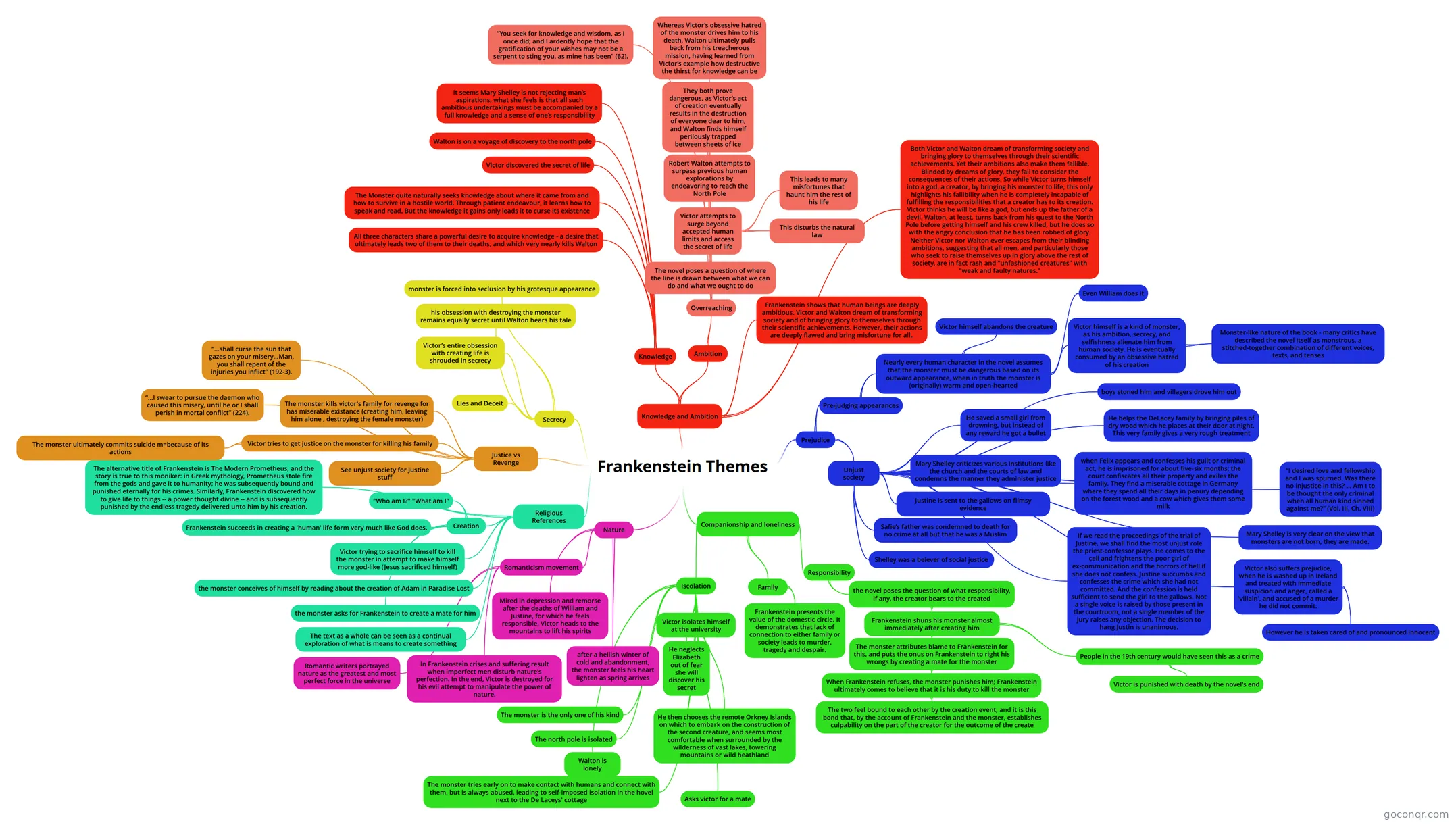
Mind map: Frankenstein Themes
Inhalt der Mindmap
Frankenstein Themes
Knowledge and Ambition
- Frankenstein shows that human beings are deeply ambitious. Victor and Walton dream of transforming society and of bringing glory to themselves through their scientific achievements. However, their actions are deeply flawed and bring misfortune for all..
- Both Victor and Walton dream of transforming society and bringing glory to themselves through their scientific achievements. Yet their ambitions also make them fallible. Blinded by dreams of glory, they fail to consider the consequences of their actions. So while Victor turns himself into a god, a creator, by bringing his monster to life, this only highlights his fallibility when he is completely incapable of fulfilling the responsibilities that a creator has to its creation. Victor thinks he will be like a god, but ends up the father of a devil. Walton, at least, turns back from his quest to the North Pole before getting himself and his crew killed, but he does so with the angry conclusion that he has been robbed of glory. Neither Victor nor Walton ever escapes from their blinding ambitions, suggesting that all men, and particularly those who seek to raise themselves up in glory above the rest of society, are in fact rash and "unfashioned creatures" with "weak and faulty natures."
- Knowledge
- Walton is on a voyage of discovery to the north pole
- Victor discovered the secret of life
- The Monster quite naturally seeks knowledge about where it came from and how to survive in a hostile world. Through patient endeavour, it learns how to speak and read. But the knowledge it gains only leads it to curse its existence
- All three characters share a powerful desire to acquire knowledge - a desire that ultimately leads two of them to their deaths, and which very nearly kills Walton
- It seems Mary Shelley is not rejecting man’s aspirations, what she feels is that all such ambitious undertakings must be accompanied by a full knowledge and a sense of one’s responsibility
- Ambition
- Overreaching
- Victor attempts to surge beyond accepted human limits and access the secret of life
- This leads to many misfortunes that haunt him the rest of his life
- This disturbs the natural law
- Robert Walton attempts to surpass previous human explorations by endeavoring to reach the North Pole
- They both prove dangerous, as Victor’s act of creation eventually results in the destruction of everyone dear to him, and Walton finds himself perilously trapped between sheets of ice
- Whereas Victor’s obsessive hatred of the monster drives him to his death, Walton ultimately pulls back from his treacherous mission, having learned from Victor’s example how destructive the thirst for knowledge can be
- “You seek for knowledge and wisdom, as I once did; and I ardently hope that the gratification of your wishes may not be a serpent to sting you, as mine has been” (62).
- The novel poses a question of where the line is drawn between what we can do and what we ought to do
- Victor attempts to surge beyond accepted human limits and access the secret of life
- Overreaching
Prejudice
- Pre-judging appearances
- Nearly every human character in the novel assumes that the monster must be dangerous based on its outward appearance, when in truth the monster is (originally) warm and open-hearted
- Victor himself is a kind of monster, as his ambition, secrecy, and selfishness alienate him from human society. He is eventually consumed by an obsessive hatred of his creation
- Monster-like nature of the book - many critics have described the novel itself as monstrous, a stitched-together combination of different voices, texts, and tenses
- Victor himself abandons the creature
- Even William does it
- Victor himself is a kind of monster, as his ambition, secrecy, and selfishness alienate him from human society. He is eventually consumed by an obsessive hatred of his creation
- Nearly every human character in the novel assumes that the monster must be dangerous based on its outward appearance, when in truth the monster is (originally) warm and open-hearted
- Unjust society
- Mary Shelley criticizes various institutions like the church and the courts of law and condemns the manner they administer justice
- Justine is sent to the gallows on flimsy evidence
- Safie’s father was condemned to death for no crime at all but that he was a Muslim
- when Felix appears and confesses his guilt or criminal act, he is imprisoned for about five-six months; the court confiscates all their property and exiles the family. They find a miserable cottage in Germany where they spend all their days in penury depending on the forest wood and a cow which gives them some milk
- If we read the proceedings of the trial of Justine, we shall find the most unjust role the priest-confessor plays. He comes to the cell and frightens the poor girl of ex-communication and the horrors of hell if she does not confess. Justine succumbs and confesses the crime which she had not committed. And the confession is held sufficient to send the girl to the gallows. Not a single voice is raised by those present in the courtroom, not a single member of the jury raises any objection. The decision to hang Justin is unanimous.
- “I desired love and fellowship and I was spurned. Was there no injustice in this? … Am I to be thought the only criminal when all human kind sinned against me?” (Vol. III, Ch. VIII)
- Mary Shelley is very clear on the view that monsters are not born, they are made.
- He helps the DeLacey family by bringing piles of dry wood which he places at their door at night. This very family gives a very rough treatment
- boys stoned him and villagers drove him out
- He saved a small girl from drowning, but instead of any reward he got a bullet
- Shelley was a beiever of social justice
- Victor also suffers prejudice, when he is washed up in Ireland and treated with immediate suspicion and anger, called a 'villain', and accused of a murder he did not commit.
- However he is taken cared of and pronounced innocent
- Pre-judging appearances
Justice vs Revenge
- Victor tries to get justice on the monster for killing his family
- The monster ultimately commits suicide m=because of its actions
- The monster kills victor's family for revenge for has miserable existance (creating him, leaving him alone , destroying the female monster)
- See unjust society for Justine stuff
- “…shall curse the sun that gazes on your misery…Man, you shall repent of the injuries you inflict” (192-3).
- “…I swear to pursue the daemon who caused this misery, until he or I shall perish in mortal conflict” (224).
- Victor tries to get justice on the monster for killing his family
Companionship and loneliness
- Iscolation
- Victor isolates himself at the university
- The monster is the only one of his kind
- The north pole is isolated
- Walton is lonely
- He neglects Elizabeth out of fear she will discover his secret
- He then chooses the remote Orkney Islands on which to embark on the construction of the second creature, and seems most comfortable when surrounded by the wilderness of vast lakes, towering mountains or wild heathland
- The monster tries early on to make contact with humans and connect with them, but is always abused, leading to self-imposed isolation in the hovel next to the De Laceys' cottage
- Asks victor for a mate
- Family
- Frankenstein presents the value of the domestic circle. It demonstrates that lack of connection to either family or society leads to murder, tragedy and despair.
- Responsibility
- the novel poses the question of what responsibility, if any, the creator bears to the created
- Frankenstein shuns his monster almost immediately after creating him
- The monster attributes blame to Frankenstein for this, and puts the onus on Frankenstein to right his wrongs by creating a mate for the monster
- When Frankenstein refuses, the monster punishes him; Frankenstein ultimately comes to believe that it is his duty to kill the monster
- The two feel bound to each other by the creation event, and it is this bond that, by the account of Frankenstein and the monster, establishes culpability on the part of the creator for the outcome of the create
- When Frankenstein refuses, the monster punishes him; Frankenstein ultimately comes to believe that it is his duty to kill the monster
- People in the 19th century would have seen this as a crime
- Victor is punished with death by the novel's end
- The monster attributes blame to Frankenstein for this, and puts the onus on Frankenstein to right his wrongs by creating a mate for the monster
- Frankenstein shuns his monster almost immediately after creating him
- the novel poses the question of what responsibility, if any, the creator bears to the created
- Iscolation
Nature
- Romanticism movement
- In Frankenstein crises and suffering result when imperfect men disturb nature's perfection. In the end, Victor is destroyed for his evil attempt to manipulate the power of nature.
- Romantic writers portrayed nature as the greatest and most perfect force in the universe
- Mired in depression and remorse after the deaths of William and Justine, for which he feels responsible, Victor heads to the mountains to lift his spirits
- after a hellish winter of cold and abandonment, the monster feels his heart lighten as spring arrives
- Romanticism movement
Secrecy
- Lies and Deceit
- Victor’s entire obsession with creating life is shrouded in secrecy
- his obsession with destroying the monster remains equally secret until Walton hears his tale
- monster is forced into seclusion by his grotesque appearance
Religious References
- Creation
- "Who am I?" "What am I"
- Frankenstein succeeds in creating a 'human' life form very much like God does.
- the monster asks for Frankenstein to create a mate for him
- Victor trying to sacrifice himself to kill the monster in attempt to make himself more god-like (Jesus sacrificed himself)
- the monster conceives of himself by reading about the creation of Adam in Paradise Lost
- The text as a whole can be seen as a continual exploration of what is means to create something
- The alternative title of Frankenstein is The Modern Prometheus, and the story is true to this moniker: in Greek mythology, Prometheus stole fire from the gods and gave it to humanity; he was subsequently bound and punished eternally for his crimes. Similarly, Frankenstein discovered how to give life to things -- a power thought divine -- and is subsequently punished by the endless tragedy delivered unto him by his creation.
- Creation
Informationen
- Beschreibung
- GCSE English Literature (Frankenstein) Mindmap am Frankenstein Themes, erstellt von Louise Whitton am 26/09/2016.
- Erstellt von
- Louise Whitton
- Aufrufe
- 8
- Bewertung
Mehr zu Themes in Frankenstein