
Mindmap
Disease Surveillance
Inhalt der Mindmap
Disease Surveillance
International organisations involved
- World Health Organisation of the United Nations (WHO)
- UN’s coordinating authority on health
- Sets agenda/policy, defines standards & norms, provides advice, technical support...
- World Health Assembly- decision making body
- Meets in spring once a year – decide on what WHO should focus on. Comprised of representatives of member states
- Many initiatives on zoonoses, emerging diseases
- MZCP (Mediterranean Zoonoses Control Programme)
- Working on leishmania (sandfly → dogs and people)
- GLEWS (Global early warning system for major animal diseases (4 including zoonoses)
- Run with OiE and FAO
- Look at ‘rumours’ → allow investigation to investigate
- MZCP (Mediterranean Zoonoses Control Programme)
- Largely human health, but also heavily invested in animal health as well (esp. zoonoses)
- Food & Agriculture Organisation of the United Nations
- Mandate: defeat hunger
- Est. 1943 (prior to UN)
- 1962. Codex Alimentarius
- 'Food Bible'
- The definitive guide to standards and codes on all aspects of food
- World Organisation for Animal Health
- Purpose
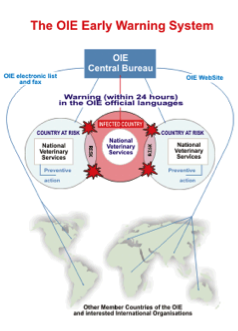
- Inform members of world animal health situation
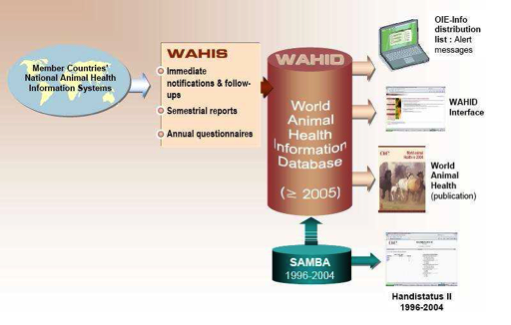
- World Animal Health Information System
- Relies on member states relaying info on disease
- List of notifiable diseases:
- A & B lists of notifiable diseases
- A → need to be controlled e.g. FMD, swine fever
- B → important for trade, bTB, Aujeszky’s
- May 2004: single list
- B list was becoming eradicated – no longer a principal difference in the approach to the two lists
- A & B lists of notifiable diseases
- Inform members of world animal health situation
- Structure
- Each member has delegate
- UK: CVO
- Nigel Gobbons – Chief Veterinary Officer
- UK: CVO
- International committee
- All delegates
- Annual meeting
- Numerous working groups, ad hoc committees
- Each member has delegate
- Office International des Epizooties
- Jan 24th 1924
- 1920s – Rinderpest outbreak in Belgium
- OiE formed off the back of it
- Paris
- Jan 24th 1924
- Renamed in May 2003, still called OIE
- 178 Member states/territories
- Key international organisation for animal health
- Zoonoses (incl. food safety)
- Animal health codes – standards on all notifiable diseases
- Purpose
- World Health Organisation of the United Nations (WHO)
GLEWS (joint with FAO, WHO)
- Global Early Warning System for Major Animal Diseases, including zoonoses
- Non zoonotic
- African Swine Fever (ASF)
- Classical Swine Fever (CSF)
- Contagious Bovine Pleuropneumonia (CBPP)*
- Foot and Mouth Disease (FMD)*
- Peste des Petits Ruminants (PPR)
- Rinderpest – Stomatitis/Enteritis
- Eradicated in 2011
- Zoonotic
- Anthrax
- Bovine Spongiform Encephalopathy (BSE)
- Brucellosis (B. melitensis)
- Crimean Congo Hemorrhagic Fever
- Ebola virus
- Foodborne diseases
- Highly Pathogenic Avian Influenza (HPAI)
- Japanese Encephalitis
- Marburg Hemorrhagic Fever
- New World Screwworm
- Nipah Virus
- Old World Screwworm
- Q Fever
- Rabies
- Rift Valley Fever* (RVF)
- Sheep Pox*/Goat Pox
- Tularemia
- Venezuelan Equine Encephalomyelitis
- West Nile Virus
- *diseases for which trend analyses and forecasting will be emphasized
European Food Safety Authority
- Risk assessment regarding food and feed safety
- Provide independent scientific advice
- 8 panels
- Expert working groups
- ~ 4,000 scientists across Europe
- Meet in Parma, Italy to discuss issues
National Surveillance
- Monitoring Systems
- Monitoring of disease causing agents in human and animal populations carried out through Statutory Notification
- Doctors in clinical practice and vets:
- Statutory duty to notify appropriate authority/officer of:
- All notifiable diseases diagnosed
- Any suspected notifiable diseases
- Statutory duty to notify appropriate authority/officer of:
- Vets at all levels – on farm or in the laboratory running tests – all must inform if a notifiable disease is suspected or confirmed
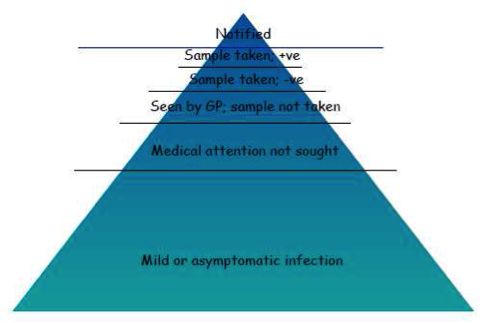
- Notified Cases: Human Population
- False negative – issues with sensitivity
- False positive – issues with specificity, GP unaware that they needed to be reported
- e.g. Campylobacter – suspected there are 10x more cases than are notified
- Statutory Notification: Man
- Notification introduced in 1889 as a means of identifying and preventing spread of infectious disease
- Cholera, smallpox, scarlet fever, typhoid fever and diphtheria
- Smallpox used to be fatal
- Cholera was a large issue in the 19th century
- Cholera, smallpox, scarlet fever, typhoid fever and diphtheria
- Agents which cause food-borne disease notifiable since 1949
- E.g. E. coli, campylobacter
- Notification introduced in 1889 as a means of identifying and preventing spread of infectious disease
- Notifiable Diseases, UK: Man
- Public Health (Infectious Diseases) Regulation, 1988
- Encephalitis, polio, anthrax, diptheria, dysentery, leprosy, leptospirosis, malaria, measles, meningitis, mumps, paratyphoid fever, rabies, rubella, scarlet fever, tetanus, tuberculosis, typhoid fever, viral haemorrhagic fever, viral hepatitis, whooping cough, yellow fever
- Malaria – imported now, but used to have endemic malaria in the UK
- Smallpox eradicated, and therefore no longer on here. Only have it in a few labs for research purposes
- Measles can cause encephalitis, and in some countries it can kill
- Some differences in Scotland
- Encephalitis, polio, anthrax, diptheria, dysentery, leprosy, leptospirosis, malaria, measles, meningitis, mumps, paratyphoid fever, rabies, rubella, scarlet fever, tetanus, tuberculosis, typhoid fever, viral haemorrhagic fever, viral hepatitis, whooping cough, yellow fever
- Public Health (Control of Diseases) Act, 1984 (as amended)
- Food poisoning (any agent, food and water)
- Cholera
- Plague
- Cholera and plague are still causing outbreaks in the world
- Relapsing fever
- Ticks
- Smallpox
- Typhus
- Amendment requires notification of any condition that might pose threat to public health
- Something new/unfamiliar that the government may need to take action on
- Ireland
- Bacillary dysentery, nvCJD, all food poisoning organisms
- nvCJD – new form of BSE
- Bacillary dysentery, nvCJD, all food poisoning organisms
- Spain
- Botulism, Shigellosis, Trichinosis (trichinella)
- France
- Botulism, listeriosis
- Easily transmitted by eating soft cheeses – a lot of soft cheese in France
- Botulism, listeriosis
- USA
- Botulism, Giardia, Hepatitis, E. coli O157, Listeriosis, Salmonellosis, Shigellosis, Trichinosis
- E. coli - Hamburger disease
- Botulism, Giardia, Hepatitis, E. coli O157, Listeriosis, Salmonellosis, Shigellosis, Trichinosis
- Public Health (Infectious Diseases) Regulation, 1988
- Disease Monitoring: Man
- Notifications from doctors – symptoms or lab reports
- Consultant in Communicable Disease Control
- Look at what needs to be done
- Laboratory reports from clinical labs confirming agent
- PHE- Centre for Infections (CfI), Colindale
- Base for communicable disease surveillance
- Advise Department of Health on action required to address emerging threat
- Public Health England (PHE, formerly Health Protection Agency):
- Will receive information on cases of disease caused by agents via food and water
- Collate findings, publish trends on HPA website (http:www.hpa.org.uk) and in Health Protection Report (HPR) each week
- Information also collated by Office of National Statistics
- Information from surveillance of FBD outbreaks also sent to European Food Safety Authority (EFSA) annually
- Annual reports produced on the basis of this information
- European coordination
- Eur. Centre for Disease Prevention & Control (ECDC):
- Based in stockholm
- Programme on food and waterborne diseases and zoonoses:
- Anthrax, botulism, brucellosis, campylobacteriosis, cholera, cryptosporidiosis, echinococcosis, giardiasis, hepatitis A, leptospirosis, listeriosis, salmonellosis, shigellosis, toxoplasmosis, trichinellosis, tularaemia, typhoid/paratyphoid fever, variant Creutzfeldt-Jakob disease (vCJD), VTEC/STEC (verotoxin/shigatoxin producing E. coli) infection, and yersiniosis.
- Coordination of surveillance, prevention, knowledge etc
- Eur. Centre for Disease Prevention & Control (ECDC):
- Animal Health (DEFRA)
- Key government department for surveillance of animal health
- Run post mortem labs etc.
- CVO is within DEFRA
- 2003: 10 year UK Veterinary Surveillance Strategy
- Coalition: merged with Veterinary Laboratories Agency → AHVLA
- 2014: merged with plant health agency → Animal and Plant Health Agency (APHA)
- Key government department for surveillance of animal health
- RADAR
- Information from e.g.:
- Agricultural holdings, land and livestock data from UK government databases;
- Animal health data from private veterinary surgeons and animal owners;
- Livestock industries
- Companion animal data, including that collected by the PETS travel scheme, and horse passport registrations;
- Information on carcass condemnations and throughputs from abattoirs;
- This use of information could still be improved
- Diagnostic data from veterinary laboratories;
- Information on the number of fallen stock consigned for destruction
- Meteorological information from the Met Office.
- Very important for certain diseases e.g. FMD can be carried certain distances in the wind (+ classical swine fever) – enough to be blown to the UK from Europe
- Rapid Analysis & Detection of Animal Associated Risks
- IT tool for collation, management and analysis of the numerous and varied surveillance reports
- Includes detailed info on number and location of animals in UK
- Proved key failure during 2001 FMD outbreak
- Information from e.g.:
- DACTARI
- Dog & Cat Travel and Risk Information:
- Voluntary reporting scheme
- Aimed at practicing vets
- Focus on
- Leishmaniasis (zoonotic, sand fly vector)
- Babesiosis (tick borne)
- Anaemia (related to malaria in humans)
- Don’t know if we have it in the UK, but we have it in the database
- Ehrlichosis (Rickettsia, tick borne)
- Fever in small animals
- Dirofilariasis (heartworm, mosquito vector)
- Mostly tropical, quite regular in imported animals
- Brought into/back into the country
- Doesn’t seem to have been hugely successful as a scheme
- PETS → under PETS scheme, legally travelled there
- V. influential
- Quarantine → pet scheme not allowed for animals from these countries
- Acarus Lab
- Mostly focuses on tick/insect bourne diseases, run by the University of Bristol
- To provide a rapid diagnostic service for a number of arthropod-borne microbial diseases in companion animals, specifically: Babesiosis, Bartonellosis, Borrelliosis, Ehrlichiosis and Leishmaniasis
- To develop novel methodologies for the rapid identification of specific micro-parasites
- e.g. PCR
- To develop research projects addressing the prevalence, ecology and epidemiology of these disease in the UK
- To raise awareness amongst veterinary practitioners on the subject of arthropod-borne diseases
- Climate change – will see a rise in vector bourne diseases
- To establish a focus for the dissemination of information on these diseases for the scientific community
- Non-profit
- PCR based
- 24hr turn around
- Monitoring Systems
Animal-Human Disease Interface
- Major concern – novel/emerging diseases
- Animals major reservoir/origin
- ONE HEALTH
- ‘Horizon scanning’ encompasses animal and human disease reports
- Human Animal Infection and Risks Surveillance Group (HAIRS)
- Public Health England, DEFRA, APHA, DoH
- Scans outputs from wide variety of sources to identify novel disease occurrences in animals and humans that may pose threat to public health
- Produces monthly report, disseminated to various bodies
- National Expert Panel on New and Emerging Infections
- Putbreak – HAIRS come together to discuss whether it is of concern for the UK
- Major concern – novel/emerging diseases
Global trends in emerging infectious diseases (EID)
- Agents
- Bacteria: 55%
- Drug resistance prime factor
- Tends to be known bacteria, resistant to drugs e.g. multidrug resistant TB from India
- Virus, prion: 25%
- Protozoa: 10%
- Fungi: 6.6%
- Helminths 3.3%
- Bacteria: 55%
- Zoonoses
- 60% of events
- 72% of these - wildlife origin
- E.g. Nipah virus, SARS
- 72% of these - wildlife origin
- Increasing incidence over time (52% of events in 1990’s)
- The proportion of zoonotic diseases is increasing, has risen to 75% from 60% in the 1940s
- 60% of events
- Vector-bourne
- 23% of events
- ~29% 1994-2004
- Increasing incidence
- Appearing in areas they haven’t been before (looking for it?)
- Climate change
- 23% of events
- Temporal trends
- Increasing incidence of emerging infections?
- Taking into account reporting bias (temporal and geographical)
- Other patterns
- EID concentrated in higher latitudes
- Cf human pathogen species richness
- Hotspots: NE USA, Japan, SE Australia, W Europe (↑ density of people and international travel)
- Socio-economic drivers (pop density, drug use, agricultural practices)
- Zoonoses from wildlife correlate with wildlife biodiversity
- Drug resistant EIDs correlate with socioeconomic factors
- Also political factors – ease of buying antimicrobial factors
- Easy – rapid development of resistance
- Hard - slower development
- Zoonoses from wildlife & vector borne disease are concentrated in lower latitude, developing countries.
- Most surveillance & research in rich, developed countries
- Planet poorly equipped for early warning of emerging diseases?
- EID concentrated in higher latitudes
- Emerging infectious disease events 1940-2004
- Infections due to new strain of pathogen (e.g. multidrug resistant strains)
- Appearance of pathogen in humans (e.g. HIV-1, SARS)
- That have never been seen in humans before
- SARS = Southern Avian Respiratory Syndrome
- Increased incidence of disease (e.g. lyme disease)
- Agents
Bilder und Dateien der Mindmap
Informationen
- Beschreibung
- BVSc3 AD2 (Public Health) Mindmap am Disease Surveillance, erstellt von Jess Pope am 09/01/2017.
- Erstellt von
- Jess Pope
- Aufrufe
- 2
- Bewertung