
Mindmap
Electricity
Inhalt der Mindmap
Electricity
Static Electricity
- When you rub two different insulating materials against each other they become electrically charged
- This happens because negatively charged electrons move from on material to the other
- The material that loses electrons becomes positively charged
- The Material that gains the electrons becomes negatively charged
- Two charged objects will repel each other if the charges are the same and attract each other if opposite
- The Material that gains the electrons becomes negatively charged
- The material that loses electrons becomes positively charged
- This happens because negatively charged electrons move from on material to the other
- When you rub two different insulating materials against each other they become electrically charged
Current and Voltage In Electrical Circuits
- Circuit Symbols
- For a circuit to work, two things are important
- There must be a complete circuit
- A complete circuit is one without any gaps
- There must be no short circuits
- Short circuits are ways of getting past the lamp without going through another component
- There must be a complete circuit
- Series and Parallel circuits
- Series circuits are circuits where each component is connected one after the other in a single loop
- The current that flows across the components is the same
- Parallel circuits are circuits where components are connected in separate loops
- The current is shared between each component connected in parallel
- Series circuits are circuits where each component is connected one after the other in a single loop
- Electric current:
- a flow of electric charge
- No current can flow if the series is broken
- Current is measured in amps (A) and it is measured using an ammeter which is connected in series with a component
- The size of an electric current is the rate of flow of electric charge
- It is calculated as: I = Q ÷ t
- Where I is current (A), Q is charge in Coulombs (C) and t is time in seconds
- It is calculated as: I = Q ÷ t
- The size of an electric current is the rate of flow of electric charge
- Current is measured in amps (A) and it is measured using an ammeter which is connected in series with a component
- No current can flow if the series is broken
- When more cells are added to a circuit p.d. increases so more current can flow
- a flow of electric charge
- Potential Difference
- Potential Difference, or voltage is needed to make current flow and is often provided by cells or batteries
- It is measured in volts, V
- The potential difference across a component in a circuit is measured using a voltmeter which is connected in parallel
- The potential difference between two points in an electric circuit is the work done when a coulomb of charge passes between the points
- It is calculated as: V = W ÷ Q
- Where V is p.d. (V), W is work done in joules (J) and Q is charge (C)
- It is calculated as: V = W ÷ Q
- The potential difference between two points in an electric circuit is the work done when a coulomb of charge passes between the points
- The potential difference across a component in a circuit is measured using a voltmeter which is connected in parallel
- It is measured in volts, V
- A typical cell produces 1.5V
- If two or more cells are connected in series their p.d. is the sum of the two values
- If their are connected in opposite directions then they are subtracted e.g. to cells in opposite directions will produce a p.d. of 0V meaning no current can flow
- If two or more cells are connected in series their p.d. is the sum of the two values
- Potential Difference, or voltage is needed to make current flow and is often provided by cells or batteries
Resistance
- There is a resistance to the flow of an electric current through most conductors which increase as the length of the wire increases or the thickness of the wire decreases
- The moving electrons can collide with ions in the metal wire which makes it more difficult to flow which causes resistance
- The resistance of a long wire is greater than that of a short wire because electrons collide more
- The resistance of a thin wire is greater than the resistance of a thick wire because a thin wire has fewer electrons to carry the current
- As the temperature increases the metal ions vibrate more so there are more collisions and the resistance increases
- The resistance of a long wire is greater than that of a short wire because electrons collide more
- Resistance can of a component can be found by measuring the current flowing through it, and potential difference across it
- The equation used to calculate this is V = I × R which can be rearranged as R = V ÷ I
- Where V is potential difference, I is Amps and R is resistance in ohms, Ω
- The equation used to calculate this is V = I × R which can be rearranged as R = V ÷ I
- The moving electrons can collide with ions in the metal wire which makes it more difficult to flow which causes resistance
- The current flowing through a resistor at a constant temperature is directly proportional to the potential difference across it
- The resistance of a lamp increases as the temperature of its filament increases. The current flowing through a filament lamp is not directly proportional
- The diode has a very high resistance in one direction which means that the current can only flow in the other direction
- A light-emitting diode, LED, produces light when a current flows through it in the forward direction. LEDs are often used for indicator lights in electrical equipment such as computers and television sets. As LEDs use a much smaller current than other types of lighting, their use is increasing.
- Thermistors are used as temperature sensors - for example, in fire alarms. Their resistance decreases as the temperature increases:
- At low temperatures, the resistance of a thermistor is high and little current can flow through them
- At high temperatures, the resistance of a thermistor is low and more current can flow through them
- LDRs (light-dependent resistors) are used to detect light levels, for example, in automatic security lights. Their resistance decreases as the light intensity increases:
- In the dark and at low light levels, the resistance of an LDR is high and little current can flow through it
- In bright light, the resistance of an LDR is low and more current can flow through it
- There is a resistance to the flow of an electric current through most conductors which increase as the length of the wire increases or the thickness of the wire decreases
Household Electricity
- AC and DC
- Direct Current is current that only flows in one and it is supplied by batteries and cells
- On an oscilloscope Direct Current would have a straight line
- Alternating current is current that constantly changes direction and it is supplied by mains plugs
- On an oscilloscope an Alternating current would show a wave
- Direct Current is current that only flows in one and it is supplied by batteries and cells
- Cables and Plugs
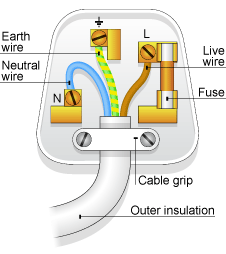
- A mains electricity cable has two or three inner wires made of copper, because copper is a good conductor, and covered by plastic, because it is a good insulator
- The inner wires are colour: blue is neutral, brown is live, and thee green and yellow stripey wire is earth
- The features of a plug are
- A plastic or rubber case because they are both good insulators
- Three pins are made from brass, which is a good conductor of electricity
- A fuse between the live terminal pin which breaks the circuit if too much current flows
- The cable is secured in the plug by a cable grip
- To remember where each of the wires go: b(L)ue is (L)eft, b(R)own is (R)ight, and s(T)riped is (T)op
- A mains electricity cable has two or three inner wires made of copper, because copper is a good conductor, and covered by plastic, because it is a good insulator
- Fuses
- Fuses protect electrical circuits and appliances by breaking if a fault in an appliance causes too much current to flow
- The fuse contains a metal wire which melts easily, if the current going through the fuse is too great, the wire heats up until it melts and breaks the circuit
- Fuses are made in standard ratings such as 3A, 5A and 13A
- A suitable fuse is one that should melt just above the appliance's working current, for example: if the device works at 3A use a 5A fuse
- Fuses are made in standard ratings such as 3A, 5A and 13A
- The fuse contains a metal wire which melts easily, if the current going through the fuse is too great, the wire heats up until it melts and breaks the circuit
- Circuit breakers also protect circuits by detecting a difference in current between the live and neutral wires
- They work much faster than fuses and don't need replacing, just turning on again
- Fuses protect electrical circuits and appliances by breaking if a fault in an appliance causes too much current to flow
- Earthing
- Many electrical appliances have metal cases; the earth wire creates a safe route for the current to flow if the live wire touches the casing
- You would get an electric shock if the live wire inside an appliance came loose and touched the metal casing
- The earth terminal is connected to the metal casing so that the current goes through the earth wire instead of causing an electric shock
- A strong current surges through the earth wire because it has a very low resistance breaking the fuse and disconnecting the appliance
- Some appliances do not have earth wires this is because they have a plastic casing and there is no threat of an electric shock
- A strong current surges through the earth wire because it has a very low resistance breaking the fuse and disconnecting the appliance
- The earth terminal is connected to the metal casing so that the current goes through the earth wire instead of causing an electric shock
- You would get an electric shock if the live wire inside an appliance came loose and touched the metal casing
- Many electrical appliances have metal cases; the earth wire creates a safe route for the current to flow if the live wire touches the casing
- AC and DC
Charge, Current and Power
- Choosing appliances
- Some appliances are more efficient at transferring energy than others
- For example less energy is wasted as heat energy from energy-saving, such as LEDs, and compact fluorescent lamps (CFLs) than from filament lamps
- Filament lamps contain a thin metal filament that glows when electricity passes through it, however, most of the electrical energy is transferred as heat energy instead of light energy so it is innefficient
- Modern energy-saving lamps work in a different way; they transfer a greater proportion of electrical energy as light energy so is more efficient than the filament bulb
- Some appliances are more efficient at transferring energy than others
- Power
- Power is a measure of how quickly energy is transferred; the unit of power is watts, W
- The more energy that is transferred in a certain time the greater the power
- Power is calculated as P = E ÷ t
- Where P is power (W), E is energy transferred (J) and T is time (S)
- To calculate the power in an electrical appliance use P = I × V
- Where P is power (P), I is the current (A) and V is potential difference (V)
- Power is calculated as P = E ÷ t
- The more energy that is transferred in a certain time the greater the power
- Power is a measure of how quickly energy is transferred; the unit of power is watts, W
- Choosing appliances
Bilder und Dateien der Mindmap
Informationen
- Beschreibung
- GCSE Physics (Additional GCSE) Mindmap am Electricity, erstellt von seth.bragg am 20/04/2014.
- Erstellt von
- seth.bragg
- Aufrufe
- 112
- Bewertung