
Mindmap
CHEMISTRY 6 pt 2
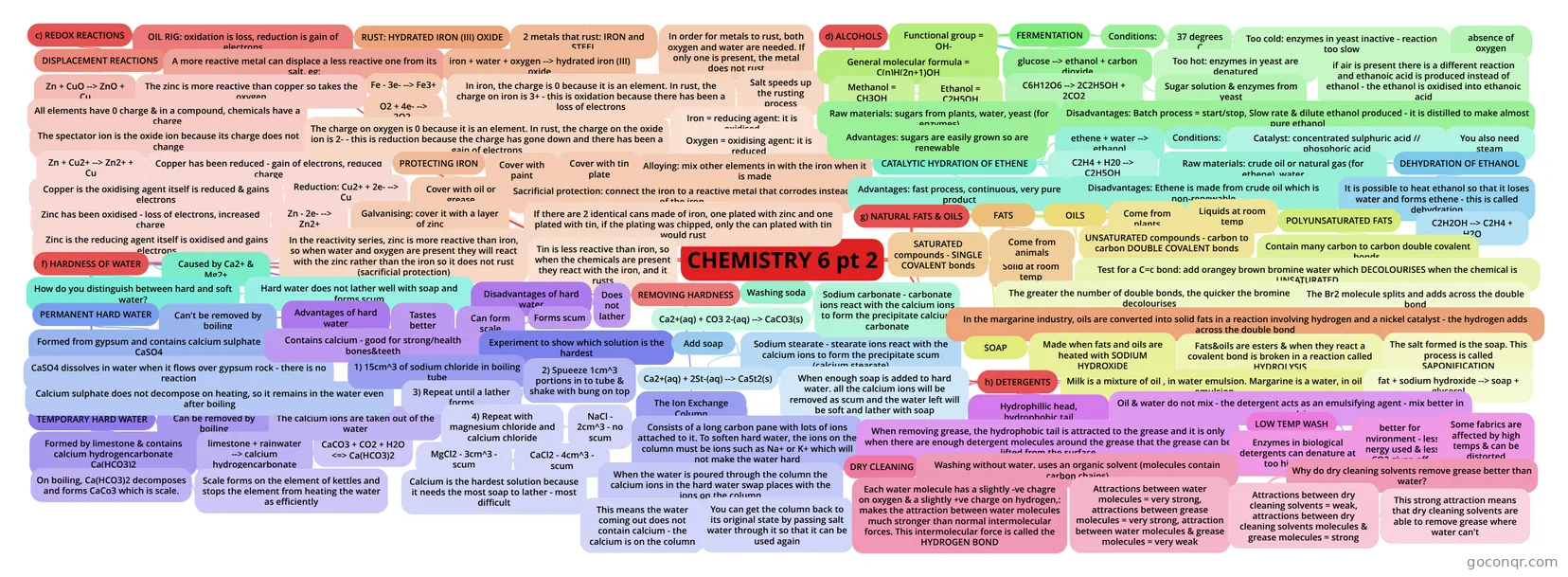
Mind map: chemistry 6 pt 2
Inhalt der Mindmap
CHEMISTRY 6 pt 2
c) REDOX REACTIONS
- OIL RIG: oxidation is loss, reduction is gain of electrons
- DISPLACEMENT REACTIONS
- A more reactive metal can displace a less reactive one from its salt, eg:
- Zn + CuO --> ZnO + Cu
- The zinc is more reactive than copper so takes the oxygen
- All elements have 0 charge & in a compound, chemicals have a charge
- The spectator ion is the oxide ion because its charge does not change
- Zn + Cu2+ --> Zn2+ + Cu
- Copper has been reduced - gain of electrons, reduced charge
- Reduction: Cu2+ + 2e- --> Cu
- Copper is the oxidising agent itself is reduced & gains electrons
- Reduction: Cu2+ + 2e- --> Cu
- Zinc has been oxidised - loss of electrons, increased charge
- Zn - 2e- --> Zn2+
- Zinc is the reducing agent itself is oxidised and gains electrons
- Zn - 2e- --> Zn2+
- Copper has been reduced - gain of electrons, reduced charge
- Zn + Cu2+ --> Zn2+ + Cu
- Zn + CuO --> ZnO + Cu
- A more reactive metal can displace a less reactive one from its salt, eg:
- RUST: HYDRATED IRON (III) OXIDE
- 2 metals that rust: IRON and STEEL
- In order for metals to rust, both oxygen and water are needed. If only one is present, the metal does not rust
- Salt speeds up the rusting process
- In order for metals to rust, both oxygen and water are needed. If only one is present, the metal does not rust
- iron + water + oxygen --> hydrated iron (III) oxide
- Fe - 3e- --> Fe3+
- In iron, the charge is 0 because it is an element. In rust, the charge on iron is 3+ - this is oxidation because there has been a loss of electrons
- Iron = reducing agent: it is oxidised
- In iron, the charge is 0 because it is an element. In rust, the charge on iron is 3+ - this is oxidation because there has been a loss of electrons
- O2 + 4e- --> 2O2-
- The charge on oxygen is 0 because it is an element. In rust, the charge on the oxide ion is 2- - this is reduction because the charge has gone down and there has been a gain of electrons
- Oxygen = oxidising agent: it is reduced
- The charge on oxygen is 0 because it is an element. In rust, the charge on the oxide ion is 2- - this is reduction because the charge has gone down and there has been a gain of electrons
- Fe - 3e- --> Fe3+
- PROTECTING IRON
- Cover with oil or grease
- Cover with paint
- Cover with tin plate
- Sacrificial protection: connect the iron to a reactive metal that corrodes instead of the iron
- Alloying: mix other elements in with the iron when it is made
- Galvanising: cover it with a layer of zinc
- If there are 2 identical cans made of iron, one plated with zinc and one plated with tin, if the plating was chipped, only the can plated with tin would rust
- In the reactivity series, zinc is more reactive than iron, so when water and oxygen are present they will react with the zinc rather than the iron so it does not rust (sacrificial protection)
- Tin is less reactive than iron, so when the chemicals are present they react with the iron, and it rusts
- 2 metals that rust: IRON and STEEL
d) ALCOHOLS
- Functional group = OH-
- General molecular formula = C(n)H(2n+1)OH
- Methanol = CH3OH
- Ethanol = C2H5OH
- FERMENTATION
- glucose --> ethanol + carbon dioxide
- C6H12O6 --> 2C2H5OH + 2CO2
- Conditions:
- 37 degrees C
- Too cold: enzymes in yeast inactive - reaction too slow
- Too hot: enzymes in yeast are denatured
- absence of oxygen
- if air is present there is a different reaction and ethanoic acid is produced instead of ethanol - the ethanol is oxidised into ethanoic acid
- Sugar solution & enzymes from yeast
- 37 degrees C
- Disadvantages: Batch process = start/stop, Slow rate & dilute ethanol produced - it is distilled to make almost pure ethanol
- Raw materials: sugars from plants, water, yeast (for enzymes)
- Advantages: sugars are easily grown so are renewable
- glucose --> ethanol + carbon dioxide
- CATALYTIC HYDRATION OF ETHENE
- ethene + water --> ethanol
- C2H4 + H20 --> C2H5OH
- Conditions:
- Catalyst: concentrated sulphuric acid // phosphoric acid
- You also need steam
- Raw materials: crude oil or natural gas (for ethene), water
- Advantages: fast process, continuous, very pure product
- Disadvantages: Ethene is made from crude oil which is non-renewable
- ethene + water --> ethanol
- DEHYDRATION OF ETHANOL
- It is possible to heat ethanol so that it loses water and forms ethene - this is called dehydration
- C2H2OH --> C2H4 + H2O
- It is possible to heat ethanol so that it loses water and forms ethene - this is called dehydration
f) HARDNESS OF WATER
- Caused by Ca2+ & Mg2+
- How do you distinguish between hard and soft water?
- Hard water does not lather well with soap and forms scum
- TEMPORARY HARD WATER
- Can be removed by boiling
- The calcium ions are taken out of the water
- Formed by limestone & contains calcium hydrogencarbonate Ca(HCO3)2
- limestone + rainwater --> calcium hydrogencarbonate
- CaCO3 + CO2 + H2O <=> Ca(HCO3)2
- On boiling, Ca(HCO3)2 decomposes and forms CaCo3 which is scale.
- Scale forms on the element of kettles and stops the element from heating the water as efficiently
- limestone + rainwater --> calcium hydrogencarbonate
- Can be removed by boiling
- PERMANENT HARD WATER
- Can't be removed by boiling
- Formed from gypsum and contains calcium sulphate CaSO4
- CaSO4 dissolves in water when it flows over gypsum rock - there is no reaction
- Calcium sulphate does not decompose on heating, so it remains in the water even after boiling
- Advantages of hard water
- Contains calcium - good for strong/health bones&teeth
- Tastes better
- Disadvantages of hard water
- Forms scum
- Can form scale
- Does not lather
- Experiment to show which solution is the hardest
- 1) 15cm^3 of sodium chloride in boiling tube
- 2) Spueeze 1cm^3 portions in to tube & shake with bung on top
- 3) Repeat until a lather forms
- 4) Repeat with magnesium chloride and calcium chloride
- NaCl - 2cm^3 - no scum
- MgCl2 - 3cm^3 - scum
- CaCl2 - 4cm^3 - scum
- Calcium is the hardest solution because it needs the most soap to lather - most difficult
- 4) Repeat with magnesium chloride and calcium chloride
- 3) Repeat until a lather forms
- 2) Spueeze 1cm^3 portions in to tube & shake with bung on top
- 1) 15cm^3 of sodium chloride in boiling tube
- REMOVING HARDNESS
- Add soap
- Sodium stearate - stearate ions react with the calcium ions to form the precipitate scum (calcium stearate)
- Ca2+(aq) + 2St-(aq) --> CaSt2(s)
- When enough soap is added to hard water. all the calcium ions will be removed as scum and the water left will be soft and lather with soap
- Ca2+(aq) + 2St-(aq) --> CaSt2(s)
- Sodium stearate - stearate ions react with the calcium ions to form the precipitate scum (calcium stearate)
- Washing soda
- Sodium carbonate - carbonate ions react with the calcium ions to form the precipitate calcium carbonate
- Ca2+(aq) + CO3 2-(aq) --> CaCO3(s)
- Sodium carbonate - carbonate ions react with the calcium ions to form the precipitate calcium carbonate
- The Ion Exchange Column
- Consists of a long carbon pane with lots of ions attached to it. To soften hard water, the ions on the column must be ions such as Na+ or K+ which will not make the water hard
- When the water is poured through the column the calcium ions in the hard water swap places with the ions on the column
- This means the water coming out does not contain calcium - the calcium is on the column
- You can get the column back to its original state by passing salt water through it so that it can be used again
- This means the water coming out does not contain calcium - the calcium is on the column
- When the water is poured through the column the calcium ions in the hard water swap places with the ions on the column
- Consists of a long carbon pane with lots of ions attached to it. To soften hard water, the ions on the column must be ions such as Na+ or K+ which will not make the water hard
- Add soap
g) NATURAL FATS & OILS
- FATS
- Solid at room temp
- Come from animals
- SATURATED compounds - SINGLE COVALENT bonds
- OILS
- Liquids at room temp
- Come from plants
- UNSATURATED compounds - carbon to carbon DOUBLE COVALENT bonds
- POLYUNSATURATED FATS
- Contain many carbon to carbon double covalent bonds.
- Test for a C=c bond: add orangey brown bromine water which DECOLOURISES when the chemical is UNSATURATED
- The greater the number of double bonds, the quicker the bromine decolourises
- The Br2 molecule splits and adds across the double bond
- The greater the number of double bonds, the quicker the bromine decolourises
- Test for a C=c bond: add orangey brown bromine water which DECOLOURISES when the chemical is UNSATURATED
- Contain many carbon to carbon double covalent bonds.
- In the margarine industry, oils are converted into solid fats in a reaction involving hydrogen and a nickel catalyst - the hydrogen adds across the double bond
- SOAP
- Made when fats and oils are heated with SODIUM HYDROXIDE
- Fats&oils are esters & when they react a covalent bond is broken in a reaction called HYDROLYSIS
- The salt formed is the soap. This process is called SAPONIFICATION
- fat + sodium hydroxide --> soap + glycerol
- The salt formed is the soap. This process is called SAPONIFICATION
- Fats&oils are esters & when they react a covalent bond is broken in a reaction called HYDROLYSIS
- Milk is a mixture of oil , in water emulsion. Margarine is a water, in oil emulsion
- Made when fats and oils are heated with SODIUM HYDROXIDE
- FATS
h) DETERGENTS
- Hydrophillic head, hydrophobic tail
- Oil & water do not mix - the detergent acts as an emulsifying agent - mix better in an emulsion
- When removing grease, the hydrophobic tail is attracted to the grease and it is only when there are enough detergent molecules around the grease that the grease can be lifted from the surface
- LOW TEMP WASH
- better for environment - less energy used & less CO2 given off
- Some fabrics are affected by high temps & can be distorted
- Enzymes in biological detergents can denature at too high a temp
- DRY CLEANING
- Washing without water. uses an organic solvent (molecules contain carbon chains)
- Each water molecule has a slightly -ve chagre on oxygen & a slightly +ve charge on hydrogen,: makes the attraction between water molecules much stronger than normal intermolecular forces. This intermolecular force is called the HYDROGEN BOND
- Why do dry cleaning solvents remove grease better than water?
- Attractions between water molecules = very strong, attractions between grease molecules = very strong, attraction between water molecules & grease molecules = very weak
- Attractions between dry cleaning solvents = weak, attractions between dry cleaning solvents molecules & grease molecules = strong
- This strong attraction means that dry cleaning solvents are able to remove grease where water can't
- Attractions between dry cleaning solvents = weak, attractions between dry cleaning solvents molecules & grease molecules = strong
- Attractions between water molecules = very strong, attractions between grease molecules = very strong, attraction between water molecules & grease molecules = very weak
- Hydrophillic head, hydrophobic tail
Informationen
- Beschreibung
- GCSE Chemistry Mindmap am CHEMISTRY 6 pt 2, erstellt von charl.mallon am 23/04/2014.
- Erstellt von
- charl.mallon
- Aufrufe
- 21
- Bewertung