
Mindmap
Chapter 8
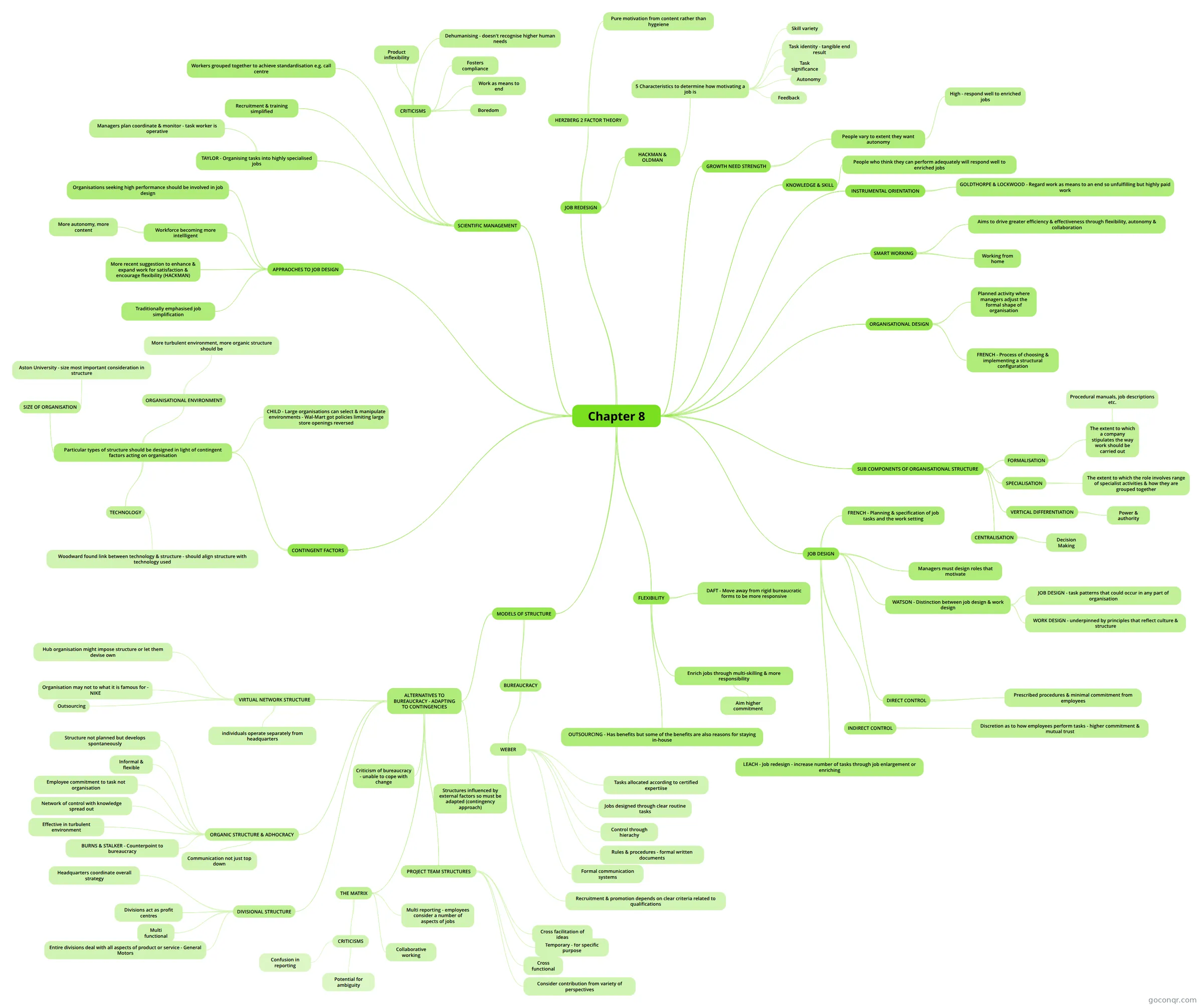
Mind map: Chapter 8
Inhalt der Mindmap
Chapter 8
ORGANISATIONAL DESIGN
- Planned activity where managers adjust the formal shape of organisation
- FRENCH - Process of choosing & implementing a structural configuration
SUB COMPONENTS OF ORGANISATIONAL STRUCTURE
- FORMALISATION
- The extent to which a company stipulates the way work should be carried out
- Procedural manuals, job descriptions etc.
- The extent to which a company stipulates the way work should be carried out
- SPECIALISATION
- The extent to which the role involves range of specialist activities & how they are grouped together
- VERTICAL DIFFERENTIATION
- Power & authority
- CENTRALISATION
- Decision Making
- FORMALISATION
JOB DESIGN
- FRENCH - Planning & specification of job tasks and the work setting
- Managers must design roles that motivate
- WATSON - Distinction between job design & work design
- JOB DESIGN - task patterns that could occur in any part of organisation
- WORK DESIGN - underpinned by principles that reflect culture & structure
- DIRECT CONTROL
- Prescribed procedures & minimal commitment from employees
- INDIRECT CONTROL
- Discretion as to how employees perform tasks - higher commitment & mutual trust
- LEACH - Job redesign - increase number of tasks through job enlargement or enriching
FLEXIBILITY
- DAFT - Move away from rigid bureaucratic forms to be more responsive
- Enrich jobs through multi-skilling & more responsibility
- Aim higher commitment
- OUTSOURCING - Has benefits but some of the benefits are also reasons for staying in-house
MODELS OF STRUCTURE
- BUREAUCRACY
- WEBER
- Tasks allocated according to certified expertiise
- Jobs designed through clear routine tasks
- Control through hierachy
- Rules & procedures - formal written documents
- Formal communication systems
- Recruitment & promotion depends on clear criteria related to qualifications
- WEBER
- ALTERNATIVES TO BUREAUCRACY - ADAPTING TO CONTINGENCIES
- Criticism of bureaucracy - unable to cope with change
- Structures influenced by external factors so must be adapted (contingency approach)
- PROJECT TEAM STRUCTURES
- Temporary - for specific purpose
- Cross functional
- Consider contribution from variety of perspectives
- Cross facilitation of ideas
- THE MATRIX
- Multi reporting - employees consider a number of aspects of jobs
- Collaborative working
- CRITICISMS
- Potential for ambiguity
- Confusion in reporting
- DIVISIONAL STRUCTURE
- Multi functional
- Entire divisions deal with all aspects of product or service - General Motors
- Divisions act as profit centres
- Headquarters coordinate overall strategy
- ORGANIC STRUCTURE & ADHOCRACY
- BURNS & STALKER - Counterpoint to bureaucracy
- Effective in turbulent environment
- Network of control with knowledge spread out
- Employee commitment to task not organisation
- Communication not just top down
- Informal & flexible
- Structure not planned but develops spontaneously
- VIRTUAL NETWORK STRUCTURE
- individuals operate separately from headquarters
- Outsourcing
- Organisation may not to what it is famous for - NIKE
- Hub organisation might impose structure or let them devise own
- BUREAUCRACY
CONTINGENT FACTORS
- Particular types of structure should be designed in light of contingent factors acting on organisation
- TECHNOLOGY
- Woodward found link between technology & structure - should align structure with technology used
- SIZE OF ORGANISATION
- Aston University - size most important consideration in structure
- ORGANISATIONAL ENVIRONMENT
- More turbulent environment, more organic structure should be
- CHILD - Large organisations can select & manipulate environments - Wal-Mart got policies limiting large store openings reversed
- TECHNOLOGY
- Particular types of structure should be designed in light of contingent factors acting on organisation
APPRAOCHES TO JOB DESIGN
- Traditionally emphasised job simplification
- More recent suggestion to enhance & expand work for satisfaction & encourage flexibility (HACKMAN)
- Workforce becoming more intellligent
- More autonomy, more content
- Organisations seeking high performance should be involved in job design
SCIENTIFIC MANAGEMENT
- TAYLOR - Organising tasks into highly specialised jobs
- Managers plan coordinate & monitor - task worker is operative
- Recruitment & training simplified
- Workers grouped together to achieve standardisation e.g. call centre
- CRITICISMS
- Product inflexibility
- Dehumanising - doesn't recognise higher human needs
- Fosters compliance
- Work as means to end
- Boredom
- TAYLOR - Organising tasks into highly specialised jobs
JOB REDESIGN
- HERZBERG 2 FACTOR THEORY
- Pure motivation from content rather than hygeiene
- HACKMAN & OLDMAN
- 5 Characteristics to determine how motivating a job is
- Skill variety
- Task identity - tangible end result
- Task significance
- Autonomy
- Feedback
- 5 Characteristics to determine how motivating a job is
- HERZBERG 2 FACTOR THEORY
GROWTH NEED STRENGTH
- People vary to extent they want autonomy
- High - respond well to enriched jobs
- People vary to extent they want autonomy
KNOWLEDGE & SKILL
- People who think they can perform adequately will respond well to enriched jobs
INSTRUMENTAL ORIENTATION
- GOLDTHORPE & LOCKWOOD - Regard work as means to an end so unfulfilling but highly paid work
SMART WORKING
- Aims to drive greater efficiency & effectiveness through flexibility, autonomy & collaboration
- Working from home
Informationen
- Beschreibung
- Mindmap am Chapter 8, erstellt von emily_palmer am 03/05/2014.
- Erstellt von
- emily_palmer
- Aufrufe
- 25
- Bewertung