
8571514
Beschreibung

Mindmap von Florence Papworth, aktualisiert more than 1 year ago

|
Erstellt von Florence Papworth
vor mehr als 9 Jahre
|
|
B: Digestion and absorption of lipids
- Lipid digestion and
absorption
- The majority of fats in the diet are
triacylglycerols as well as phospholipids and
cholesterols.
- Fats = hydrophobic=
emulsified to be digested.
- Fats droplets broken down into micelles = increase surface area.
- mechanical mixing and emulsifying action
of bile salts
- mechanical mixing and emulsifying action
of bile salts
- Pancreatic lipase acts on droplets
- Chloesterol esters -> chloesterol and FA
- Triacylglycerol -> FA, diacylglycerols and monoaclyglycerols
- Phospholipids -> lysophospholipids and FA
- Chloesterol esters -> chloesterol and FA
- Lipase and gastric lipases important.
- Products of digestion, as well as fat soluble vitamins require BILE ACIDS
for ABSORPTION.
- Excess bile salts recycled. Approx 5% in faeces.
- Excess bile salts recycled. Approx 5% in faeces.
- Fats droplets broken down into micelles = increase surface area.
- The majority of fats in the diet are
triacylglycerols as well as phospholipids and
cholesterols.
- Lipid digestion
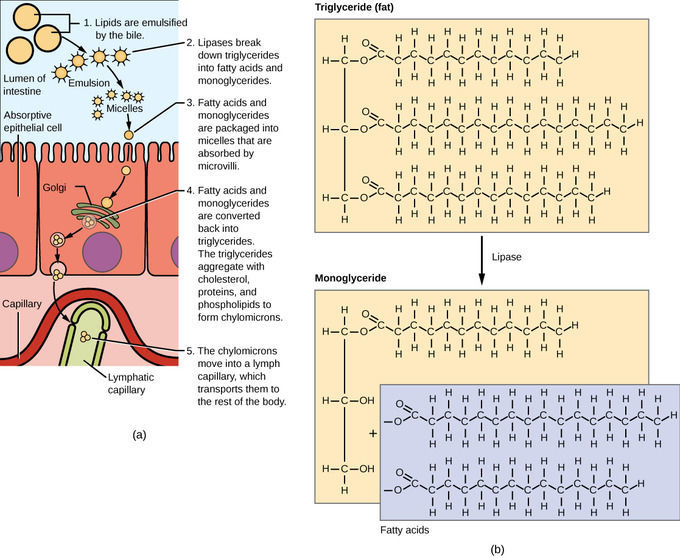
- Bile salts stick to fat droplets = emulsified.
Lipases break down triglyceride emulsion
droplets into FA and monoglycerides. These are
then packaged into micelles absorped by
microvilli of intestines. Inside, monoglyceride
converted back to tryglyceride which aggregate
to form chylomycrons. Chylomicrons move into
lymph capillary, transporting them to the rest of
the body.
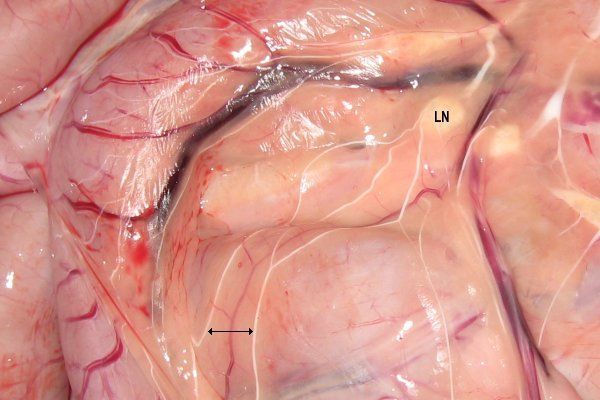
- Chylomicrons in lymph fluid then drain to lymph nodes and join with larger lymph vessles.
- Arrows show lymph vessels draining small intestine packed with chylomicrons, giving vessel a milky appearance.
- Chylomicrons in lymph fluid then drain to lymph nodes and join with larger lymph vessles.
- Blood plasma before meal =
clear. After meal has cloudy
appearance due to CMs
scattering light.
Anmerkungen:
- Plasma sample left over night, CMs form fatty band at top of liquid.
- Bile salts stick to fat droplets = emulsified.
Lipases break down triglyceride emulsion
droplets into FA and monoglycerides. These are
then packaged into micelles absorped by
microvilli of intestines. Inside, monoglyceride
converted back to tryglyceride which aggregate
to form chylomycrons. Chylomicrons move into
lymph capillary, transporting them to the rest of
the body.
- Lipid Absorption
- Mixed micelles absorbed into enterocyte.
Monoglycerides and FA re-esterfiicated in SER to
TAG. TAG is packed in the golgi into chylomicrons.
Chylocmicrons exocytose into the draining lymph
vessels. Only medium chain FAs and glycerol pass
straight through enterocyte into capillary vessels.
(Micelles large so longer process).
Anmerkungen:
- Enterocyte - cell of intestinal lining. SER- smooth endoplasmic reticulum. TAG- tryacylglycerol
- CM's transport lipids derived from diet (are exogenous)
- Mixed micelles absorbed into enterocyte.
Monoglycerides and FA re-esterfiicated in SER to
TAG. TAG is packed in the golgi into chylomicrons.
Chylocmicrons exocytose into the draining lymph
vessels. Only medium chain FAs and glycerol pass
straight through enterocyte into capillary vessels.
(Micelles large so longer process).
- Lipoproteins
Anmerkungen:
- Lipoproteins are complexes of lipids, apolipoproteins and phospholipids. Apolipoproteins - proteins that bind lipids together.
- Lipids - insoluble. Transported in blood with proteins as LIPOPROTEIN PARTICLES.
- Classes of lipoproteins - CM,
VLDL,IDL,LDL,HDL (decreasing
size/increasing density order)
Anmerkungen:
- CM - chylomicrons VLDL- very low density lipoproteins IDL - intermediate density lipoprotiens LDL- low density lipoproteins HDL - high density lipoproteins
- Transport ENDOGENOUSLY
synthesised triacylglycerols and
chloesterol from liver to other tissues.
- Role/reason for transport
of proteins.
Anmerkungen:
- Structural, ligands for receptors, activators of enzymes, assoc. w/ lipoproteins so transported between.
- CMs rapidly cleared ---> HDLs
present for much longer. CMs
-> HDL decreasing triacyl
glycerol and increasing protein
and cholesterol. (CMs high in
triacylglycerol, low in protein
and cholesterol, hence are the
largest but least dense.)
- Overview of lipoprotein
metabolism
- Pathway of delivery of exogenous fats
(packaged asCMS) = SMALL INTESTINE --> LIVER
--> PERIPHERAL TISSUES (smooth muscle,
ovaries, testes etc)
- Small i. to liver = exogenous.
Liver to tissue =endogenous.
- TG hydrolysis to deliver FAs
to tissues, catalysed by
lipoprotein lipase.
Anmerkungen:
- TG = triglyceride
- CMs -> liver. VLDLs, IDLs
and LDLs -> tissues (or
return to liver to be
reprocessed)
- Small i. to liver = exogenous.
Liver to tissue =endogenous.
- Pathway of delivery of exogenous fats
(packaged asCMS) = SMALL INTESTINE --> LIVER
--> PERIPHERAL TISSUES (smooth muscle,
ovaries, testes etc)
- Pathway of EXogenous
lipid transport
- Dietary fat enters gut and is
processed into NASCENT CMs.
Proteins are added to nascent CMs
as they mature. LPL reduces TAG
content of mature CM as glycerol
and FAs are proveided to muscle or
adipose cells. CM remnants donate
their proteins (to nascent CMs) and
are transported to the liver for
processing.
Anmerkungen:
- NASCENT CMs- newly formed chylomicrons. Cll, E proteins added to nascent CMs LPL- lipoprotein lipase, present on lumen of BV epithelial cells.
- LPL - on surface of capillaries, is activated by apoCll.
Hydrolyse TAG to glycerol and FAs which enter cells
for oxidation or storage.
- Dietary fat enters gut and is
processed into NASCENT CMs.
Proteins are added to nascent CMs
as they mature. LPL reduces TAG
content of mature CM as glycerol
and FAs are proveided to muscle or
adipose cells. CM remnants donate
their proteins (to nascent CMs) and
are transported to the liver for
processing.
- Pathway of ENDogenous
lipid transport
- Nascent VLDLs mature by addition of Cll
and E proteins. VLDLs are converted for
storage by LPL (activated by Cll) as
ADIPOSE tissue. VLDL remnant donates
Cll to nascent VLDLs and itself becomes an IDL.
IDL is then directly recylced in the liver,
or donates E protein to become LDL and
then is recycled by liver. Liver recycles
these into VLDLs again.
Anmerkungen:
- LDL can also bind its B100 receptor as an effective way of delivering cholesterol to other peripheral tissues.
- Nascent VLDLs mature by addition of Cll
and E proteins. VLDLs are converted for
storage by LPL (activated by Cll) as
ADIPOSE tissue. VLDL remnant donates
Cll to nascent VLDLs and itself becomes an IDL.
IDL is then directly recylced in the liver,
or donates E protein to become LDL and
then is recycled by liver. Liver recycles
these into VLDLs again.
- HDL and reverse
cholesterol transport
- Functions of HDL
- Removes chol. from peripheral
tissues. Transferred as VLDL, IDL or
LDL for recirculation or directly
carried back to liver for degredation
or secretion.
- Provides apoproteins for other lipoproteins
Anmerkungen:
- APOPROTEIN - the protein portion of a molecule or complex. Joins to a nonprotein protein molecule(s), such as a lipoprotein.
- Removes chol. from peripheral
tissues. Transferred as VLDL, IDL or
LDL for recirculation or directly
carried back to liver for degredation
or secretion.
- Liver makes and exports
discoidal, nascent HDL particles.
- Cholesterol is transferred
from peripheral tissues to NASCENT
HDL. Synthesis of cholesterol
ester, CE, by lecithin
acyltransferase, LCAT.
Anmerkungen:
- LCAT is found within HDL.
- Spherical, mature HDL is
formed.
- Direct transfer of HDL
cholesterol to liver, or via
VLDL, IDL and LDL (through
the action of cholesterol ester
transfer protein, CETP).
- Functions of HDL
- Essential fatty
acids
- Mammals cannot incorporate double bonds beyond carbon
9, need omega 3 and omega 6 fats for the synthesis of a
wide range of improtant lipid molecules, eg thromboxanes,
prostaglandins, leukatrienes...
Anmerkungen:
- w = omega symbol omega is the methyl carbon at the end.
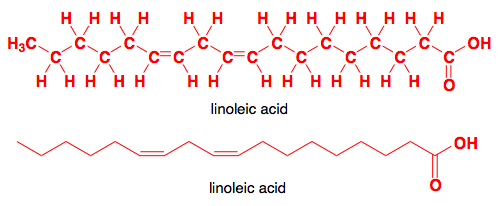
- Linoleic acid, 9,12-octadecanoic acid, 18:2 w-6,9
- Mammals cannot incorporate double bonds beyond carbon
9, need omega 3 and omega 6 fats for the synthesis of a
wide range of improtant lipid molecules, eg thromboxanes,
prostaglandins, leukatrienes...
Medienanhänge
Möchten Sie kostenlos Ihre eigenen Mindmaps mit GoConqr erstellen? Mehr erfahren.