
Mindmap
Energy Sources
Inhalt der Mindmap
Energy Sources
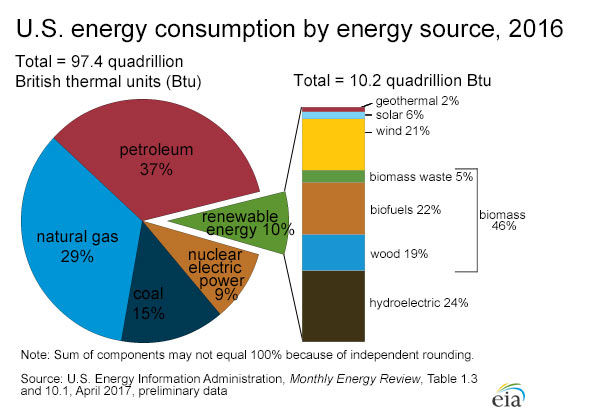
- https://www.eia.gov/EnergyExplained/?page=us_energy_home
NUCLEAR POWER
- Nuclear Reactor
- moderator
- usually water
- immerses the fuel elements
- goal: to slow spare nuetrons produced during fission so they can be used in a chain fission reaction (can react again)
- immerses the fuel elements
- usually water
- fuel elements
- region where they are placed= reactor core
- usually thin rods; amount of which varries by size of generator
- contain fissionable nuclei (Uranium 235)
- control rods
- controlls the number of spare nuetrons available at a given time; thereby controlls the rate of fission reactions
- thermal nuetrons (0.04 electron volts) produce a fission reaction in the control rod
- during fission, new electrons given out (1 MeV)
- would usually escape being part of another fission reaction because accompanied by massive energy release
- during fission, new electrons given out (1 MeV)
- moderator
- nuclear repositories: store waste
- The Nuclear waste Policy Act established a national policy disposing of highly active nuclear waste.
- Spent nuclear fuel and high-level radioactive waste must be safely transported to the repository.
- The Nuclear waste Policy Act established a national policy disposing of highly active nuclear waste.
- RADIATION ≠ RADOACTIVITY
- http://theconversation.com/explainer-the-difference-between-radiation-and-radioactivity-20014
- remember isotopes-- carbon 12, 13 (6, 7 neutrons) are stable but carbon 14 (8 neutrons) is radioactive
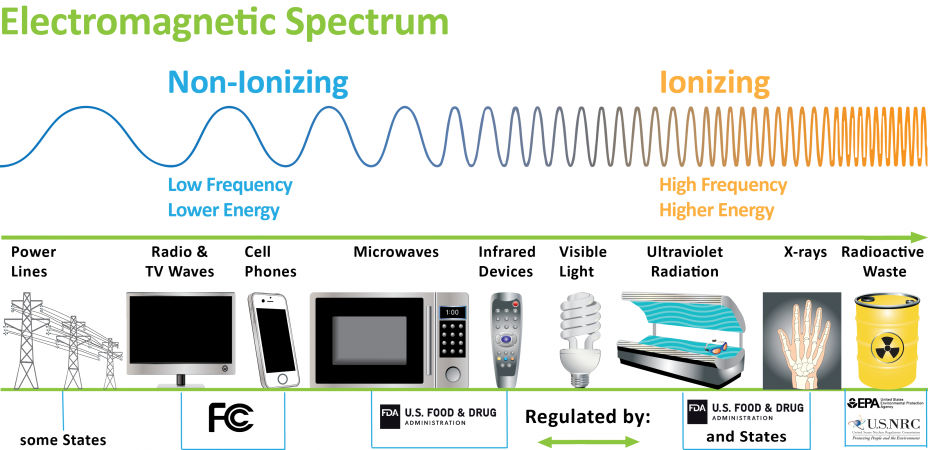
- Adding or removing an electron from the atom results in a charged particle, called an ion. Ions can react very differently to atoms.
- Radioactivity is the term given to the breaking-up (decay) or rearrangement of an atom’s nucleus. Decay occurs naturally and spontaneously to unstable nuclei. This instability is usually caused by a mismatch between the number of protons and neutrons.
- Neutron release, alpha and beta decay are all accompanied by the release of a particle. It is the particle (or the gamma ray in gamma decay) that is the “radiation” associated with radioactivity.
- HEALTH EFFECTS OF NON-IONIZING RADIATION (RADIOACTIVITY)
- suffiecnt energy to change/damage cells-- can cause cancer
- Ionizing radiation has sufficient energy to cause chemical changes in cells and damage them. Some cells may die or become abnormal, either temporarily or permanently. By damaging the genetic material (DNA) contained in the body’s cells, radiation can cause cancer. Fortunately, our bodies are extremely efficient at repairing cell damage. The extent of the damage to the cells depends upon the amount and duration of the exposure, as well as the organs exposed. A very large amount of radiation exposure (acute exposure), can cause sickness or even death within hours or days. Such acute exposures are extremely rare.
- suffiecnt energy to change/damage cells-- can cause cancer
- radiation is a possible consequence of many processes, not just radioactivity.
- Ionizing radiation has so much energy it can knock electrons out of atoms, a process known as ionization.
- Nuclear Reactor
OIL
- formation
- Takes million of yrs
- dead organic matter falls to bottom of ocean decays
- covered in sediment, sediment compresses to become rock
- puts heat and pressure on organic matter...
- new rock containing oil formed through heat and pressure
- necesities: nonpourous rock + clay or salt
- new rock containing oil formed through heat and pressure
- puts heat and pressure on organic matter...
- covered in sediment, sediment compresses to become rock
- dead organic matter falls to bottom of ocean decays
- Takes million of yrs
- history
- kerosene lamps...
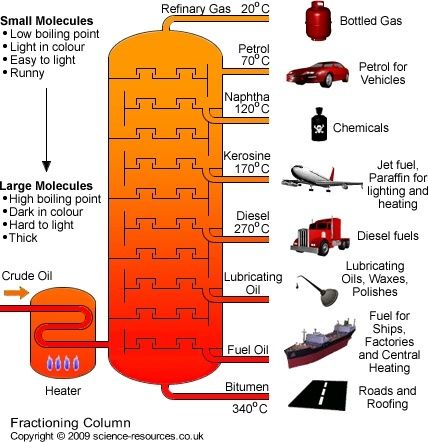
- fractional distillation
- crude oil (what harvested) is seperated into different parts by being heated
- it evaporates, and different parts (gases) settle at different parts of the column
- coolest on top, warmest on bottom
- it evaporates, and different parts (gases) settle at different parts of the column
- crude oil (what harvested) is seperated into different parts by being heated
- effects on enviornment
- drilling mud commonly spills out rather than entering pits
- (marine) animals harmed
- Oil and gas complexes lead to: Environment stripped of vegetation Increased erosion Ground surface disruption Wildlife habitat destruction
- pipe explosions contaminate drinking water
- gas wells release methane
- seismic surveying (creating picture of land to find oil deposits)= noise pollution, frightens whales
- oil and gas both emit VOCs, 3rd largest emmiter of NOx (turns into ground level ozone, smog)
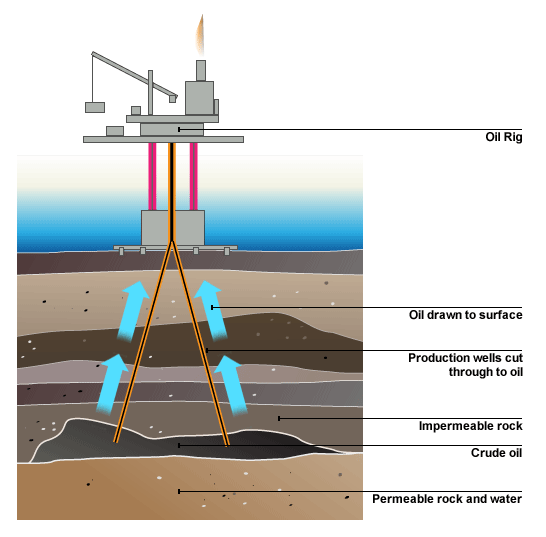
- offshore drilling
- if oil is detected in seismic surveying, companies have the right to drill for oil
- can also be found by detecting magnetic anomalies in rock
- production wells: last 10-20 yrs, larger than exploratory wells
- exploratory wells: small, cylindrical circle of rock taken
- The United States consumes more energy from petroleum than from any other energy source. In 2015, total U.S. petroleum consumption was about 19 million barrels per day (b/d), the equivalent of about 36% of all the energy consumed in the United States.
- petroluem China (12%) Japan (5%) India (4%) Russia (4%)
- The U.S. Energy Information Administration projects that petroleum and other liquids will continue to contribute the largest share of total U.S. energy consumption through 2040, although the share will decline slightly.
- Natural gas production in 2016 was the second largest amount after the record high production in 2015. More efficient and cost-effective drilling and production techniques have resulted in increased production of natural gas from shale formations (coal now cheaper globally)
- The U.S. Energy Information Administration projects that petroleum and other liquids will continue to contribute the largest share of total U.S. energy consumption through 2040, although the share will decline slightly.
- petroluem China (12%) Japan (5%) India (4%) Russia (4%)
- formation
NATURAL GAS
- methods of harvest
- fracking (Hydrolic fracturing)
- both: drill vertically (sometimes slanted) until reach level containing gas, then drill horizontally
- drill pipes
- special mixture of water and sand used to crack the rocks-- making gas in pores of rocks accessible
- water flushed out at end
- sometimes explosives are used to expand well area
- water flushed out at end
- special mixture of water and sand used to crack the rocks-- making gas in pores of rocks accessible
- horizontal drilling
- fracking (Hydrolic fracturing)
- history
- invention of bunsen burner made nat. gas useful for more than just heat/ light (what it was used for in 9th/20th centuries)
- formation
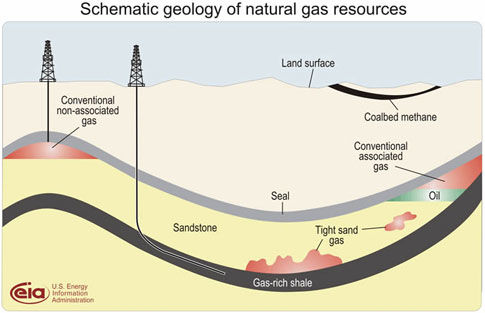
- **often forms alongside oil
- CONVENTIONAL DEPOSIT: underneath impermeable rock, w/ oil on bottom gas on top
- UNCONVENTIONAL DEPOSIT: in porous/permeable rock (when fracking used)
- shale gas, tight gas, coal bed methane
- Conventional natural gas deposits are commonly found in association with oil reservoirs, with the gas either mixed with the oil or buoyantly floating on top, while unconventional deposits include sources like shale gas, tight gas sandstone, and coalbed methane.
- UNCONVENTIONAL DEPOSIT: in porous/permeable rock (when fracking used)
- CONVENTIONAL DEPOSIT: underneath impermeable rock, w/ oil on bottom gas on top
- organic matter in ocean dies, subjected to heat and pressure
- hydrocarbons extracted
- methane= hydrocarbon at its purest, lightest
- hydrocarbons extracted
- **often forms alongside oil
- methods of harvest
coal
- formation of coal
- organic matter (plants in swamps near equator) died in swamps--decomposed under pressure from stuff
- decomposed by anerobic bacteria, which were able to survive in the stagnant (and therefore oxygen-less) swamp waters
- acid released in decay process-- kills bacteria, leaves decayed matter as peat
- looks like decayed wood
- smokes when burned, still containg some moisture
- sand, silt, sediment accumulate over time, addding pressure to peat
- silt== fine sand, clay, or other material carried by running water and deposited as a sediment, especially in a channel or harbor.
- forms lignite, "brown coal" carbon concentration 25-30%
- ignites easily, can spontaneously combust, ranks lowest on energy scale (lowest proportion of carbon to moisture)
- used in coal gassification, may be in higher demand in near future
- does not burn cleanly-- smoke
- more pressure, heat: bituminous, subituminous... "black coal"
- 80-60% carbon content
- used to produce steam (to generate electricity) and to produce steel
- produces less harmful wastes like fly ash, SO2... burns more effectively
- more pressure, heat: anthracite... "stone coal"
- metamorphic, occurs in folded strata
- 92-98% carbon concentration, highest on energy ranking scale
- burns most cleanly-- best for space/home heat,
- hard to ignite, not used in power plants bc 2-3x more expensive than bit/subit coal
- burns most cleanly-- best for space/home heat,
- 92-98% carbon concentration, highest on energy ranking scale
- metamorphic, occurs in folded strata
- more pressure, heat: anthracite... "stone coal"
- produces less harmful wastes like fly ash, SO2... burns more effectively
- used to produce steam (to generate electricity) and to produce steel
- 80-60% carbon content
- more pressure, heat: bituminous, subituminous... "black coal"
- does not burn cleanly-- smoke
- used in coal gassification, may be in higher demand in near future
- ignites easily, can spontaneously combust, ranks lowest on energy scale (lowest proportion of carbon to moisture)
- sand, silt, sediment accumulate over time, addding pressure to peat
- smokes when burned, still containg some moisture
- looks like decayed wood
- acid released in decay process-- kills bacteria, leaves decayed matter as peat
- decomposed by anerobic bacteria, which were able to survive in the stagnant (and therefore oxygen-less) swamp waters
- organic matter (plants in swamps near equator) died in swamps--decomposed under pressure from stuff
- Coal production peaked in 2008 and trended down through 2016. Coal production in 2016 was about the same as production was in 1977. The primary reason for the general decline in coal production in recent years is the decrease in coal consumption for electricity generation.
- formation of coal
Nonrenewable Energy Sources: do not form or replenish in a short periiod of time
- Renewable Energy Sources
- wind power
- based on windmills, which use mechanical energy of wind to ex) grind corn
- transformation: mechanical (wind) -- spins generator-- to electrical
- Hydroelectric
- wheels (turning generator) spun by water
- often hydroelectric dam created
- transformation: mechanical to electrical
- often hydroelectric dam created
- wheels (turning generator) spun by water
- hydrogen fuel cell
- hydrogen and oxygen forced together
- H: 1 proton, 1 electron, passed through membrane (proton can pass through, electron can't, goes in a circuit on outside-- power harvested
- remember: electricity= flow of electrons through a circuit
- biproduct= water (vapor)
- H: 1 proton, 1 electron, passed through membrane (proton can pass through, electron can't, goes in a circuit on outside-- power harvested
- could not be useful for a power plant (too many small parts, expensive)
- good in car, bus
- risk: if this got into an accident and blew up on impact, would be ginormous explosion...
- good in car, bus
- to obtain fuel: H produced by regular pond algae (otherwise, would have to burn fossil fuels to get this H)
- hydrogen and oxygen forced together
- biomass
- thermochemical conversion: takes biomass (woodchips, waste)... a small part of the material is used to heat the rest IN ABSENCE OF OXYGEN
- product of thermochemical conversion: methane/H or liquid fuel
- technically, incineration is a type of biomass burning
- ex of economical usage: corn stalks used as biofuel (these are otherwise useless, left over after harvest)
- can either straight up burn biomass or burn a little of it, pull methane (NAT GAS) out, harvest for electricity
- subjecting to heat and pressure= just how fossil fuels formed
- can either straight up burn biomass or burn a little of it, pull methane (NAT GAS) out, harvest for electricity
- basically, getting ethanol
- def: Renewable organic materials, such as wood, agricultural crops or wastes, and municipal wastes, especially when used as a source of fuel or energy.
- when burnt, trash releases dioxins: ethanol doesn't
- does not release NOx, SOx, less ozone
- thermochemical conversion: takes biomass (woodchips, waste)... a small part of the material is used to heat the rest IN ABSENCE OF OXYGEN
- solar power
- "in 20 days, enough sunlight falls on earth to = the total level of energy of fossil fuels"
- expensive, only 15% efficiency
- photovoltaic cell= PV system= converts sunlight directly into electricity (DC)
- alternatively, stores energy in battery: then can be used as (AC)
- use silicon semiconductors: act as insulators until hit by heat, light, then become conductors
- alternatively, stores energy in battery: then can be used as (AC)
- energy transformations
- electromagnetic to electric
- if battery: electromagnetic (radiant) to chemical to electric
- electromagnetic to electric
- wind power
- Renewable Energy Sources
Bilder und Dateien der Mindmap

Informationen
- Beschreibung
- 9th grade Environmenal Science Mindmap am Energy Sources, erstellt von Meredith W am 24/05/2017.
- Erstellt von
- Meredith W
- Aufrufe
- 2
- Bewertung