
912262
Beschreibung

Mindmap von tiffragbourne, aktualisiert more than 1 year ago

|
Erstellt von tiffragbourne
vor fast 12 Jahre
|
|
KARST PROCESSES
+ LANDFORMS
- karstification process
- essential independent
variables that guide the
development of the karst
landscape = 'coordinate features'
- CHEMICAL DRIVING FORCE
- PRECIPITATION
- chemical reactions drive
towards equilibrium
(saturation and cessation
of dissolution)WITHOUT
PRECIPITATION
- chemical reactions drive
towards equilibrium
(saturation and cessation
of dissolution)WITHOUT
PRECIPITATION
- PRECIPITATION
- PHYSICAL DRIVING FORCE
- PRECIPITATION
- removes saturated solutions
and replaces with fresh
solutions
- removes saturated solutions
and replaces with fresh
solutions
- RELIEF
- PRECIPITATION
- HYDROGEOLOGIC SETTING
- TECTONIC SETTING
- THIICKNESS OF SOLUABLE ROCK
- places
limits on the
extent of
karst
development
- e.g. western
Pennsylvania only
10-12m
- E.G. Adriatic coast 9000m
- e.g. western
Pennsylvania only
10-12m
- places
limits on the
extent of
karst
development
- STRATIGRAPHIC
AND
LITHOLOGICAL
SETTING
- TECTONIC SETTING
- CHEMICAL DRIVING FORCE
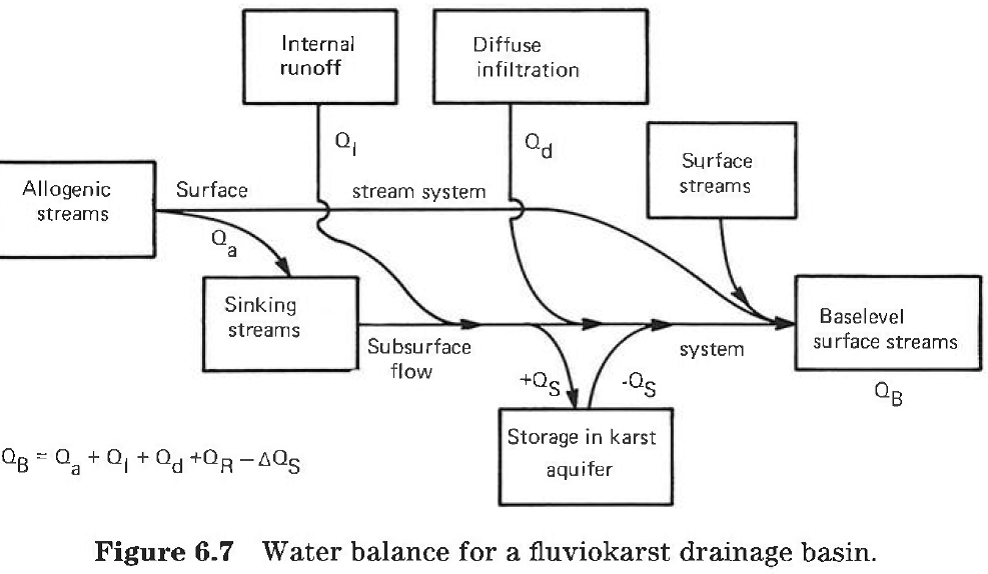
- Karst hydrologic cycle
- Karst aquifer and
associated groundwater
basins assumed to be
embedded in larger
basins containing
non-karstic rocks
(ALLOGENIC)
- Runoff originates from
allogenic streams
together with internal
runoff (Qi = IN
DIAGRAM )
- Overland flow
disappears into
sinkholes ->
internal runoff
(Qa )
- Karst aquifer assumed to
have a single output = base
level stream with flow QB from
springs
- Porosity and permeability OF
AQUIFERS - ranges
- Primary porosity
- fracture
porosity
- conduit
porosity
- INFLUENCE ON
- Water infiltrating
percolates downwards
under gravity until it
reaches level where all
pores are water-filled.
- Phreatic
zone
- water-saturated
zone below the
water table
- water-saturated
zone below the
water table
- Vadose
zone
- unsaturated
zone above the
water table
- unsaturated
zone above the
water table
- Water infiltrating
percolates downwards
under gravity until it
reaches level where all
pores are water-filled.
- Karstic aquifers
contain integrated
systems of pipe-like
conduits that act as
drains for the highly
localised transport
of watery
- Properties of carbonate
aquifers vary widely
- Primary porosity
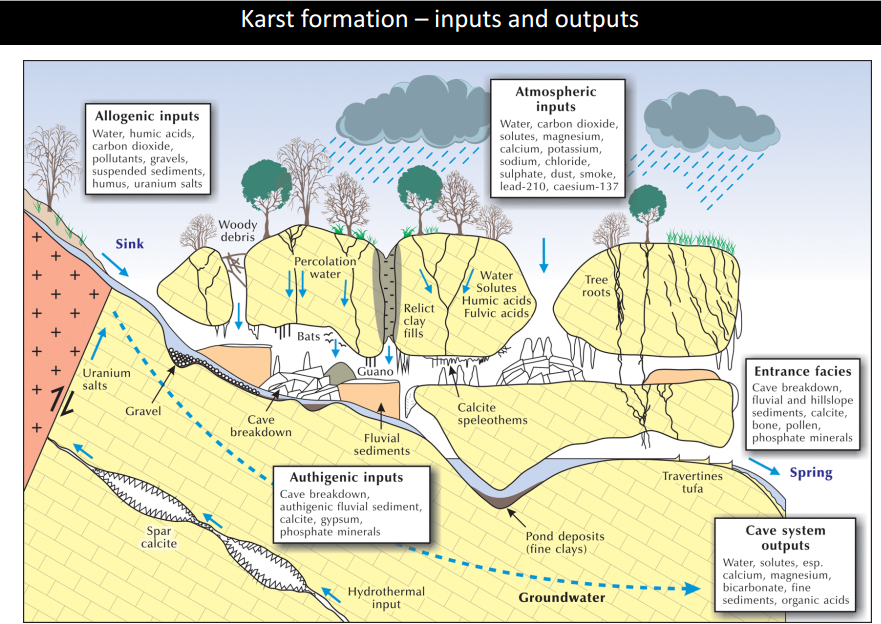
- KARST RECHARGE
- OCCURS IN = Catchments of
mixed geology
- solution attributable
both:
- 1) precipitation (autogenic
recharge)
- AND 2) water that flows on to the karst
from elsewhere (allogenic
recharge)
- 1) precipitation (autogenic
recharge)
- Denudation varies as geochemical
evolution of the water different
- BECAUSE
- 1) soil and
boil vary from
point to point
- recharge is
organised differently
- AUTOGENIC CASE =
diffuse and relatively even
- ALLOGENIC CASE = ocused + high
volume + solution restricted to line of
watercourse
- AUTOGENIC CASE =
diffuse and relatively even
- 1) soil and
boil vary from
point to point
- BECAUSE
- OCCURS IN = Catchments of
mixed geology
- Karst aquifer and
associated groundwater
basins assumed to be
embedded in larger
basins containing
non-karstic rocks
(ALLOGENIC)
- essential independent
variables that guide the
development of the karst
landscape = 'coordinate features'
- Theoretical Cave
Development Models
in Carbonates
- VADOSE THEORY
- Caves formed by
action of underground
streams flowing at or
above the water table
- solution takes place most actively at
the top of the saturated zone
BECAUSE aggressiveness is lost
once water descends through sinkholes
and enters the water table
- Caves formed by
action of underground
streams flowing at or
above the water table
- DEEP PHREATIC THEORY
- origin = Davis's work on
Peneplains
- origin = Davis's work on
Peneplains
- VADOSE THEORY
- KARST = A distinctive topography in which the
landscape is largely shaped by the dissolving
action of water on carbonate bedrock
- results in
- surface and
subsurface features
- sinkholes
- vertical
shafts
- disappearing streams
- springs
- underground
drainage systems
- caves
- sinkholes
- Caocite Dissolution
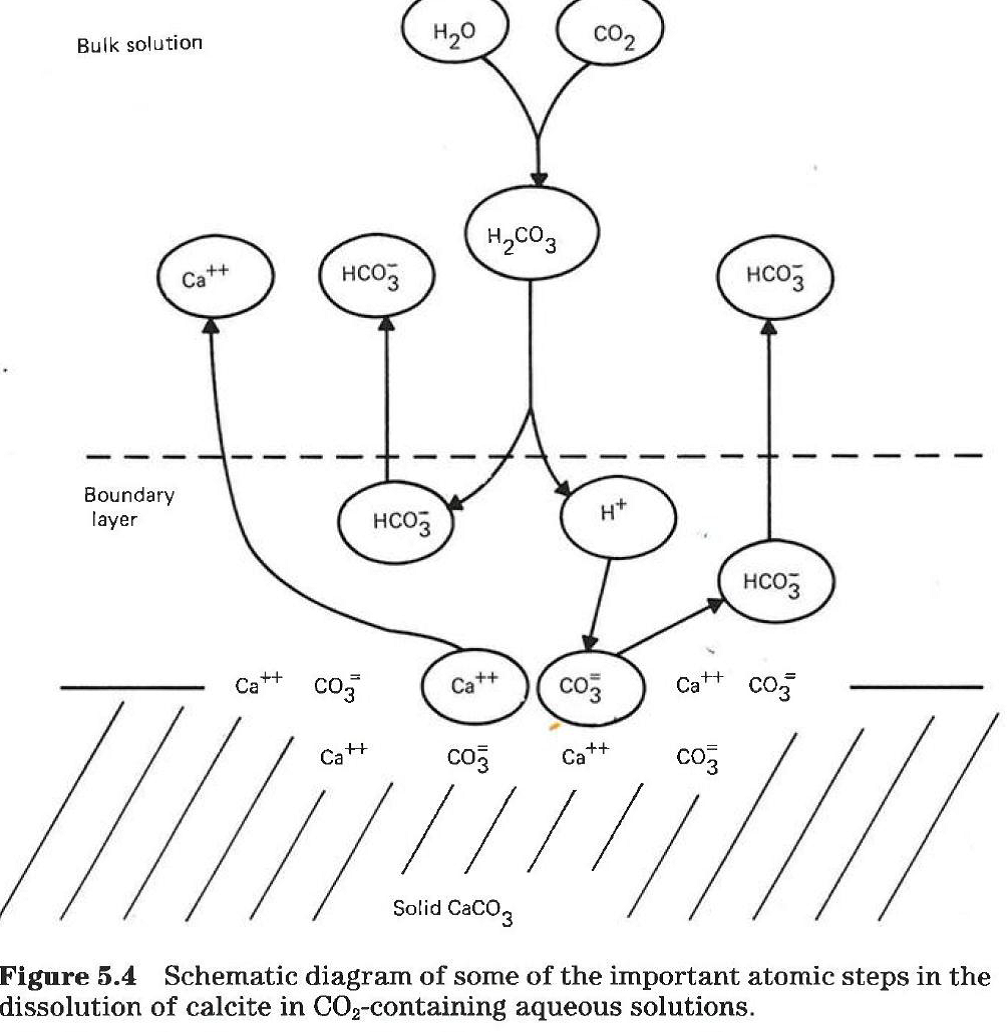
- 1) In the presence of water, calcite
dissociates to yield a positively charged
calcium cation and a negatively charged
carbonate anion
- CaCO3 -><- Ca++ + CO3 2-
- Dissolution of the limestone or
dolomite is most intensive where the
water first contacts the rock surface
- CaCO3 -><- Ca++ + CO3 2-
- 2) Carbon dioxide gas
dissolves in water to
produce carbonic acid
- CO2 + H20 -><- H2CO3
- Hydration of
aqueous CO2 to
form neutral
carbonic acid
- Hydration of
aqueous CO2 to
form neutral
carbonic acid
- CO2 + H20 -><- H2CO3
- 3) The carbonic acid
dissociates into a
hydrogen cation (protom)
and a bicarbonate ion.
- H2CO3 -><- H+ + HCO3
- Ionization of the carbonic acid to
form a bicarbonate ion and a proton
- Ionization of the carbonic acid to
form a bicarbonate ion and a proton
- H2CO3 -><- H+ + HCO3
- 4) Free protons H+ combine
with carbonate anions
HCO3 -
- HCO3 - = which are
more soluble in water
than carbonate
- H+ + CO3 2- -> <- HCO3
- Reaction of the proton with a carbonate
ion on the crystal surface to form a
second bicarbonate ion
- Reaction of the proton with a carbonate
ion on the crystal surface to form a
second bicarbonate ion
- HCO3 - = which are
more soluble in water
than carbonate
- 5) Continuing production of bicarbonate
releases calcium ions Ca2+ into the
boundary layer of the water
- Kinematics
- 1. Desorption of the second
bicarbonate ion and its diffusion
across the boundary layer into the
bulk solution
- 2. Release of the calcium
ion from the crystal
- 3. Diffusion of the
calcium ion across the
boundary layer into the
bulk solution
- 1. Desorption of the second
bicarbonate ion and its diffusion
across the boundary layer into the
bulk solution
- The ions are carried away in
solution
- Kinematics
- Both limestone and marble =
composed of the mineral
calcite= chemically is calcium
carbonate: CaCO3
- MARBLE = metamorphosed limestone
- Dolomite is a double carbonate of
calcium and magnesium:
CaMg(CO3 )2 = less soluble than
calcite = karst on dolomite = less
well developed than on limestone or
marble
- MARBLE = metamorphosed limestone
- SUMMARY EQUATION = CaCO3 + H20 + CO2 -><- Ca(HCO3 )2
- Ca(HCO3 )2 =
calcium
bicarbonate
- HOWEVER reactions are fully reversible = when
precipitates are exposed to un-saturated ground water =
re-dissolve
- Ca(HCO3 )2 =
calcium
bicarbonate
- 1) In the presence of water, calcite
dissociates to yield a positively charged
calcium cation and a negatively charged
carbonate anion
- changing
water
table
levels
- subsidence
- Distinctive
landforms
- Saturated and
undersaturated solutions
- SATURATED = dynamic equilibrium
with no more solution: the solution
- either
- supply of CO2 going
into solution being
exhausted
- where it is balanced
by outgassing of
CO2
- supply of CO2 going
into solution being
exhausted
- can lead to
groundwater becomes
SUPERSATURATED
with dissolved minerals
- further dissolution = not
possible, =carbonate salts of
calcium and magnesium may
precipitate from the water
- features E.G.
stalactites.
- features E.G.
stalactites.
- further dissolution = not
possible, =carbonate salts of
calcium and magnesium may
precipitate from the water
- either
- UNSATURATED =
there is net dissolution
of the mineral
- SOMETIMES refferred to as
AGGRESSIVE
- Aggressive dissolution = flow is
focussed in pre-existing openings in the
rock OR in the zone of water-table
fluctuation where ground water is in
contact with the atmosphere
- Aggressive dissolution = flow is
focussed in pre-existing openings in the
rock OR in the zone of water-table
fluctuation where ground water is in
contact with the atmosphere
- SOMETIMES refferred to as
AGGRESSIVE
- SATURATED = dynamic equilibrium
with no more solution: the solution
- surface and
subsurface features
- IN = humid regions.
- wet regions
have much
higher
denudations
rates than drier
regions
- EXAMPLE FLORIDA
- wet regions
have much
higher
denudations
rates than drier
regions
- results in
- LANDFORM
- Distinctive landforms due
to high rock solubility,
which causes secondary
porosity and subsidence.
- Distinctive landforms due
to high rock solubility,
which causes secondary
porosity and subsidence.
- FORMATION
- the carbon
dioxide
cascade
- 1. As rain falls
through the
atmosphere, it
picks up CO2
which dissolves in
the droplets
- 2. Once rain
hits the
ground, it
percolates
through the
soil and picks
up more CO2
- 3. a weak solution of
carbonic acid is formed
- EQUATION = H2O + CO2 -> <-H2CO3
- Hydration
- Hydration
- EQUATION = H2O + CO2 -> <-H2CO3
- 4. infiltrating water naturally
exploits any cracks or crevices in
the rock.
- CHEMISTY =
carbonic acid reacts
readily with
limestone CaCO3
and/or dolomite
(CaMgCO3)2
- CHEMISTY =
carbonic acid reacts
readily with
limestone CaCO3
and/or dolomite
(CaMgCO3)2
- 5.. Over long periods, with a
continuous supply of CO2
-enriched water, carbonate
bedrock begins to dissolve.
- CHEMISTRY = Cavities
and voids develop a=
limestone or dolomite
dissolved into component
ions of calcium (Ca++),
magnesium (Mg++) and
bicarbonate (HCO3 - ).
- CHEMISTRY = Cavities
and voids develop a=
limestone or dolomite
dissolved into component
ions of calcium (Ca++),
magnesium (Mg++) and
bicarbonate (HCO3 - ).
- 6. Openings in the
bedrock increase in
size
- 7. underground
drainage system
begins to develop, =
allows more water to
pass = accelerating
the formation of karst
- 8. leads to the
development of
subsurface caves
- 1. As rain falls
through the
atmosphere, it
picks up CO2
which dissolves in
the droplets
- Environmental variables affecting karst formation
- PRECIPITATION=
DOMINANT
- wet regions have
much higher
denudations rates than
drier regions
- wet regions have
much higher
denudations rates than
drier regions
- TEMPERATURE
- ORGANIC MATTER
- TURBULENCE
- PRECIPITATION=
DOMINANT
- the carbon
dioxide
cascade
- CHEMISTRY
- Salts
- Calcite and dolomite are
ionic salts. In pure water
they dissociate into their
constituent ions
- 1) CaCO3 -><- Ca++ + CO
- 2) CaMg(CO3 )2 -> <- Ca++ + Mg++ + 2CO
- 1) CaCO3 -><- Ca++ + CO
- Calcite and dolomite are
ionic salts. In pure water
they dissociate into their
constituent ions
- Ph
- Calcite: pH ~ 8.4
CO2 in air
dissolved in cloud
droplets Falls as
lower pH
precipitation with
very slow
dissolution
- Calcite: pH ~ 8.4
CO2 in air
dissolved in cloud
droplets Falls as
lower pH
precipitation with
very slow
dissolution
- Soils
- Water, and Humic
Acid; pH ~ 4-7
Precipitation soaks
though O and A
horizons and adds
plant acids
- CaCO3 (s) + 2H+ (aq) -><- Ca++ (aq) + CO2 (g) + H2O
- CaCO3 (s) + 2H+ (aq) -><- Ca++ (aq) + CO2 (g) + H2O
- Water, and Humic
Acid; pH ~ 4-7
Precipitation soaks
though O and A
horizons and adds
plant acids
- Temperature
- Cold water contains
more CO2
- CO2 + H2O -><- H2CO3 -><- H+ + HCO3 -
- CO2 + H2O -><- H2CO3 -><- H+ + HCO3 -
- Cold water contains
more CO2
- Pressure
- deeper H2O ,
more CO2
absorbed -> more
‘aggressive’
water
- deeper H2O ,
more CO2
absorbed -> more
‘aggressive’
water
- Mixing
- can result in
undersaturated H2O
- can result in
undersaturated H2O
- Speed of flow
- runoff can move a long
distance in a few days
- runoff = time taken for a
solution to approach
saturation)
- runoff = time taken for a
solution to approach
saturation)
- runoff can move a long
distance in a few days
- Solubility:
- calcite in pure water =
very small (less than
that of quartz)
- Add CO2 to water = carbonic
acid = calcite begins to dissolve.
- Add CO2 to water = carbonic
acid = calcite begins to dissolve.
- calcite in pure water =
very small (less than
that of quartz)
- Salts
- Evolution
- : Karst aquifers form by flowing
water containing carbon dioxide
(CO 2) which dissolves carbonate
rocks.
- : Karst aquifers form by flowing
water containing carbon dioxide
(CO 2) which dissolves carbonate
rocks.
Medienanhänge
Möchten Sie kostenlos Ihre eigenen Mindmaps mit GoConqr erstellen? Mehr erfahren.