
Mindmap
Tectonics
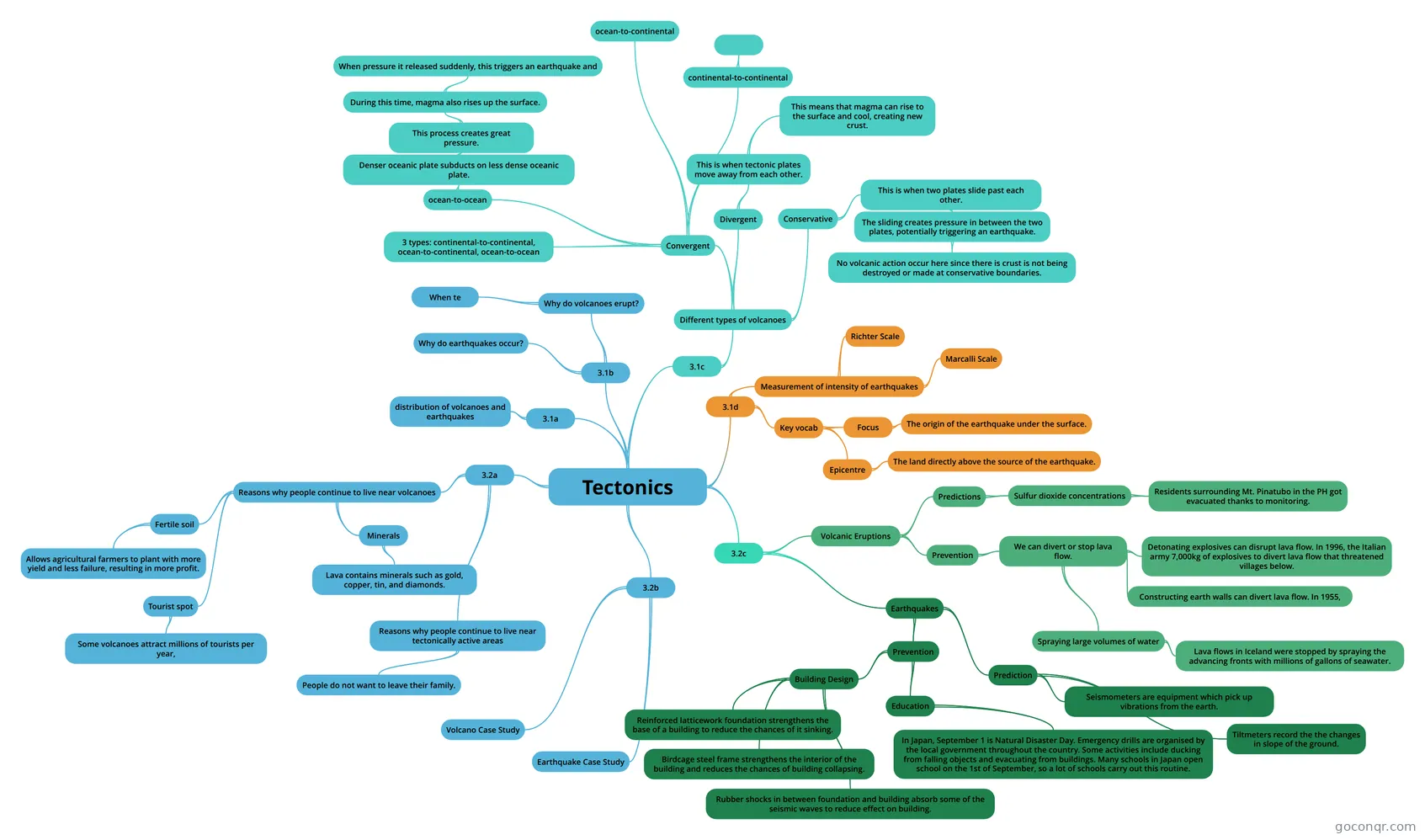
Mind map: Tectonics
Inhalt der Mindmap
Tectonics
3.1a
- distribution of volcanoes and earthquakes
3.1b
- Why do earthquakes occur?
- Why do volcanoes erupt?
- When te
3.1c
- Different types of volcanoes
- Convergent
- 3 types: continental-to-continental, ocean-to-continental, ocean-to-ocean
- ocean-to-ocean
- Denser oceanic plate subducts on less dense oceanic plate.
- This process creates great pressure.
- During this time, magma also rises up the surface.
- When pressure it released suddenly, this triggers an earthquake and
- During this time, magma also rises up the surface.
- This process creates great pressure.
- Denser oceanic plate subducts on less dense oceanic plate.
- continental-to-continental
- ocean-to-continental
- Divergent
- This is when tectonic plates move away from each other.
- This means that magma can rise to the surface and cool, creating new crust.
- This is when tectonic plates move away from each other.
- Conservative
- This is when two plates slide past each other.
- The sliding creates pressure in between the two plates, potentially triggering an earthquake.
- No volcanic action occur here since there is crust is not being destroyed or made at conservative boundaries.
- The sliding creates pressure in between the two plates, potentially triggering an earthquake.
- This is when two plates slide past each other.
- Convergent
- Different types of volcanoes
3.1d
- Measurement of intensity of earthquakes
- Richter Scale
- Marcalli Scale
- Key vocab
- Focus
- The origin of the earthquake under the surface.
- Epicentre
- The land directly above the source of the earthquake.
- Focus
- Measurement of intensity of earthquakes
3.2a
- Reasons why people continue to live near volcanoes
- Fertile soil
- Allows agricultural farmers to plant with more yield and less failure, resulting in more profit.
- Tourist spot
- Some volcanoes attract millions of tourists per year,
- Minerals
- Lava contains minerals such as gold, copper, tin, and diamonds.
- Fertile soil
- Reasons why people continue to live near tectonically active areas
- People do not want to leave their family.
- Reasons why people continue to live near volcanoes
3.2b
- Volcano Case Study
- Earthquake Case Study
3.2c
- Volcanic Eruptions
- Predictions
- Sulfur dioxide concentrations
- Residents surrounding Mt. Pinatubo in the PH got evacuated thanks to monitoring.
- Sulfur dioxide concentrations
- Prevention
- We can divert or stop lava flow.
- Detonating explosives can disrupt lava flow. In 1996, the Italian army 7,000kg of explosives to divert lava flow that threatened villages below.
- Constructing earth walls can divert lava flow. In 1955,
- Spraying large volumes of water
- Lava flows in Iceland were stopped by spraying the advancing fronts with millions of gallons of seawater.
- We can divert or stop lava flow.
- Predictions
- Earthquakes
- Prediction
- Seismometers are equipment which pick up vibrations from the earth.
- Tiltmeters record the the changes in slope of the ground.
- Prevention
- Building Design
- Reinforced latticework foundation strengthens the base of a building to reduce the chances of it sinking.
- Birdcage steel frame strengthens the interior of the building and reduces the chances of building collapsing.
- Rubber shocks in between foundation and building absorb some of the seismic waves to reduce effect on building.
- Education
- In Japan, September 1 is Natural Disaster Day. Emergency drills are organised by the local government throughout the country. Some activities include ducking from falling objects and evacuating from buildings. Many schools in Japan open school on the 1st of September, so a lot of schools carry out this routine.
- Building Design
- Prediction
- Volcanic Eruptions
Informationen
- Beschreibung
- GCSE Geography (Unit 2) Mindmap am Tectonics, erstellt von Aaron . am 05/06/2017.
- Erstellt von
- Aaron .
- Aufrufe
- 2
- Bewertung