
Notizen
Chapter 35
Inhalt der Notizen (1)
Seite 1
Chapter 35: Plant Form and Function
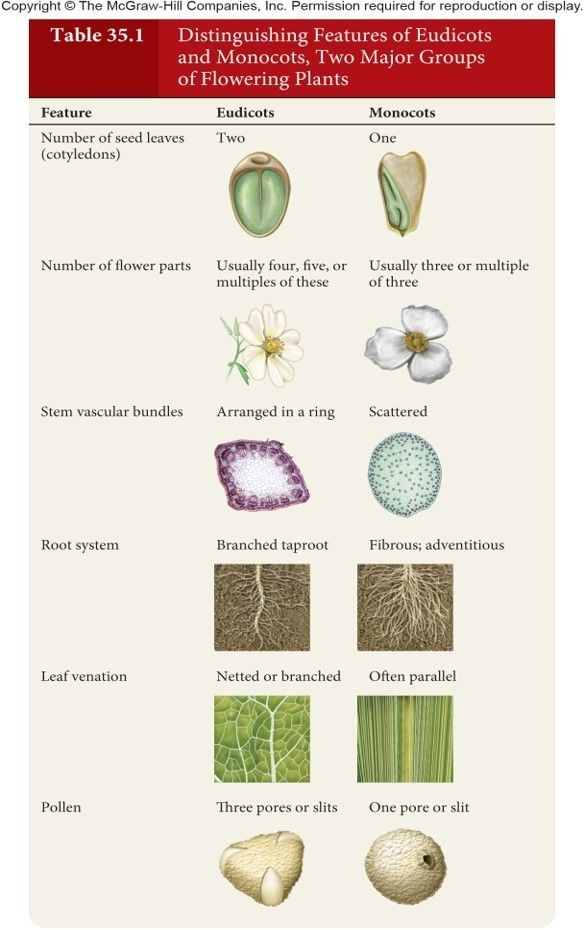
A. Cotyledon
i. Seed leaf
ii. Monocots
a. One seed leaf
b. Parallel veins in leaf
c. Scattered vascular bundles in stem
d. Fibrous root systems (usually)
e. Flower parts in 3’s
iii. Eudicots
a. Twos seed leaves
b. Veins usually net-like
c. Vascular bundles arranged in a ring
d. Taproot usually present
e. Flower parts in 4’s and 5’s
B. Root systems
i. Taproot: a long vertical root with smaller lateral roots
ii. Some roots are modified to store food in the form of starch (exp: carrots)
iii. Fibrous root system: an extensive network of roots that do not penetrate very deeply into the ground
iv. The tips of roots care covered with root hairs
a. Root hairs are where most water and minerals are absorbed
v. Adventitious roots
a. Prop roots
b. Extend above ground and give plants additional support
c. Examples: buttress roots and pneumatophores
C. Shoot system
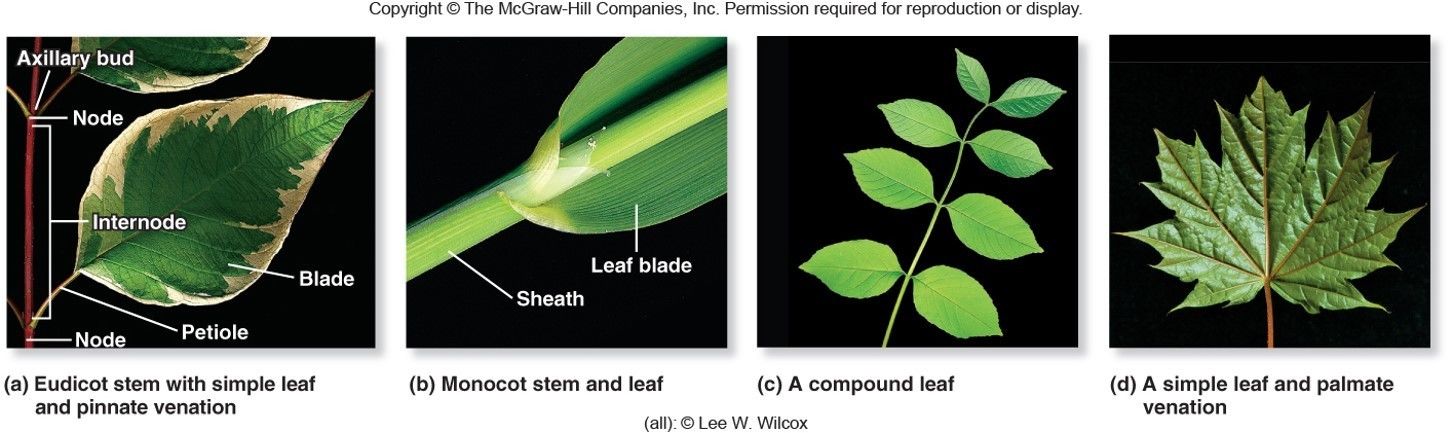
i. Stems are divided up into nodes and internodes
ii. Nodes: the point at which leaves are attached
iii. Internodes: between nodes
iv. Axillary buds: located at the intersection of the stem and leaf
v. Terminal (apical) buds: located at the tip of a growing stem
vi. Vascular bundles: comprised of xylem and phloem
vii. Cortex: the outer layer of the eudicot stem
viii. Pith: the central layer of the eudicot stem
D. Modified stems
i. Stolons: horizontal stems that allow plants to spread over a large area
ii. Rhizomes: horizontal underground stems
iii. Tubers: ends of rhizomes modified for food storage
iv. Bulbs: vertical underground stem s
v. Corms: short, swollen stems
vi. Thorns
E. Leaves
i. Consist of a flattened blade and a petiole: a stalk (the petiole may not be present)
ii. Simples leaves: a single individual leaf
iii. Compound leaves: divided into many leaflets
iv. Modified leaves
a. Tendrils, cactus spines, succulent leaves, brightly colored pastal-like leaves (bracts) and bud scaled, and flower parts
F. Plant tissues
i. Parenchyma
a. Relatively undifferentiated cells
b. Involved in metabolic functions
ii. Collenchyma
a. Provides support for the growing portion of a plant
iii. Sclerenchyma cells
a. Provides support
b. Contains lignin
iv. Xylem: consist of two or more cells, tracheids, and vessel elements
a. These are dead when fully functional
b. Consists of fibers
v. Phloem: consist of living sieve-tube elements (members)
a. Special cells that lack many organelles
G. Plant growth
i. Annuals: plants that live 1 year
ii. Perennials: plants that live more than 1 year
iii. Biennials: live 2 years; growth first year; flower 2nd year
iv. Meristems (growing tissue)
a. Apical (primary) meristem: on tops of roots and shoots
b. Lateral (secondary) meristem: along the sides of roots and shoots
v. Primary growth
a. Primary growth produces the primary plant body consisting of three tissues: dermal, vascular, and ground tissue
1. Allows for extension of the roots and shoots of a plant
b. The root had a root cap to protect the growth meristem
1. The root has 3 zones of growth:
-Meristem and root cap
-Zone of elongation
-Zone of maturation
2. The root has 3 layers:
-Epidermis: an outer layer
-Cortex: middle
-Root core: inner layer
-Xylem and phloem develop in the root core
vi. Secondary growth
a. Secondary growth allows for the increase in the diameter of the plant
1. Produces key constituents of wood and bark
b. Vascular cambium
1. Forms secondary tissue
2. Produces secondary xylem to the inside and secondary phloem to the outside
3. Fully formed secondary xylem is dead and it forms wood
4. Rings are formed by the season growth of vascular cambium
c. Cork cambium
1.A secondary tissue that replaces the epidermis on a stem
2. It forms the outer layer of bark (the cork)