
Notizen
Sola Scriptura Notes

Inhalt der Notizen (4)
Seite 1
The Concept of Sola Scriptura and the Church’s stand on it
All Christian denominations share many common beliefs like the Holy Trinity, the Incarnation, human and divine nature of Jesus Christ, the Second Coming and the Kingdom of God. However, there are many issues over which there is a continuing debate like the infant baptism and the ‘co-existence’ of human and divine nature in Jesus Christ. Another issue that is the basis of lack of doctrinal unity among Christian denominations is the principle of ‘Sola Scriptura’. This essay will examine Sola Scriptura in further detail and our Church’s position on this principle.
Sola Scriptura (by Scripture alone), is a Christian doctrine followed by some Christian denominations that the Bible is the supreme authority in all matters of faith and morals. According to this belief, the Bible contains all the knowledge necessary for salvation and holiness, nothing else should be used or supplemented with it. The passage that is most often cited as a proof text that supports sola scriptura is 2 Timothy 3:17 ‘All Scripture is God-breathed and is useful for teaching, rebuking, correcting and training in righteousness’. Sola Scriptura contains two important facets
That the Bible is the sole source of God’s revelation
Affirms that there is no church authority empowered to interpret the meaning of Scripture.
Seite 2
Our Church, along with most of the Apostolic Churches, does not agree with the theory of Sola Scriptura and also highlights the danger of this type of practice and teaching. The above-mentioned positions by the supporters of Sola Scriptura create insurmountable difficulties in sustaining the Christian tradition.
Sola Scriptura viewpoint ignores the evidence that Bible, as we now have it, did not exist for over three hundred years. The Bible was compiled based on the decisions taken in Council of Carthage (AD 397).
Sola Scriptura ignores the superabundance of historical evidence that early Church relied on Apostolic Traditions in resolving doctrinal disputes, not Scripture alone. The Nicene Creed (AD 325) itself was composed before the Bible the compiled.
Above are some historical pieces of evidence that the Church was not established on the basis of Bible, but later Church introduced the Bible for its own purpose, practices and teachings. In other words, these evidence tell the tradition is ancient than written Gospels.
Seite 3
Furthermore, there are multiple pieces of evidence in Bible itself stating that Scripture is not complete. Apostle John concludes his Gospel (John 21: 24-25) “This is the disciple who testifies to these things and who wrote them down. We know that his testimony is true. Jesus did many other things as well. If every one of them were written down, I suppose that even the whole world would not have room for the books that would be written. “. There is further evidence from St. Luke, letters of St. Paul and Acts that Bible was written based on what was heard or told by others or for passing on the teachings to others.
Another vital issue with Sola Scriptura is the interpretation. Sola Scriptura asserts that the Holy Spirit guides the Christian incorrectly interpreting the word of God in matters essential to the faith. Or Sola Scriptura rejects any original infallible authority, other than Bible. It may be noted that Jesus was opposing the misleading interpretations of Moses’ traditions by the Pharisees, but never taught against Moses’ traditions. St. Paul and St. Peter were criticizing Jewish traditions. When Scripture is seen as the only source of infallible teaching, its interpretation is subject to fallible interpretation, and without an infallible interpreter, a certainty of Christian belief is not possible.
Seite 4
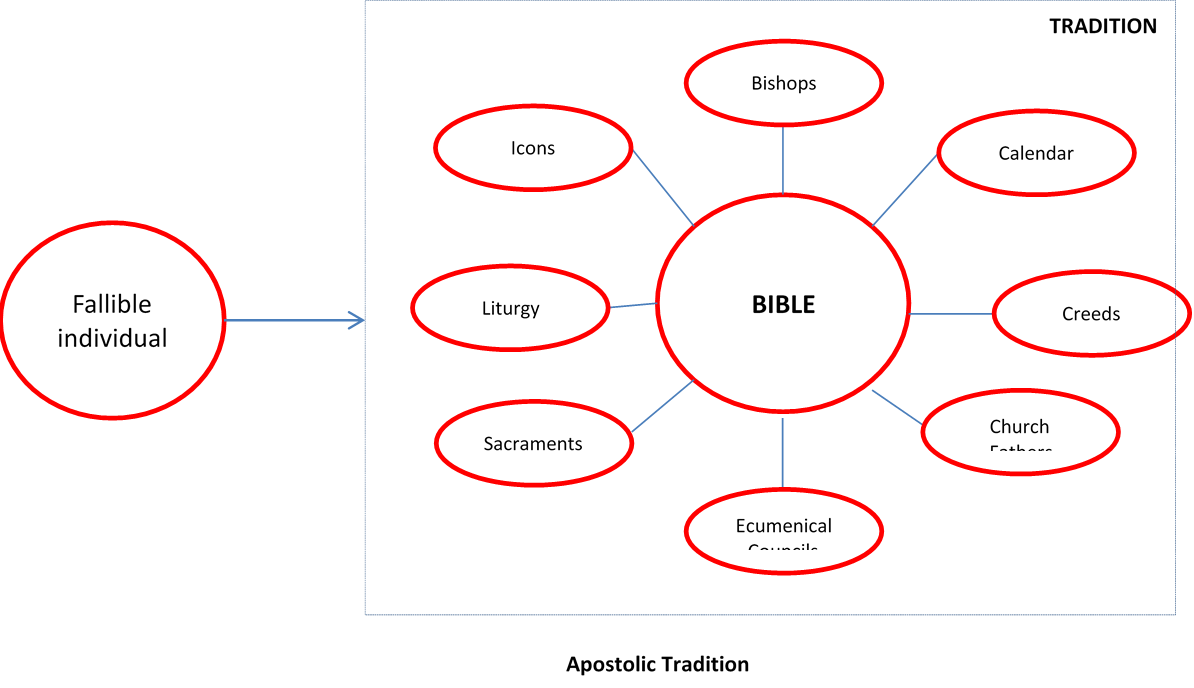
The arguments against Sola Scriptura do not, in any means, degrade the dignity or holiness of the Holy Bible. In fact, the issue is only in ‘Sola’ (one) and not ‘Scriptura’. While the Sola Scriptura advocates Bible as the sole source of faith and practice, for the Orthodox Church the source of faith and practice is Tradition which consists of the Bible, the Liturgy, the Sacraments, the Ecumenical Councils, and the Church Fathers all of which taken together form an interlocking and internally consistent matrix. In that way, the Syrian Orthodox Church is truly apostolic and the Bible is an essential part of its rich tradition.
Informationen
- Beschreibung
- 10th grade Theology Notiz am Sola Scriptura Notes, erstellt von Biju George am 03/09/2019.
- Erstellt von
- Biju George
- Aufrufe
- 8
- Bewertung