
Notizen
Chapter 8
Inhalt der Notizen (1)
Seite 1
8.1New Product Development Strategy
A firm can obtain products in 2 ways:
acquisition: buying a whole company, a patent, or a license to produce someone else's product
New Product Development: Developing new products through the firm’s own research and development efforts
Creating successful new products requires:
Understanding consumers, markets, and competitors
Developing products that deliver superior value to customers
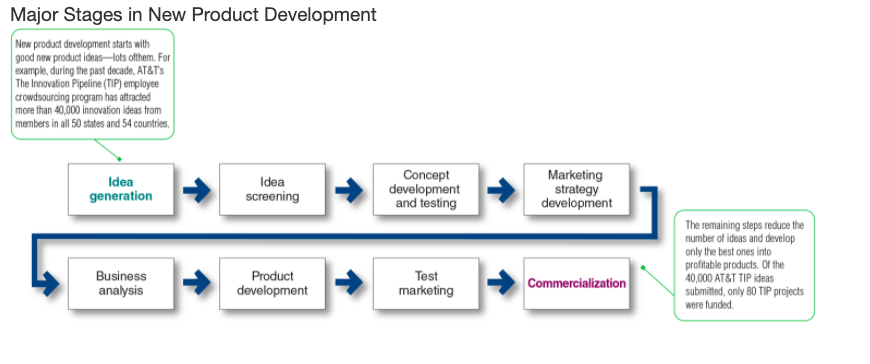
8.2 The New Product Development Process
Step 1: Idea Generation: they systematic research for new product ideas
Internal idea sources:
Internal social networks: R&D
Intrapreneurial programs: encourage employees to develop new product ideas
External idea sources:
Customers: find products that better solve problems
Competitors: clues about new products
Distributors and suppliers: contribute ideas
crowdsourcing: Inviting broad communities of people into the new product innovation process
Step 2 Idea Screening: helps spot good ideas and drop bad ones as soon as possible; its goal is to reduce number of ideas
Ways of screening new ideas:
New idea write-up reviewed by a committee
R-W-W framework–is it REAL?, can we WIN? is it WORTH DOING?
Step 3 concept development: Developing a new product into alternative product concepts
product concept: a detailed version of the new product idea stated in meaningful consumer terms
Find out how attractive each concept is to customers
Choose the best one
Step 3 (cont.) concept testing: Testing new product concepts with groups of target consumers
Presenting the concepts to consumers symbolically or physically
Asking customers to respond by answering questions about their reactions to the concepts
Step 4 Marketing Strategy Development: designing an initial marketing strategy for introducing this car to the market
The marketing strategy statement: consists of three parts:
describes the target market, value proposition, sales, market share, profit goals
outlines product's planned price, distribution and marketing budget for first year
describes the planned, long-run sales, profit goals, and marketing mix strategy
Step 5 Business Analysis: A review of the sales, costs, and profit projections for a new product
used to find out whether these factors satisfy the company’s objectives
Step 6 Product Development: Developing the product concept into a physical product
To ensure that the product idea can be turned into a workable market offering
Step 7 Test Marketing: the stage of new-product development in which the product and marketing program are tested in realistic market settings.
Introduces the product and its proposed marketing program into realistic market settings
Gives the marketer experience with marketing a product before the full introduction
Tests the product and its marketing program
Testing takes time, and costs can be high
Test marketing is appropriate when a large investment is required, when the risk is high, or when management is not sure of the product or marketing program.
Step 8 Commercialization: introducing a new product into the market.
Must decide on timing (i.e., when to introduce the product).
Must decide on where to introduce the product (e.g., single location, state, region, nationally, internationally).
Must develop a market rollout plan
Managing a new Product Development: focuses on finding new ways to solve customer problems and create more satisfying customer experiences.
Team-Based New-Product Development: An approach to developing new products in which various company departments work closely together, overlapping the steps in the product development process to save time and increase the effectiveness.
8.3 Product Life Cycle Strategies
Product life cycle (PLC): the course that a product's sales and profits take over its life time.
5 PLC Stages:
Product development begins when the company finds and develops a new product idea. sales are zero and the company's investment costs mount.
Introduction is a period of slow sales growth as the product is introduced in the market. Profits are nonexistent because of the heavy expenses of product introduction.
Growth is a period of rapid market acceptance and increasing profits.
Maturity is a period of slowdown in sales growth because the product has achieved acceptance by most potential buyers. Profits level off or decline because of increased marketing outlays to defend the product against the competition.
Decline is the period when sales fall off and profits drop.
PLC can also be applied to Style, Fashions, and Fads
style: A style is a basic and distinctive mode of expression. ex colonial homes, abstract art.
fashion: a currently accepted or popular style in a given field. ex clothes. whats popular dies. not always gonna be around like style.
Fads: temporary periods of unusually high sales driven by consumer enthusiasm and immediate product or brand popularity. Really popular then dies really really fast.
Informationen
- Beschreibung
- Notiz am Chapter 8 , erstellt von shannon coyne am 03/10/2020.
- Erstellt von
- shannon coyne
- Aufrufe
- 0
- Bewertung