
Notizen
Populations in Transition
Inhalt der Notizen (1)
Seite 1
Explain population trends and patterns in births (Crude Birth Rate), natural increase and mortality (Crude Death Rate, infant and child mortality rates), fertility and life expectancy in contrasting regions of the world
- Crude birth rate : the number of births per 1000 population in a given year
- Crude death rate : the number of deaths per 1000 population in a given year
- Natural increase : when the numbers of births is higher than the number of deaths
- Natural decrease : when the numbers of births is lower than the number of deaths
- Fertility rate : the number of live births per 1000 women aged 15-49 in a given year
- Life expectancy (E0) : average number of years that a person can be expected to live, usually from birth, if demographic factors remain unchanged
High birth rate:
- Lack of contraception e.g. condoms
- Religious beliefs e.g. belief against contraception and abortion (Roman Catholicism)
- Agricultural based society (need for people to farm and collect water)
- High infant mortality (if some babies may die, couples will be tempted to have more children)
- No care homes or pensions so old dependents will need their children to care for them in old age.
- Pro-natalist policies (governments encouraging couples to have more children)
Low birth rate:
- Availability and affordability of contraception e.g. cheap or free condoms
- Emancipation (freedom) of women (freedom to get an education and work)
- Improved levels of education (especially female)
- Reduced infant mortality
- Introduction of pensions and care homes
- Development of economy into secondary and tertiary sectors
- Increasing cost of children
- Delayed marriages and less children
- Anti-natalist policies e.g. China's one child policy
- High cost of raising children
High death rate:
- Natural disasters (often only causes short term increases) e.g. Indian Ocean tsunami
- Conflicts and wars
- Poor medical care
- Poor hygiene and sanitation
- Poor diet (might be a shortage of food or unhealthy food)
- Drinking alcohol, smoking or taking drugs
- Lack of exercise (sedentary lifestyle)
- Shortage of clean water
- Diseases e.g. cancer and AIDS
Low death rate:
- Immunisation programs e.g. small pox
- Availability of clean water
- Improved diet and knowledge of diet e.g. five portions of fruit and diet
- Improved levels of exercise
- Improved medical care
- Improved preventative testing e.g. for cancer so people can be treated before it kills them
Explain population momentum and its impact on population projections
Population momentum is the tendency for a population to grow despite a fall in birth rate or fertility levels.
- It occurs because of a relatively high concentration of people in the pre-childbearing and childbearing years.
- As these people grow older and move through reproductive ages, the more the number of births will exceed the number of deaths in the older populations, and so the population will continue to grow.
Population projections are predictions about future population based on trends in fertility, mortality and migration.
Examine the impacts of youthful and ageing populations
The Causes of an ageing populations
High life expectancy caused by:
- Good medical care
- Good diet and improved water supply
- Good sanitation and hygiene
-Low birth rates caused by:
-Emancipation of women
-Cost of children
-Emigration of economically active
Advantages of an ageing population
- Elderly people have a lot of experience and can be valuable in the workplace
- Less money spent on schooling and natal medical care
- Lower crime rates and less money needed to be spent on policing
Problems of an ageing population
- Shortage of economically active population
- Reduced taxation income for the government
- Cost of providing healthcare and care homes (elderly tend to get sick more frequently)
- Reduced spending on education, policing, transport network, etc.
- Cost of paying for pensions
- Service decline (schools, sports centres, etc. not used by older residents)
Solutions to an ageing population
- Pro-natalist policies (see below - Singapore)
- Increased immigration of economically active
- Increased retirement age
- Private pensions
- Private healthcare
- Increased taxes of economically active
Pro-natalist Policy: A policy that encourages couples to have more children. You can not force people to have more children so you have to offer incentives instead e.g. free childcare or even money
Governments may have a pro-natalist policy if they have a declining population and a shortage of young dependents (low birth rates and fertility rates). A government can't force couples to have more children, so instead it must offer incentives. Incentives may include:
- Cash payments
- Free or subsidised healthcare
-Free or subsidised education
-Free nurseries or subsidised childcare.
-Reduced tax rates
-Child benefits e.g. weekly or monthly payments
-Free equipment e.g. pushchairs, cots or even washing machines
- Poster and advertising campaigns
Case study: pro-natalist policy in FranceMany areas of Europe have a low fertility rate because of the following reasons:
- education - people are more aware of the availability of contraception and consequences an unplanned pregnancy can have on their career
- women in careers - Women may choose to follow their career choice rather than start a family while young
- later marriages
- state benefits - couples no longer need children to help care for them when older
France was a country with concerns that professional women were choosing not to have children. The government were worried that the population was not going to replace itself over time.
The policies that were put in place to encourage three-children families were:
- a cash incentive of £675 monthly (nearly the minimum wage) for a mother to stay off work for one year following the birth of her third child
- the 'carte famille nombreuse' (large family card), giving large reductions on train fares
- income tax based on the more children the less tax to pay
- three years paid parental leave, which can be used by mothers or fathers
- government subsidised daycare for children under the age of three, and full time school places for over threes paid for by the government
This has resulted in mothers considering having children and remaining in work. The fertility rate in France is one of Europe's highest.
Discuss the causes of migrations, both forced and voluntary
People migrate for many different reasons. These reasons can be classified as economic, social, political or environmental:
- economic migration - moving to find work or follow a particular career path
- social migration - moving somewhere for a better quality of life or to be closer to family or friends
- political migration - moving to escape political persecution or war
- environmental causes of migration include natural disasters such as flooding
Some people choose to migrate, eg someone who moves to another country to enhance their career opportunities. Some people are forced to migrate, eg someone who moves due to war or famine.
A refugee is someone who has left their home and does not have a new home to go to. Often refugees do not carry many possessions with them and do not have a clear idea of where they may finally settle.
Examine gender inequalities in culture, status, education, birth ratios, health, employment, empowerment, life expectancy, family size, migration, legal rights and land tenure
- Gender-related Development Index (GDI): measures inequality between the sexes in life expectancy, education and the standard of living
- Cultural preference for sons: girls receive less nutritious food and less medical care
- Pregnant women that are undernourished will have low-weight babies and undernourished children
- Half of international migrants are women, most of them work in "sweatshops"
- Working women are increasingly becoming unionized
- Formal law, traditional legal systems and societal norms, including customary and religious laws, often deny women in the right to acquire and inherit property, particularly in countries where Shariah law applies
Tenure - the way in which the rights. restrictions and responsibilities that people have with respect to land (and property) are held
Explain dependency and ageing ratios
- Dependency Ratio: The ratio between the amount of dependents (old and young) and the economically active
- Young Dependents: The number or the percentage of the population under the age of 16.
- Old Dependents: The number or the percentage of the population over the age of 65.
- Economically Active: People between the ages of 16 and 65. This is basically the working group.
Advantages of youthful population
- Large potential workforce
- Lower medical costs
- Attractive to new investment
- Source of new innovation and ideas
- Large potential market for selected goods
- Development of services such as schools
Disadvantages of youthful population
- Cost of supporting schools and clinics
- Need to provide sufficient food, housing and water to a growing population, e.g. Rio de Janeiro
- High rates of unemployment
- Large numbers living in poor quality housing, e.g. in shanty towns
- High rates of population growth
- High crime rates
Solutions
- An anti-natalist policy might be introduced like China's one child policy.
- Increase family planning. Make contraception available and affordable
- Ensure females are educated and emancipated
Evaluate examples of a pro-natalist policy and an anti-natalist policy
Carrying Capacity: The amount of people that the resources of a country can support. The carrying capacity of a country can change with improvements in technology e.g. desalination, discoveries of new resources, or the loss of existing resources e.g. volcanic eruption destroying farm land
Anti-natalist policy: A policy that attempts to reduce birth rates. This might be through better education and supply of contraception or through much stricter policies like China's one child policy
Case study: China
The one-child policy, established in 1979, meant that each couple was allowed just one child. Benefits included increased access to education for all, plus childcare and healthcare offered to families that followed this rule.
Problems with enforcing the policy: - Those who had more than one child didn't receive these benefits and were fined.
- The policy was keenly resisted in rural areas, where it was traditional to have large families.
- In urban areas, the policy has been enforced strictly but remote rural areas have been harder to control.
- Many people claim that some women, who became pregnant after they had already had a child, were forced to have an abortion and many women were forcibly sterilised. There appears to be evidence to back up these claims.
Impact of the policy
- The birth rate in China has fallen since 1979, and the rate of population growth is now 0.7 per cent.
- There have been negative impacts too - due to a traditional preference for boys, large numbers of female babies have ended up homeless or in orphanages, and in some cases killed. In 2000, it was reported that 90 per cent of foetuses aborted in China were female.
- As a result, the gender balance of the Chinese population has become distorted. Today it is thought that men outnumber women by more than 60 million.
Long term implications
China's one-child policy has been somewhat relaxed in recent years. Couples can now apply to have a second child if their first child is a girl, or if both parents are themselves only-children.
While China's population is now rising more slowly, it still has a very large total population (1.3 billion in 2008) and China faces new problems, including:
- the falling birth rate - leading to a rise in the relative number of elderly people
fewer people of working age to support the growing number of elderly dependents - in the future China could have an ageing population
Evaluate internal (national) and international migrations in terms of their geographic (socio-economic, political and environmental) impacts at their origins and destinations
Impacts on source area
Positive impacts
- Population pressure reduced (e.g. Ireland during the 1950s and 1960s)
- Remittances sent home (e.g. labour migrants from Malawi and Lesotho in South Africa)
Negative impacts
- Removal of younger, more educated people (e.g. Indian software experts to the USA)
- Decline in local market/pulling power (e.g. southern Italy)
- Reduced workforce (e.g. Swaziland migrants moving to South Africa)
- Reduced purchasing power/smaller market (e.g. rural Ireland in the 1950s and 1960s)
- Closure of local services such as schools, hospitals (e.g. following the expansion of Uganda Asians to the UK in 1973)
Impacts on destination
Positive impacts
- Population growth (e.g. Turks to West Germany in the 1970s and Portugese to Switzerland)
- Larger workforce (e.g. the USA)
- Increased demand for services (e.g. the M4 corridor in the UK)
- Increased demand for housing (e.g. Silicon Valley in Califormia)
- New industry and investment attracted to the area
- New skilled, young workforce (e.g. Italians in Bedford in the 1950s)
- Multicultural enrichment (e.g. Toronto, Canada)
Negative impacts
- Racism and segregation (e.g. Los Angeles, USA)
- Cultural disharmony (e.g. Bradford and Oldham, UK)
- Overcrowding and ghettoization (e.g. blacks in NY)
- Spread of diseases (e.g. flu to Amazonian tribes or those of Easter Island)
The global population is changing. These changes present governments and global organisations with challenges. Governments can try to influence people's choice regarding the number of children a family has but that they are often unsuccessful.
To what extent does the global population need to be controlled?
What factors influence family size?
Patterns and Change
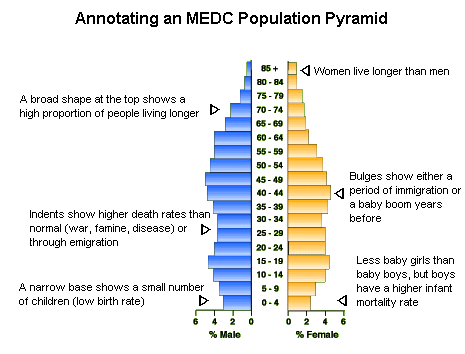
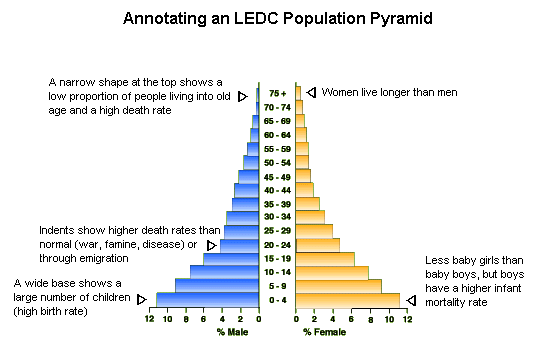
Analyse population pyramids
EXPANSIVE population pyramids show larger numbers or percentages of the population in the younger age groups. These types of pyramids are usually found in populations with very large fertility rates and lower than average life expectancies. The age-sex distributions of many Third World countries would probably display expansive population pyramids.
CONSTRICTIVE population pyramids display lower numbers or percentages of younger people. The age-sex distributions of the United States fall into this type of pyramid.
STATIONARY or near-stationary population pyramids display somewhat equal numbers or percentages for almost all age groups. Of course, smaller figures are still to be expected at the oldest age groups. The age-sex distributions of some European countries, especially Scandinavian ones, will tend to fall into this category.
Informationen
- Beschreibung
- IB Geography Notiz am Populations in Transition, erstellt von fuzziihead am 16/05/2015.
- Erstellt von
- fuzziihead
- Aufrufe
- 9
- Bewertung