
Notizen
Anatomy and Physiology
Inhalt der Notizen (6)
Seite 1
Vocabulary
Anatomy: Study of structure and relationship between body parts Anatomy: Study of structure and relationship between body parts
Physiology: Study of how those structures work together to keep you alive Physiology: Study of how those structures work together to keep you alive
Homeostasis: Balance of materials and energy that keep you alive
Everyone's cause of death is caused by an extreme and irreversible loss of homeostasis
Histology: Study of tissue Histology: Study of tissue
Seite 2
4 Primary Tissue Types
Nervous Tissue: Provides us with control and communication
Muscle Tissue: Provides movement
Epithelial Tissue: Cover and protect the body
Connective Tissue: Provides support
Seite 3
Nervous tissue
Sensing and responding to stimuli
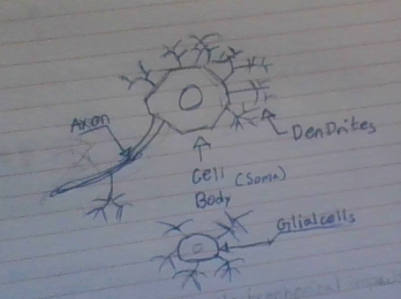
Made of two different cells-Neurons and Glial Cells
Muscles tissues
Can contract and move
3 types of Muscle Tissue
Skeletal: voluntary (think to move)- I.e. leg muscles
Cardiac: involuntary (Moves by itself) found only in the heart
Smooth: involuntary found in the digestive system
Epithelial Tissue
Covers and protects your body
Avascular- doesn't have a blood supply and relies on connective tissue
The name of the tissue is by the types of tissue and how it is layered ( I.e. Stratified squamous)
All Epithelial cells are POLAR i.e. they have distinct sides
2 types of Epithelial Tissue
Proper Epithelium-Covers and lines your inner and outer body and lines body cavities i.e. pelvic cavity
Glandular Epithelium- forms your glands and secretes hormones
Seite 4
Epithelial Tissue Continued
3 types of Cells
SQUAMOUS cells (flattened shape and flat nucleus, fast absorption and diffusion, making thin membranes).
CUBOIDAL cells (spherical nucleus, cuboidal cell shape, absorb nutrients and produce secretions like sweat).
COLUMNAR cells (Elliptical nucleus, column-shaped cell with hexagonal cross-section, tall, thick & cushion underlying tissues, absorb nutrients and produce secretions).
TYPES OF LAYERING
SIMPLE EPITHELIUM: one layer of cells.
STRATIFIED: Multiple layers set up on top of each other, like bricks.
PSEUDOSTRATIFIED: Mostly one layer but formed with cells of different shapes and sizes. The cell's nuclei can be at a lot of different levels (i.e. they don't lie on the same plane- different heights). So it looks like multi-layered.
GLANDULAR EPITHELIUM
Forms two different types of glands:
ENDOCRINE glands (secrete hormones directly into the bloodstream or to nearby cells)
EXOCRINE glands (secrete their juices into tubes or ducts that lead to the outside of the body
Seite 5
Connective tissue
Function: supporting organs and cells, transporting nutrients and wastes, defending against pathogens, storing fat, and repairing damaged tissues
All come from Mesenchyme- An embryotic tissue that can be formed anyway and can move
Different degrees of Blood flow ex. Cartilage has no blood vessels and connective tissue in your skin has lots of blood vessels
Most connective tissue is made of nonliving Materials called extracellular Matrix which is made of 2 components- ground substance (rubbery unstructured material that fills in the gaps in between cells and protects them) and fibers which provide support to the ground substance and has different types collagen fibers- the strongest and most abundant type, elastic fibers- longer and thinner and form the framework of the matrix made of elastin protein, reticular fibers with an extra coating of glycoprotein and cradle and support your organs like nets
4 types of Connective tissue
Proper
Made Loose and Dense
Loose Connective tissue
Areolar (most common type of Connective tissue)
Reticular fiber (like Areolar but made of reticular fibers provides the soft framework many organs)
Adipose (fat made mostly of cells called adipocytes
Loose Connective tissue have lots of ground substance. the elastin helps skin come back to place while collagen helps anchor
Dense Connective Tissue
Regular ( great for handling force when force is going in one direction it is in you ligaments and joints
Irregular (great for handling force when it in going all different direction it is in your dermis under you skin
Elastic (great for your joints and here you want to be flexible it is your spine)
Dense Connective tissue have lots collagen which makes it hard to chew and very stiff
Cartilage
does not have any blood and nerves
it can stand against tension and compression
Made of 3 different types
Hyaline (clear/glasslike tissue and adds support it is in your ribcage and sternum and in your nose)
Elastic l(like Hyaline but more elastin fibers base of your outer ear)
Fibro(acts like a shock-absorber and in the disks in your spine
Bone
Spongy (it in the heads of long bones and in the inner layer of flat bones like sternum strong bot porous and makes and stores bone marrow
Compact (dense with no visible holes forms the external layer of bones)
Blood
main job is to transport stuff to parts of your body
Cell Types
Immature
All immature cells end with the suffix -blast
All Immature cells are stem cells
Secrete ground substance and fibers to make the matrix
Mature
Immature cells turn into mature cells and now with -cyte
maintain the health of the matrix sometimes can change back to immature to fix damages
Immune cells
Macrophages
Leukocytes
Seite 6
THE INTEGUMENTARY SYSTEM
Skin
the skin has 3 layers
Epidermis
The only layer you can see and is made of stratified squamous tissue
most of your Epidermis is made of keratinocytes which make keratin
Dermis
Does most of the work (feeling thing and circulation of blood
Hypodermis
Made of fat tissue acts like a cushion
Informationen
- Beschreibung
- 6th grade Science (Anatomy and Physiology) Notiz am Anatomy and Physiology , erstellt von Roshan C am 02/04/2024.
- Erstellt von
- Roshan C
- Aufrufe
- 4
- Bewertung