
Notizen
P1 - created from Mind Map
Inhalt der Notizen (1)
Seite 1
Heating Houses
Energy flow
Measuring temperature
Specific heat capacity
Specific latent heat
Energy flows from a warmer to a colder body. When energy flows away from a warm object, the temperature decreases
A thermogram uses colour to show temperature; hottest: white/yellow coldest:black/dark blue/purple.
Temperature is a measurement of hotness on a arbitary scale.
When the temperature of a body increases, the average kinetic energy of the particles increases
Heat is a measurement of internal energy, it is measured on an absolute scale.
Energy needed to raise the temperature of 1kg by 1 degree c
Measured in Joules per kg degree celsius j/kgoc
energy transferred = mass x specific heat capacity x temperature change
Energy needed to melt or boil 1kg of the material
Measured in Joules per kilogram J/kg
energy transferred = mass x specific latent heat
When a substance changes state, energy is need to break the bonds that hold the molecules together. This explains why there's no change in temperature.
Keeping homes warm
Practical insulation
Conduction, convection and radiation
Energy efficiency
Double Glazing - Reduces energy loss by conduction. Gap between 2 pieces if filled with gas/contains a vaccum. Particles in a gas are far apart, it's very difficult to transfer energy
Loft insulation - reduces energy loss by conduction and convection. - Warm air rises - Energy is transferred through ceiling by conduction - Air in loft is warmed and trapped by insulation, both sides are same temp so no energy is transferred
Cavity wall- reduces energy loss by conduction and convection. Air in foam is good insulator, and the air can't move because it's caught in the foam
Insulation blocks- used to build new homes, shiny foil on both sides to reduce radiation; - energy from sun is reflected to keep the home cool in summer, energy from home is reflected back to keep home warm in winter
Conduction - due to the transfer of kinetic energy between particles
Convection - Gas expands when it's heated. Less dense, so rises. Density = kg/m3
Radiation doe not need a material to transfer energy. Energy can be transferred through a vaccum
Density = mass / volume
efficiency = useful energy output (x100%) / total energy input
Energy from home is lost to the environment
Different types of insulation cost different amounts and save different amounts of energy
Payback time = cost of insulation /annual saving
Buildings that are energy efficient are well insulated; little energy is lost to the surroundings
Designers and architects have to make sure that little energy is lost
Spectrum of waves
Wave properties
Getting messages across
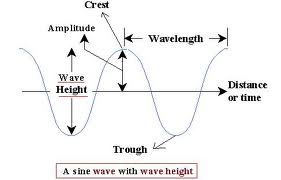
Amplitude - Maximum displacement of a particle from its rest position
Crest - Highest point
Trough - Lowest point
Wavelength - distance between two successive points having same displacement
Frequency - Number of complete waves passing a point in one second
wave speed - frequency x wavelength
Some optical instruments such as periscope use two or more plane mirrors
Refraction occurs because speed of waves decreases as wave enters a more dense medium and increases as the wave enters a less dense medium. Freq stays same but wavelength changes
Diffraction is the spreading out of a wave as it passes through a gap
Size of communications receiver depends on wavelength of radiation
Amount of diffraction depends on size of gap; the most diffraction occurs when the gap is a similar size to wavelengths. Effects are noticeable in telescopes and microscopes
Light and lasers
Morse code
Sending signals
Laser light
Critical angle
Endoscopy
Uses a series of dots and dashes to represent the alphabet. Used by signalling lamps as series of short and long flashes of light. Example of digital signal
When sent by light, electricity, microwaves or radio, almost instantaneous
Advantages and disadvantages. Can the signal be seen by others? Can the wire be cut? How far does the signal have to travel?
White light is made up of different colours of different freq. out of phase
Has only a single frequency, is in phase and shows low divergence
Used to read from the surface of a CD. As pitted, which represents digital signal, laser light is shone onto cd surface and reflection provides info for digital signal
Normally refraction happens when light travels from one material to another
If it's passing from a more dense material into less dense, the angle of refraction is lager than the angel of incidence
When angle is 90 degrees, the angel of incidence is called the critical angle
Total internal reflection - when the angle of incidence is bigger than the critical angle
Some fibres are coated to improve reflection
Allows doctors to see inside a body without the need for surgery. Light passes along one set of optical fibres to illuminate inside of the body, the light is reflected and then passes up another set of fibres to the eye/camera
Cooking and communicating using waves
Cooking with waves
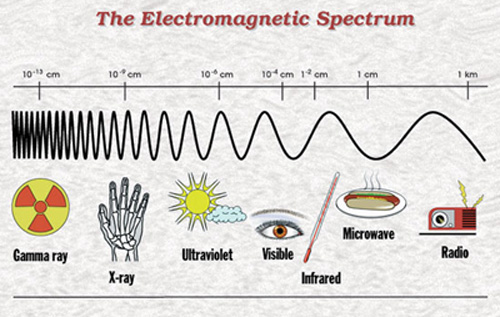
Electromagnetic spectrum
Microwaves
Microwave radiation is used to communicate over long distances. The transmitter and receiver must be in line of sight.
Infrared radiation doesn't penetrate food easily
Microwaves penetrate up to 1cm into food
Microwaves can penetrate glass or plastic but are reflected by shiny metal surfaces. Special glass in a microwave open door reflects them and they can cause body tissue to burn
Energy is transferred by waves; the amount of energy depends on the frequency or wavelength of the wave
High frequency (short wavelength) waves transfer more energy
Ovens cook food by infrared radiation; energy is absorbed by the surface of food, the kinetic energy of the surface increases, the rest of the food is heated by conduction
Microwave ovens cook by microwave radiation- the water/fat molecules in the outer layers of food vibrate more
Microwaves have wavelengths between 1mm and 30cm
Phones use longer wavelengths than microwave ovens, less energy is transferred
Satellites are used for microwave communication. Signal from Earth is received, amplified and re-transmitted back to Earth. They're in line of sight because there are no obstructions in space.
Microwaves do not show much diffraction, adverse weather and large areas of water can scatter the signals, the curvature of the Earth limits the line of sight so transmitters have to be on high buildings.
Mobile phones can interfere with sensitive equipment -this is why they are banned on planes and in hospitals.
Wireless signals
Radio refraction and interference
Radio reflection
Communication problems
Wireless technology is used by radio and television, laptops, mobile phones
Radio waves are reflected and refracted in the Earth's atmosphere: the amount of refraction depends on the frequency of the wave/there is less refraction at higher frequencies
Radio stations broadcast signals with a particular frequency
The same frequency can be used by more than one radio station; the radio stations are too far away from each other to interfere/but in unusual weather conditions, the radio waves can travel further and broadcasts interfere
Digital Audio Broadcasting or DAB also provides a greater choice of radio stations but the audio quality isn't as good as the FM signals. DAB eliminates interference between other radio stations
Radio waves are reflected in the ionosphere. They behave like light in an optical fibre and undergo total internal reflection
Water reflects radio waves but land mass doesn't
Continued reflection by the ionosphere and the oceans allows radio waves to be received from an aerial that is not in line of sight
Microwaves pass through the ionosphere
Microwave signals are received by orbiting satellites, amplified and retransmitted back to Earth
Communication satellites orbit above the equator and take 24 hours to orbit Earth
Radio waves are diffracted when they meet an obstruction
Refraction in the atmosphere needs to be thought about when sending a signal to a satellite
Transmitting aerial needs to send a focused beam to the satellite - aerial is small
Some energy lost from edge because of diffraction
Transmitted beam is slightly divergent
Stable Earth
Earthquake waves
Earth's insides
Tan or burn
Ozone depletion
A seismograph shows the different types of earthquake wave
L waves travel around the surface VERY slowly
P waves are longitudinal pressure waves: P waves travel through the Earth between 5km/s and 8km/s
S waves are transverse waves. They travel through the Earth at between 3 km/s and 5.5 km/s/
Can pass through solids and liquids
Can only pass through solids
P waves travel through the Earth and are refracted by the core
S waves are not detected on the opposite side of the Earth to an Earthquake. They can't travel through liquid, which means that it tells the scientists that the core is liquid
The paths that are taken by P waves help scientists figure out how big the Earth's core is
Tan- caused by the action of ultraviolet light on the skin
maximum time to spend in the sun = published normal burn time x SPF
People are becoming more aware of the dangers- like sunbeds
Cells in the skin produce melanin, a pigment which produces a tan
People with darker skin don't tan as easily because uv radiation is filtered out
Scientists didn't believe that there was a thinning of the ozone layer, they thought the instruments were faulty but they compared with others and were confident in their findings
Ozone is found in stratosphere
CFC gases (aerosols) destroy the ozone and thin it out. This increases danger to us
The ozone layer is at its thinnest above the South Pole because the chemicals work best in cold conditions
Scientists monitor the thickness by using satellities
Helps filter out UV radiation
Agreement to reduce CFC emissions
P1
Informationen
- Beschreibung
- Science Notiz am P1 - created from Mind Map, erstellt von georgia.somerville am 01/12/2013.
- Erstellt von
- georgia.somerville
- Aufrufe
- 118
- Tags
- Verlauf
-
- Erstellt von georgia.somerville · 1 Dez 2013
- Zu Notiz kopiert von georgia.somerville · 1 Dez 2013
- Bewertung