
Notizen
Salts

Inhalt der Notizen (1)
Seite 1
The more reactive the metal the faster the reaction
Copper doesn't react with dilute acids because it's less reactive than hydrogen
The speed of the reaction is indicated by the speed at which bubbles are given off
The hydrogen is confirmed by the burning splint test and the 'pop'
The name of the salt depends on the metal used
Hydrochloric acid will produce chloride salts
Sulphuric acid will produce sulphate salts
Nitric acid will produce Nitrate salts
Metal Oxides and Metal Hydroxides are Bases
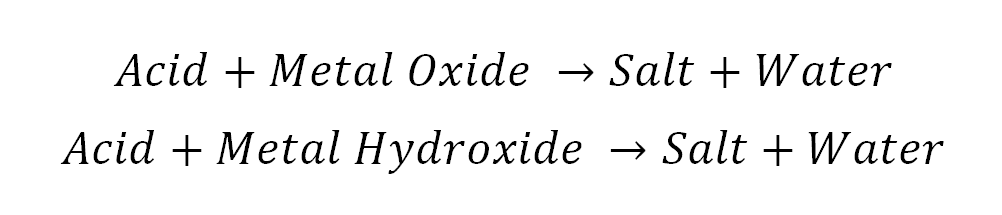
The combination of Metal and Acid descides the salt
Ammonia
Neutralised with Nitric acid (HNO3) to make Fertiliser
Ammonia dissolves in water to make an alkline solution
When mixed with nitric acid you get a neutral salt - Ammonium nitrate
There is no water produced
Good fertiliser as there is lots of nitrogen
Plants use nitrgen to make proteins
Making Soluable Salts
Using a Metal or Insoluble base
Need to pick right acid, metal or insoluble base
Ass the metal, metal oxide or hydroxide to the acid
The solid will dissolve
It will be neutralised when the excess solid falls to the bottom
Filter out the excess metal, metal oxide or hydroxide
To get the salt solution
Evaporate the water to get pure salt crystals
Evaporate it to make it more concentrated
Leave the rest to evaporate slowly
Crystalisation
Using an Alkali
You can't use the reaction above as you can't tell when the reaction has finished
You have to know exactly the right amount of alkali needed to neutralise the acid
Need to use an indicator
Then repeat using the same volumes but without the indicator
Then just evaporate to remove the water
Making Insoluble Salts
Precipitation Reactions
2 solutions that contain the ions you need
Need lead ions to lead chloride
Once the salt has precipitated out (lying at the bottom of the flask)
Filter it from the solution
Wash it
Dry it on filter paper
Can be used to remove poisonous ions from drinking water
Calcium and magnesium can be removed this way
They make water hard
Can be used fro treating sewage
Electrolysis
Electrolysis is the process by which ionic substances are broken down into simpler substances using electricity
If you pass a electric current through a substance that is molten r in a solution
It breaks down the elements it's made of
Needs a liquid to conduct electricity- the electrolyte
Electrolytes contain free ions
Usual molten or dissolved in the substance
It's the free ions tat conduct electricity
Electrons are taken from the positive electrode and given to the ions t the negative electrode
As ions loose or gain electrons they become atoms r molecules
Oxidation
Gain of oxygen
The loss of electrons
Doesn't have to involve oxygen
Reduction
Loss of oxygen
Gin of electrons
Doesn't have to involve oxygen
Here is what happens during electrolysis:
Positively charged ions move to the negative electrode during electrolysis. They receive electrons and are reduced.
Negatively charged ions move to the positive electrode during electrolysis. They lose electrons and are oxidised.
The substance that is broken down is called the electrolyte.
Electroplating
Electrolysis is used to electroplate objects
This is useful for coating a cheaper metal with a more expensive one, such as copper or silver
How it works
The negative electrode should be the object that is to be electroplated
The positive electrode should be the metal that you want to coat the object with
The electrolyte should be a solution of the coating metal, such as its metal nitrate or sulfate
Electroplating with copper
The object to be plated, such as a metal pan, is connected to the negative terminal of the power supply
A piece of copper is connected to the positive terminal
The electrolyte is coppersulfate solution
This arrangement can also be used to purify copper during copper manufacture
In this case, both electrodes are made from copper
The negative electrode gradually gets coated with pure copper as the positive electrode gradually disappears
Aluminium is common (abundant- found everywhere, naturally in compounds)
it is expensive due to the extraction process.
Aluminium ore is called bauxite
The bauxite is purified to aluminium oxide - from which aluminium can be extracted.
The extraction is done by electrolysis
aluminium oxide must be melted so that electricity can pass through it
Aluminium oxide has a very high melting point (over 2000°C)
Too expensive to melt it
it is dissolved in moltencryolite - an aluminium compound with a lower melting point than aluminium oxide
The use of cryolite reduces some of the energy costs involved in extracting aluminium
Reactivity
Sometimes there are more than 2 free ions in the electrode
e.g a salt dissolved in water will have H+ and OH-
At the negative electrode, if metal ions and H+ ions exist metal ions will stay in solution if they are more reactive than hydrogen
Because the more reactive element is keener to stay as ions
Hydrogen is produced if the metal is more reactive
At the positive electrode if OH- ions and halide ions are present (Cl-, Br-, I-) are present
Molecules of chlorine, bromine and iodine will be forms
If no halide is present oxygen is formed
Half Equations
show reactions at electrodes
Make sure number of electrons is the same for both
Write the formulae of the reactant and product
Adjust the number of ions
Count the number of charges
Add enough electrons so that both sides have the same total number of charges
e.g. Al3+ + e– → Al to Al3+ + 3e– → Al
The three products of electrolysis The three products of the electrolysis of concentrated sodium chloride solution have important uses in the chemical industry:
Hydrogen is used as a fuel and for making ammonia
Chlorine is used to kill bacteria in water, and to make bleach and plastics
Sodium hydroxide is used to make soap and bleach
Aluminium Extraction
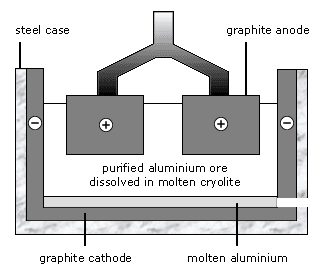
The diagram shows an aluminium oxide electrolysis tank. Both the negative electrode (cathode) and positive electrode (anode) are made of graphite, a form of carbon.
Aluminium metal forms at the negative electrode and sinks to the bottom of the tank, where it is tapped off.
Oxygen forms at the positive electrodes.
This oxygen reacts with the carbon of the positive electrodes, forming carbon dioxide, and they gradually burn away
As a result, the positive electrodes have to be replaced frequently
This adds to the cost of the process
Uses:
Decoration:
Silver is attractive
But expensive
It is cheaper to plate a cheaper material with it
Conduction:
Metals like copper conduct electricity well
used to plate for electronic circuits and computers
Oxides, Hydroxides and Ammonia
Making Salts
Electrolysis
Electroplating
Aluminium Extraction
Informationen
- Beschreibung
- GCSE Chemistry (C2b) Notiz am Salts, erstellt von juliasutton am 15/04/2014.
- Erstellt von
- juliasutton
- Aufrufe
- 699
- Tags
- Bewertung
Mehr zu Preparation and Naming of Salts