
Notizen
OLD TESTAMENT EXAM #3
Inhalt der Notizen (11)
Seite 1
BOOKS OF THE OLD TESTAMENT
GENESIS
EXODUS
LEVITICUS
NUMBERS
DEUTERONOMY
JOSHUA
JUDGES
RUTH
1 SAMUEL
2 SAMUEL
1 KINGS
2 KINGS
1 CHRONICLES
2 CHRONICLES
EZRA
NEHEMIAH
ESTHER
JOB
PSALMS
PROVERBS
ECCLESIASTES
SONG OF SOLOMON
ISAIAH
JEREMIAH
LAMENTATIONS
EZEKIEL
DANIEL
HOSEA
JOEL
AMOS
OBADIAH
JONAH
MICAH
NAHUM
HABAKKUK
ZEPHANIAH
HAGGAI
ZECHARIAH
MALACHI
Seite 2
I. 1-2 SAMUEL
- In the Hebrew bible, they were one book, but got split when translated to Greek
- As this story opens, the Judges are still leading
- THEOCRACY: Greek word for rule/power; God has political power
A. Samuel
1. His Role
Not the author; just the "key player" / first main character
- Last judge
- Prophet (God speaks to him)
- Priest (speaks to God on behalf of the people)
2. Key Events in his life
CH1 | Opens with Samuel's family. Hannah is married to Elkanah, goes up to worship the Lord at Shiloh (where the ark is), and she prays for her barrenness compared to Elkanah's other wife. Hannah declares, "If I have a child, it will be dedicated to you [God]" (Nazarite Vow). A priest, Eli, sees Hannah pray and thinks she's drunk, which shows he's not very in tune with God. Hannah bears a child and it is named Samuel ("el"), because God heard her prayer. Eli is given Samuel.
CH2 | Since she followed her vow, God blesses Hannah with other children. (Hannah's vow is so iconic that Mary actually loosely quotes her in the Magnificat.) The sons of Eli were worthless men who stole directly from temple and were rapists, but Samuel continues to grow in the Lord.
CH3 | Samuel ministers to the Lord under Eli. Then he goes to sleep and hears someone call his name. Samuel thinks it's Eli, but it's not. It happens multiple times before Eli realizes it's God speaking - which is something that hasn't happened in a while (as it's a dark time). God tells Samuel that he will punish the house of Eli forever and Eli knows this the next morning. Samuel will take over as priest.
CH4 | Civil Religion
Isrealites act as if God exists for their purposes. The Philistines defeat them and take the Ark away. Eli's sons took the Ark out and got slaughtered in battle. When Eli hears the news, he falls off his stool and dies. The wife of one of the sons goes into labor and names the child Ichabod, "Glory Has Departed". These events show that God will not be manipulated, and that we need Him - He doesn't need us.
The Philistines put the Ark in front of Dagon, a fish god, and it is subjected to God's power. The statue keeps falling down and is eventually executed. When the Ark gets passed around multiple Philistine cities, the same happens. The Philistines test the ark: cows that gave birth to calves are attached to the ark, and instead of going back to the barn the cows make a beeline for Israel.
ANYONE WHO HANDLED THE ARK INCORRECTLY WAS SAVAGELY KILLED. ON THE SPOT.
CH8 | Israel demands a king. They want to be like everybody else, even though they were told not to. Wanting a king should be about spirit, not appearance. Samuel stayed faithful to the Lord, but not his sons.
Seite 3
B. Saul
First king of Israel ("warrior king"), Tribe of Benjamin
1. Key Events From His Life
He starts off good: Bad guys come into Israelite cities and God gives Israel victory
2. Instances where Saul's Rejected by God
- Disobedience [CH31]
Saul had to wait for Samuel to come to conduct a sacrifice, but he goes ahead and does it.
- MORE DISOBEDIENCE [CH15]
Saul was to gather the troops and bring judgment on the Malachites - anything that breathes. They disobeyed and kept stuff.
Just as Saul ripped Samuel's clothes, Saul no longer has a connection with God.
Seite 4
C. David
1. Beginnings
a. - Tribe of Judah
- Hometown of Bethlehem
- Shepherd boy
b. - Annointed by Samuel
- House of Jesse
c. How David is confirmed as a great leader: David and Goliath
Jesse's sons went out to battle and David stayed behind to tend sheep because he wasn't old enough for military service.
Saul had lost heart; he was rejected by God and doesn't step up to Goliath. David does, and he beheads Goliath.
d. David is made general, and Saul does this in hopes that David will die in battle. But the Lord always makes sure David wins.
2. Fugitive Years
David gets increasingly popular. When David plays music for Saul, he almost gets speared. Johnathan helps David escape and David gathers a group. Saul tries to hunt him down to kill him; meanwhile, David leaves everything to God.
Saul has to take a leak in a cave and David was there. David could've killed him but he didn't. Saul says he won't try to kill him again, but this happens multiple times.
David sends his men to ask Nabal for food/supplies. Nabal gives David's men insults, and David is enraged. Abigail prepares food and supplies to calm David down, and she respectfully requests that he not slaughter Nabal "and sully his hands". David agrees, Nabal dies later, and Abigail becomes David's wife.
3. Triumphs as a King
Saul dies in battle, along with Johnathan and his other sons. David begins as the king of Judah, but later the entire nation.
a. Militarily
David wins practically all his battles, and conquers Philistine, Jerusalem, etc.
b. Politically
David unites kingdoms and establishes the central capital city of Jerusalem
c. Spiritual
David brings the ark into Jerusalem. Uzzah tries to steady it and drops dead; his error was thinking that the dirt would defile the ark more than his hand. God makes a covenant with David.
4. Failures
a. Adultery with Bathsheba
David is not at war, and is idle at home. David walks on a high vantage point and sees Bathsheba taking a bath. David sends for her and gets her pregnant. Bathsheba was Uriah's wife, and David gets Uriah drunk (so he'll decide to come home to his wife) but he stays with the other soldiers. Uriah dies because David told the general to put Uriah in the front lines and to pull back everyone else when the enemy engaged.
b. David takes a census, which God told them not to do
c. "The sword will not depart from your family" - Nathan's prophecy
God takes sin seriously, even against David
OVERVIEW: David was the greatest king of Israel
a. Unified nation and developed a centralized government
b. Established Jerusalem as the capitol and made it the religious and political center
c. Developed a great army and conquered all their enemies
d. Known as a man after God's own heart
D. KEY PLAYERS
David's kids
1) Absalom - Tamar (sister)
2) Ammon
Ammon made himself sick because he was obsessed with Tamar. He asked for her to treat him, and when she gets closer, he asks her to lie with him. She refuses, so Ammon forcibly rapes her. The hatred he had for her overshadowed any "love" he had. He loved himself and wanted pleasure for himself; Tamar was a conduit.
Absalom had a hunch that the rape happened, when Tamar was banished from Ammon's room and ran to him, and now he hates Ammon. He kills Ammon two years later, and Absalom takes over the capital. A battle between Absalom and David's forces happen, and David weeps even though he won because Absalom died.
Seite 5
II. 1-2 KINGS
900's to 500's
A. Solomon
1. How He Became King
First king: Saul
Second king: David
Adonijah, oldest son of David, is supported by Joab and Abiather. Nathan and Bathsheba know her child is to be king, as said by God. (Bathsheba's first, the child of adultery, died; her second is Solomon.) Solomon is supported by Zadok and his mighty men. David has Solomon proclaimed king, and Jacob and Abiather RUN THE HELL AWAY before they get accused of treason.
In CH3, Solomon asks for wisdom from God. He will bring the kingdom to its highest and greatest point.
2. How He Developed the KIngdom
a) Great Building Program
Built network of forts, a palace, a temple (one of the wonders of the ancient world)
b) Great Trade and Business
Israel becomes a commercial center. Solomon even sets up a fleet for water travel.
c) Great Army
40,000 stalls for horses: this showed they had a huge and powerful armory
d) Great Cultural (The Arts) Development
3. Solomon's Areas of Weakness
- Many foreign wives
He had 700 wives and 300 concubines. The marriages were political, and his wives were a status symbol.
- Solomon begins to worship the gods of his wives
He builds a temple to foreign gods.
- Solomon oppressed the people (taxes, forced labor)
Seite 6
B. The Divided Kingdom
1. Why the Kingdom Was Divided
a) Apostasy: turning away from God
b) Heavy taxation
c) Tribal division
2. How the Division Came About
a) Jereboam
Prophet tells him that God will tear the country away from Solomon and that he'll get half the tribes.
b) Rehoboam's folly
Rehoboam was Solomon's son. He asks his advisors what to do with the request from the people. Rehoboam, instead of respecting the old advisors' wishes, works the people even harder per his friends' suggestions.
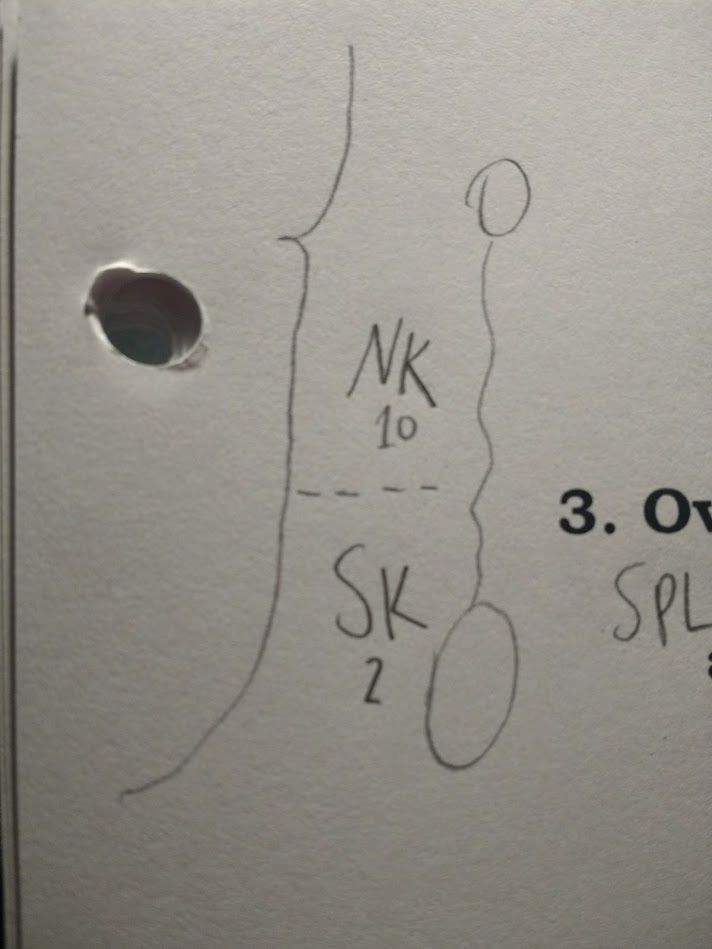
Ten tribes split away.
Judah + Benjamin - Reh
10 tribes - Jere
3. Overview of Northern Kingdom
Time period of the split: 922-722, a time during which there were 19 kings
a) Advantages were LARGER POPULATION, STRONGER ECONOMY, MAJOR ROADWAYS (better access than SK), and FERTILE PRODUCTIVE LAND.
b) Disadvantages were POLITICAL INSTABILITY, FERTILE LAND (everybody wanted this valuable resource), and FALSE WORSHIP (God's disfavor).
c) All bad kings
d) The worst king was Ahab, and his wife Jezebel was even more wicked. Jehu wipes out Ahab's line.
Micaiah, the prophet, told Ahab what God wanted him to tell him - not what Ahab wanted to hear.
e) Elijah and Elisha
f) Assyria destroyed the Northern KIngdom 722 BC
4. Overview of Southern Kingdom
Started 922 BC and went to 587 BC
19 kings, 1 dynasty (David's line)
a) Advantages were STABLE GOVERNMENT, SEVERAL GODLY KINGS, ONE CAPITAL, MORE SECLUDED, and BLESSINGS BECAUSE OF DAVID.
b) There were a bunch of great leaders, but the most notable 3 were Hezekiah, Josiah, and Asa.
Sennacherib
c) Destroyed in 587 BC by Babylon, led by Nebuchadnezzar'
5. Elijah and Elisha
They appear in the story in that order.
Elijah was an uncompromising prophet of Yahweh who opposed Baal. He was the opponent of Ahab and is often described as one of the most powerful/colorful characters of the OT.
Elijah and the prophets of Baal go to Mt. Carmel. After Elijah sets up the sacrifice and fills a trench with water, he prays for God to show these peasants what's up and fire comes down to consume the sacrifice and all the water.
Elisha was Elijah's successor. A chariot of fire took Elijah away, but his mantle was left, which Elisha uses to part the Jordan River. Since Elisha saw the mantle, he received a double portion of Elijah's spirit, and he starts a school of prophets.
Seite 7
III. 1-2 CHRONICLES
These books are commentary on 1-2 Samuel and 1-2 Kings.
They repeat some material, leave some out, and add some.
The Bible contains the first commentary on itself.
IV. EZRA - NEHEMIAH
This is a 2 volume work by the same author. They are combined as one book in the Jewish scripture.
Ezra is a scribe and Nehemiah is the king’s cup-bearer (a government official).
A. 3 Key Dates
538 BC- 1st group of exiles return because of edict of Cyrus, king of Persia; those returning were led by Zerubbabel (a descendant of David); they rebuild the Temple
458 BC- another group of Exiles return, under the leadership of Ezra, who brings reform
445 BC- Nehemiah returns, leads the rebuilding of the walls
B. Key Themes
SOVEREIGNTY OF GOD: God is explicitly behind all the events, from the destruction of Jerusalem to Ezra’s return
NECESSITY OF OBEDIENCE TO GOD'S WORD: disobedience led to the Exile and those who have returned are urged not to repeat that failure
SEPARATION FROM SIN
- No intermarriage with pagans (Ezra 9)
- Note Nehemiah’s response to the sinning men in Neh 13:25: he confronted them, cursed them, beat them, pulled out their hair!
- No joint worship with those who do not exclusively worship YWHW (Ezra 4)
4. MERCY OF GOD: He has not abandoned His people. He has judged them but not abandoned them (Ezra 9:16-19, 30-31)
5. REPENTANCE (for example, Ezra 9:5)
- Fasting is prominent in association with this
- Must start with brokenness
Seite 8
V. ESTHER
"God's care for his people in exile"
Mordecai- Esther’s uncle
Haman- wants to kill all the Jews in Persia
Vashti- Queen of Persia and the first wife of Persian King Ahasuerus in the Book of Esther
A. Key Themes
SOVEREIGNTY OF GOD: placing Esther in the right place at the right time; sleeplessness of the King leading to the exaltation of Mordecai
GOD'S CARE FOR HIS PEOPLE
WE HAVE A PLACE IN GOD'S PLAN: proper sense of destiny (4:14)
FEAST OF PURIM: the story shows the origin of this feast which begins at the end of this story to celebrate God’s deliverance
VI. JOB
Author: unknown
Place: Uz (perhaps near Edom)
Focus: Problem areas of life
This story deals with, but does not answer, the question of "why do the righteous suffer?"
It calls us to examine our motives for serving God.
A key point from the story is that not all suffering is caused by a person’s specific sin. Job is never told why he suffered.
The devil has to get permission for everything he does; the devil's on a leash.
Seite 9
VII. PSALMS
A. Introductory Points
Prayers & Praises / The Hymnbook of Israel
1. Structure
150 psalms / 5 books
2. Authors
David, and at least 73 others
Solomon
Asaph- David’s choir master
Sons of Korah- temple musicians
Heman- temple musician
Ethan- Solomon’s counselor
3. Titles
Provide info on AUTHORSHIP, HISTORICAL SETTING, and MUSIC
4. Purposes
a) Devotional- teach us how to express ourselves to God
b) Cultic- For use in corporate worship
c) Teaching- teaching & worship must go together; you cannot have worship without doctrine
5. Literary observations
- Poetic imagery that is not intended to be literal
- Parallelism (Psalm 1)
- Think of each Psalms as a whole: it’s a song
B. Types of Psalms
Psalm 1, Psalm 2, Psalm 110
C. Major Themes
- Guide to worship
- Teach us to be honest with God
- Teach importance of meditating on what God has done
- Security in God
- Missions
Seite 10
VIII. PROVERBS
A. Major Themes
1. 1:1-7: Intro
- Purpose: to impart wisdom
- Audiences:
1) the naïve- to educate them, to remove their ignorance
2) the wise- to provide them with even more wisdom
- Key Point: The Fear of God
Warnings against adultery- ch 5, 6, 7
Discipline of children
laziness vs. diligence
14:23 / 13:4 / 6:6-11 / 16:26 / 15:19 / 12:1, 11, 24 / 18:9 / 22:29 / 26:14-15
4. excellent woman
11:22 /12:4 / 18:22 / 19:14 / 21:9, 19 / 31:10-31
5. value of wisdom
CH2 / 3:13-18
6. generosity
11:25 / 21:13
7. companions
13:20
8. words
Seite 11
X. ECCLESIASTES
A. Introductory Points
- Against materialism: Solomon had it all & found it meaningless
- Author: disputed; I believe it was Solomon
- Title: Qohelet (Hebrew), meaning ‘teacher’ or ‘preacher’
‘Ecclesiastes’ comes from the Greek translation (LXX)
B. Major Themes
Life is Meaningless (1:2; 12:8)
“Vanity of vanities”- there is no ultimate experience in this life. It is gracious of God to tell us this because we tend to spend our time chasing this ultimate experience only to end in frustration and disappointment. This is then a stark, honest appraisal of the fleeting nature of our lives. Only by giving up our pursuit of the ultimate experience here and now can we truly enjoy this life. We ruin life by placing unreal expectations on it.
2. Fear of the Lord (12:13-14)
The real guiding purpose of life.
Informationen
- Beschreibung
- Religious Studies Notiz am OLD TESTAMENT EXAM #3, erstellt von Anton Nguyen am 12/11/2017.
- Erstellt von
- Anton Nguyen · Nov 2017
- Aktualisiert
- 11 Dez 2017
- Aufrufe
- 3
- Bewertung