
Notizen
Covalent bonds
Inhalt der Notizen (1)
Seite 1
Covalent bonds:-
1) When non-metal atoms combine together they form covalent bonds by sharing pairs of electrons.
2) This way both atoms feel that they have a full outer shell.
3) Each covalent bond provides one extra shared electron for each atom.
4) Each atom involved has to make enough covalent bonds to fill up its outer shell
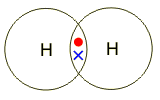
Hydrogen gas - H2
Hydrogen atoms only need one more electron to complete the first shell and so they form single covalent bonds to achieve this
Non-metal atoms combine together to form covalent bonds by sharing pairs of electrons. This way both atoms feel they have a full outer shell. Each covalent bond provides one extra shared electron for each atom. Each atom involved has to make enough covalent bonds to fill up its outer shell.
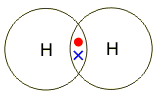
Hydrogen atoms have just one electron and only need one more to complete the first shell. They often form single covalent bonds to achieve this.
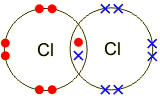
Each chlorine atom needs just one more electron to complete the outer shell so they form a single covalent bond to do so and together share one pair of electrons.
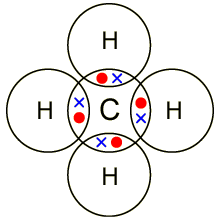
Carbon has four outer electrons which is a half full shell. To become a 4+ or 2- ion is hard work so it forms four covalent bonds to make up its full outer shell.
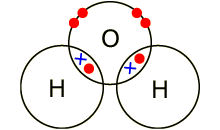
Oxygen shares two electrons. Like in water molecules, it shares electrons with the hydrogen atoms.
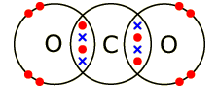
Carbon needs four more electrons to fill it up and oxygen needs two. So two double covalent bonds are formed. A double covalent bond has two shared pairs of electrons.
New Page
Informationen
- Beschreibung
- GCSE Science (Chemistry) Notiz am Covalent bonds, erstellt von eibhlinjones200 am 31/05/2013.
- Erstellt von
- eibhlinjones200 · Mai 2013
- Aktualisiert
- 19 Feb 2016
- Aufrufe
- 160
- Tags
- Bewertung