
Quiz
Chapter 5: Pharmacodynamics
Dieses Quiz enthält Fragetypen, die sich im gewohnten Player öffnen.
Fragen in diesem Quiz (14)
1What is the most accurate definition of pharmacodynamics?
- AHow a medicine changes the body
- BHow the body handles medication
- CHow the body removes drugs
- DHow the body changes the drug
2What is a frequency distribution curve?
- AA graphical representation of the number of patients responding to a drug action at different doses.
- BA graphical representation of the number of patients dying from the drug
- CA graphical representation of the number of patients getting side effects from the drug
- DA graphical representation of the onset of drug action.
3The following is information about a frequency distribution curve (since I couldn't find or make a picture I like). Please fill in the blanks.
A [blank_start]frequency distribution curve[blank_end] is a graphical representation of the number of patients responding to a drug action at different doses. On the [blank_start]Y axis[blank_end] is the number of patients responding; on the [blank_start]X axis[blank_end] is the dose of the medication. The [blank_start]peak[blank_end] of the curve indicates the largest number of patients responding to the drug. The dose in the middle of the curve represents the drug's [blank_start]median effective dose[blank_end], which is the dose required to produce a specific therapeutic response in 50% of a group of patients.
Nurses should realize that the standard or average dose predicts a therapeutic response for only [blank_start]half[blank_end] of the population. It is not enough to know the average dose; it's important to know when and how to request whether doses should be adjusted.- Afrequency distribution curve
- BMedian toxicity dose
- CGraded dose response
- DY axis
- EX axis
- Fpeak
- Gbottom
- Hmedian effective dose
- Igraded dose-response
- Jhalf
- Ka quarter
- L3/4
- Mmedian lethal dose
4A drug's median lethal dose is the dose of the drug that will be lethal in 50% of all animals.
A drug's median effective dose is the amount of the drug required to produce a specific therapeutic response in 50% of a group of patients.
The therapeutic index is the ratio of a drug's median effective dose to the drugs median lethal dose.
When the median effective and median lethal doses are close together on a graph (like shown in the picture), what does that say about the drug?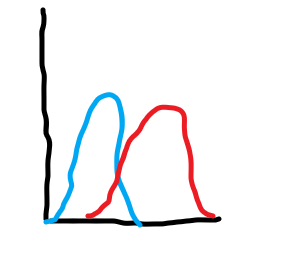
- AIt has a narrow safety margin.
- BIt has a large therapeutic index
- CIt's a safer drug.
- DIt would take a very large error to cause a patient to overdose on the drug.
5The median lethal dose is often determined in clinical trials.
- ARichtig
- BFalsch
6What does the graded dose response measure?
- AThe variability in responses to a drug observed within a single patient.
- BThe variability in responses to a drug observed within a population.
- CThe variability in responses to a drug observed within a family.
- DThe amount of patients getting sick from a drug.
7The following is information about the graded dose-response relationship and the dose-response curve. Fill in the blanks with the correct information.
The graded-dose response relationship and the graded-dose response curve observes and measures the patient's [blank_start]response[blank_end] at different [blank_start]doses[blank_end] of the drug. The 3 distinct phases are:
Phase 1: The [blank_start]flat[blank_end] portion of the curve. It indicates that few target cells have been affected by the drug.
Phase 2: The [blank_start]straight line[blank_end] portion of the curve. This portion often shows a liner relationship between the [blank_start]amount[blank_end] of drug administered and he [blank_start]degree[blank_end] of response obtained from the patient.
Phase 3: A [blank_start]plateau[blank_end] is reached in which increase the drug dose produces no additional therapeutic response. This is usually the point in which the drug has reached its [blank_start]maximal response[blank_end], so giving a higher dose will have no effect.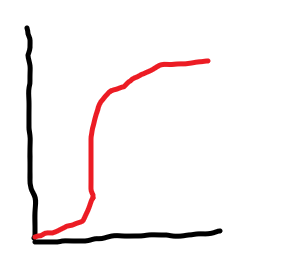
- Aresponse
- Bdoses
- Cflat
- Dstraight line
- Eamount
- Fdegree
- Gplateau
- Hmaximal response
8There are 2 fundamental ways to compare medications within therapeutic and pharmacologic classes.
[blank_start]Potency[blank_end] is how much of a drug is needed to produce a therapeutic effect. Drugs that are more potent will produce a therapeutic effect at a [blank_start]lower[blank_end] dose.
[blank_start]Efficacy[blank_end] is the [blank_start]magnitude[blank_end] of response that can be produced from a particular drug.
From a pharmacological perspective, [blank_start]efficacy[blank_end] is the more important value.- APotency
- BEfficacy
- Clower
- Dhigher
- EEfficacy
- FPotency
- Gmagnitude
- Hamount
- Iefficacy
- Jpotency
9The cellular macromolecule that a drug binds to in order to initiate its effects is called its what?
- AReceptor
- BProtein
- CMessenger
- DPort
10The vast majority of drug receptors are proteins.
- ARichtig
- BFalsch
11All drugs bind to an extracellular receptor
- ARichtig
- BFalsch
12What is a nonspecific cellular response?
- ADrugs acting independently of cellular receptors.
- BDrugs having systemic effects.
- CDrugs triggering a series of second messenger events.
- DA drug attaching to its receptor in a non-specific manner.
13This is a fill in the blank problem about drug-receptor interactions. In simplest terms, a specific activity of the cell is either enhanced or inhibited.
When a drug binds to its receptor, it produces a response that [blank_start]mimics[blank_end] the effect of the endogenous regulatory mechanism.
A drug that produces the same type of response as the endogenous substance is called an [blank_start]agonist[blank_end]. These drugs sometimes produce a greater maximal response than the endogenous chemical. A [blank_start]partial agonist[blank_end] (or an agonist-antagonist drug) describes a medication that produces a weaker, or less efficacious, response than an agonist.
A drug that occupies a receptor and prevents the endogenous chemical from acting is called an [blank_start]antagonist[blank_end]. [blank_start]Functional antagonists[blank_end] inhibit the effects of an agonist by changing pharmacokinetic forms.- Amimics
- Bagonist
- Cpartial agonist
- Dantagonist
- EFunctional antagonists
14An unpredictable an unexplained drug reaction is called what?
- AAn idosyncratic response
- BAn adverse effect
- CAn allergy
- DA side effect
Informationen
- Beschreibung
- Der Nutzer hat seine Fachbereichs-Information gelöscht. Quiz am Chapter 5: Pharmacodynamics, erstellt von Gelöschter Nutzer am 10/04/2018.
- Autor
- Gelöschter Nutzer
- Sprache
- English
- Aufrufe
- 118
- Verlauf
- Erstellt am 10 Apr 2018 · aktualisiert am 23 Apr 2018
- Schlagwörter