
Notizen
LIFE ON EARTH
Inhalt der Notizen (1)
Seite 1
Life On Earth
Early Earth and the formation of organic molecules
Early earth contained no ozone layer = large amounts of UV radiation reached the earth
no ozone layer because there was little to no free oxygen.
volcanic emissions filled atmosphere = second atmosphere consisted of methane, amonia, hydrogen, carbon dioxide, carbon monoxide and small amounts of water vapor.
violent electrical storms and acidic rain formed the present warm and mineral rich oceans
only 2 possible ways molecules could have formed = on earth from simpler molecules or arriving from the cosmos
Implications of the existence of organic molecules in the cosmos for the origin of life on Earth
organic molecules have been found in inerstellar dust.
experiment where chemicals were exposed to UV radiation
result = production of many complex organic compunds. This suggests that the conditions in interstellar ices could be the site of the production of the organic chemicals necessary for the origin of life.
Spontaneous Generation:
For many generations it was believed that life spontaneously arose out of different materials. E.g. garbage turned into rats, rotting meat turned into maggots.
Significance: This theory is significant in understanding the origin of life, because it is untrue. We can further our understanding by learning from these errors. In 1862, Louis Pasteur carried out an experiment by using a flask containing boiled broth and showed that there was no spontaneous generation if contamination of the flask was prevented.
Chemicals for life formed on Earth (Abiotic synthesis in the Atmosphere and Oceans)
Haldane and Oparin suggested that Earth had all the necessary basic chemical components for life on Earth. They proposed that the early atmosphere on Earth contained little oxygen, and that the complex organic molecules could have been created from UV radiation, electrical discharges, and heat.
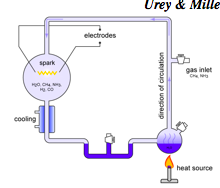
Urey & Miller Experiment
Urey and Miller set up a simulation of primitive earth. A mixture of hydrogen, ammonia, and methane in the form of steam was continuously electrically discharged for a week. The experiment resulted in a solution containing a number of amino acids and hydroxy acids which are vital components for living things. Urey and Miller’s experiment supported Oparin and Haldane’s theories on the origin of life, which showed that organic material, could be formed by raw materials.
Reason for experiment
To test the hypothesis of Oparin and Haldane which stated that conditions on the primitive Earth favoured chemical reactions that synthesized organic compounds from inorganic compounds.
It proved that living matter can be produced from non-living matter, and this chemosynthetic origin of life is believed by most biologists today.
Technologies that help us understand
Technology
Assistance in understanding
Deep sea equipment
Exploration of remote environments
Infra red observations
Gather and explore evidence from space
Aircrafts
Can pick up space dusts
Radioactive isotopes
Can date fossils
Electron microscopes
Can see greater details than lens or light microscope
Major stages of evolution of living things
4 bya – Organic molecules – amino acids, proteins, carbon compounds, etc
4-3.5 bya – Membranes – made of lipids and proteins
3.5-2.5 bya – Procaryotic heterotrophic cells – cells without membrane-bound organelles, obtained energy from organic molecules that existed in the primitive environment
2.5-2 bya – Procaryotic autotrophic cells – cells without membrane-bound organelles, obtained energy by making their own compounds (food)
1.5 bya – Eucaryotic cells – These cells have membrane bound organelles
1.5 bya – Colonial Organisms – Individual cells start to work together (not as 1 organism)
1-0.5 bya – Multicellular Organisms - Specialised cells which are dependant on each other in the colony (as one organism)
Evidence that suggests when life originated on Earth
Geological Evidence:
Banded iron formations in rocks –rings/ layers of rusted iron
Fe (II) ions + O2 ions (from photosynthesis) Fe3O4 (sinks to sea floor)
Proves that oxygen was present in the oceans, therefore oxygen is present at the time when the layers are red
Oxygen cant escape into the atmosphere until all the iron in the water has been rusted and sunk to the bottom
Can be found between 4 and 2 bya (mostly)
Red Beds – iron rich rocks that are terrestrial (formed on land) and generally age 2 bya (no older)
They prove that oxygen was present in the atmosphere at that time
Palaeontological Evidence:
Schopf claimed to find fossils dating back to 3.5 bya
used 3D X rays to prove that it wasn’t just a flaw in the rock
Cyanobacteria and heterotrophic bacteria found from at least 850 mya
Stromatalites (colonial bacteria) – formed by cyanobacteria
Anoxic to Oxic atmosphere
As oxygen levels rose, photosynthetic organisms became more abundant, while the anaerobic organisms were inhibited due to the presence of oxygen.
The formation of the ozone layer protects the Earth from UV radiation
Explosion of diverse forms of plants and animals
The evolution of photosynthesis and respiration
Conflicts with different cultures
Different cultures and religious in the world have their own ideas about life, it maybe quite different to the scientific evidence.
In biblical creationism different organisms were made for specialised environments at the same time, the organisms that were created have not changed nor are they related
Australian Aborigines believe that ancestral beings created the world a long time ago in a period known as the dream time. The scientific theories in this area are different to what the aborigines believe and this can often cause conflict.
This conflict does however provoke people to think about what might have really happened and to question beliefs and leads to the formation of new theories
Impact of increased understanding of the fossil record on the development of ideas about the history of life on Earth
important because determines the information available to scientists
the more fossils found the more ideas can be developed about the evolution of life on earth
It was initially thought that Earth was 10 000 years old because someone calculated the years in the bible; this was proved wrong when a fossil was found and dated back to 3.5 bya.
Fossils have helped us to realise how complex organisms all came from simpler organisms
Further developments in our knowledge of present-day organisms and the discovery of new organisms allows for better understanding of the origins of life and the processes involved in the evolution of living things
Microscopes have allowed us to better understand the small parts of cells, and development of specific biochemical information, and sequence of the amino acids
Biochemical techniques has also helped us to study the pathways and shows differences in Eubacteria (splits growth into Archaea and other Eubacteria)
Organisms and their environment and role in it
Procaryotic Cell
Environment
Role in ecosystem
Archaea
Hostile environments
Carry out inorganic reactions for chemical energy
Eubacteria
All habitats, known for diseases many of them cause
Plays a vital role in the recycling in an ecosystem
Cyanobacteria
Mainly in marine environments
Carries out photosynthesis
Nitrogen – fixing bacteria
Live mutualistically on plants
Converts nitrogen to ammonium ions that can be converted to amino acids in the plants
Methanogens (Archaea)
Anaerobic conditions
Use hydrogen compounds and carbon dioxide to produce energy for themselves and release methane as a waste product
Thermophiles/ Thermoacidophiles (Archaea
Hot springs or at high temperatures in acidic environments
Carry out inorganic reactions for chemical energy
Halophiles
Very salty water (about 7x the concentration of sea water)
Carry out inorganic reactions for chemical energy
Deep – sea bacteria
Boiling undersea vents of volcanoes
Basis of food web, use sulphur compounds to derive energy
Cyanobacteria
Past environment
Today’s environment
Anaerobic – respiration without oxygen
Shallow seas (warm)
Anoxic
Becomes oxic due to photosynthesis
Warm, shallow salt water
Some live in slimy aquatic environments
Some are free living
Some live in other cells
Some in terrestrial environments
Flourish in warm, wet, damn conditions eg ponds
Some produce toxins i.e. we cannot swim in them
Evidence for this:
Current cyanobacteria can live in anaerobic environment
Cyanobacteria are oldest known fossil (found in Stromatalites)
Filamentous varieties found today living in aquatic environments
Role in ecosystem:
First reefs in aquatic life
Their photosynthesis led to oxygen in environment
Led to the evolution of plants
Nitrogen-fixing change N2 into forms usable by other species eg. NH3 (ammonia), NO2 (nitrites) and NO3 (nitrates)
Binomial system
is the system that gives an organism its universal two-part name according to its genus and species.
New Page
Informationen
- Beschreibung
- Notiz am LIFE ON EARTH, erstellt von zoe98xoxo am 11/09/2013.
- Erstellt von
- zoe98xoxo · Sep 2013
- Aktualisiert
- 3 Feb 2018
- Aufrufe
- 58
- Bewertung