
Notizen
Transverse, Longitudinal, and Surface Waves
Inhalt der Notizen (1)
Seite 1
↑
F
G
↓
A = Wavelength- distance from any part of the wave to the same point on the next cycle of the wave
B = Frequency (also the Direction of Wave)- the number of wave cycles per unit (unit=hertz)
C = Period- time it takes for one wave cycle to complete
D = Amplitude- maximum height to the rest position
E = Direction of Energy
F = Trough- the lowest point of a wave
G = Crest- the highest point of a wave
H = Equilibrium (also the Rest Point)- part where the energy is the same throughout the wave
← H (the line)
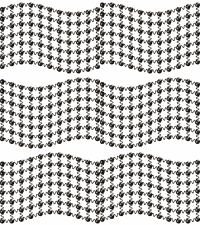
Movement of a Transverse Wave:

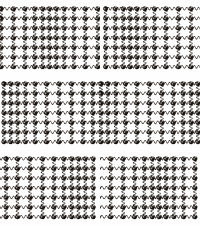
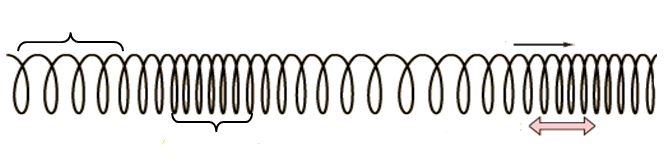
Movement of Longitudinal Waves:
A
B
E
D
|
|
|
|
|
|
C
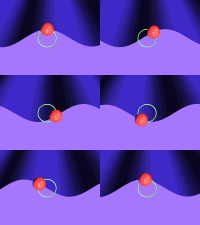
Movement of Surface Waves:
A = Rarefaction- the part of a wave that stretches out the most
B = Compression- the part of a wave that stretches out the most
C = Rest Position- area of rest in a wave
D = Direction of Energy
E = Direction of Wave
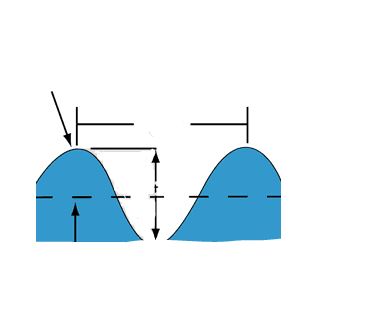
A= Crest- highest point of surface wave
B= Wavelength- distance from one point of a surface wave to another which is the same part but of a the next cycle
C= Rest Position
D= Trough- the lowest point of a surface wave
E= Wave Height- distance from crest to trough
A
B
C D
E
WAVE FORMULAS
Speed= \[Wavelength·Frequency\]
Speed= \[\frac{Wavelength}{Period}\]
Frequency=
\[\frac{Speed}{Wavelength}\]
Wavelength= \[Speed·Frequency\]
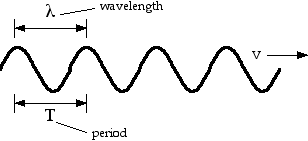
\[\lambda=Wavelength\]
\[v=Velocity\](Speed)
\[T=Period\]
Transverse Waves
Longitudinal Waves
Surface Waves
Formulas
Informationen
- Beschreibung
- Contains how waves move and wave formulas.
- Erstellt von
- Selam H · Dez 2013
- Aktualisiert
- 12 Jan 2017
- Aufrufe
- 2.005
- Tags
- Bewertung