
Quiz
The Nature of matter, atomic structure and the periodic table
Fragen in diesem Quiz (32)
1A solid's particles are:
- AClosely packed and regularly arranged.
- BClose packed and irregularly arranged.
- CSparsely collected and irregularly arranged.
2A liquid's particles are:
- AClosely packed and regularly arranged.
- BClosely packed and irregularly arranged.
- CSparse and irregularly arranged.
3A gas' particles are:
- AClosely packed and regularly arranged.
- BClosely packed and irregularly arranged.
- CSparse and irregularly arranged.
4Which of these solid facts is incorrect?
- ASolid (s) particles are strongly attracted to one another and are arranged in a lattice form. Thus, they keep their own shape.
- BSolid particles can easily move around within the solid.
- CA solid cannot be compressed.
5Which of these liquid facts is incorrect?
- AThe attractive forces between liquid particles is more easily broken since the particles have more kinetic energy. This means they are more mobile than solid particles - liquids can flow, but still take the shape of their container.
- BParticles at the surface of a liquid can break away and escape - a liquid can evaporate.
- CThere is a vast space between the particles in a liquid, so they can easily be compressed.
6Liquids that mix with each other are immiscible. True or False
- ARichtig
- BFalsch
7Which of these gas facts are incorrect?
- AGas particles have even more kinetic energy than liquid particles and there is very little attraction between them. The particles move at very high speeds and independently of one another, so they fill any available space.
- BGas particles collide with the surface of their container and exert pressure (force per unit area)
- CGases do not mix readily with other gases, because of the particle's rapid motion.
8As matter is heated... Choose the part of the process which are true.
- AAs matter is heated, the particles gain kinetic energy, transferred from heat energy, and so are able to move faster.
- BAs a solid is heated, the vibrations of its particles decrease, until eventually the particles are able to break away from each other into a sparse collection.
- CThe temperature at which all solid becomes liquid is the solid's melting point.
- DSimilarly, the particles in a liquid move faster as they are heated, until the particles break free of the liquid to become a gas. This temperature is called the liquid's boiling point.
9An element is a substance containing more than one type of atom which can be broken down into simpler substances. Elements may exist as solids, liquids or gases and can be metals or non-metals. True or False?
- ARichtig
- BFalsch
10Compounds are substances in which atoms of different elements chemically combine. Compounds have different characteristics (properties) from those of the elements they are made of. The ratio of masses of each element always stays the same, and the elements are chemically combined and not easily separated by physical means.
- ARichtig
- BFalsch
11The substances in a mixture cannot be separated by physical means. A mixture contains fixed proportions of the elements or compounds within it, and has different characteristics to the elements it is made of.
- ARichtig
- BFalsch
12A pure substance is a single element or compound able to be identified by its distinct physical properties.
- ARichtig
- BFalsch
13Name the parts of this Helium atom, along with their charges and atomic masses.
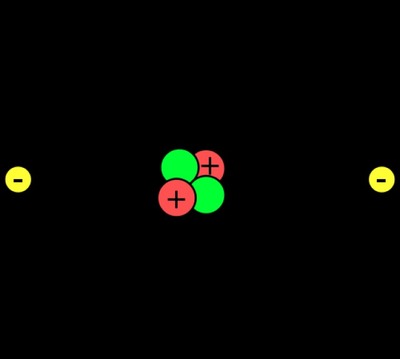
- AGreen= Proton, positive charge, atomic mass: 1.
Red=Electron, positive charge, atomic mass: 1
Yellow=Neutron, negative charge, atomic mass: 1 - BGreen=Neutron, neutral charge, atomic mass: 1
Red=Proton, positive charge, atomic mass: 1
Yellow=Electron, negative charge, atomic mass: 0 - CGreen= Proton, neutral charge, atomic mass: 1
Red= Neutron, positive charge, atomic mass: 1
Yellow= Electron, negative charge, atomic mass: 0
- AGreen= Proton, positive charge, atomic mass: 1.
14Name the purpose of each part of Beryllium's section on the periodic table. Select the correct answers below.
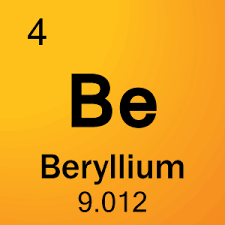
- AThe '4' represents the Mass number.
This indicates the number of protons and neutrons in the atom nucleus. - B'Be' is the sign for Beryllium.
- CThe '4' represents the atomic number.
This is the number of protons and also the number of electrons (number of protons = number of electrons) - DThe '9.012' is the atomic number.
This is the number of protons and also the number of electrons (number of protons = number of electrons) - EThe '9.012' is the atomic number.
This indicates the number of protons and neutrons in the atom nucleus.
- AThe '4' represents the Mass number.
15An element may have different numbers of neutrons in the atom nucleus. These atoms with differing numbers of neutrons are called isotopes. The number of neutrons does not affect the chemical behavior of the element, but some isotopes of elements are found to be radioactive, because their extra neutrons make the nucleus unstable.
- ARichtig
- BFalsch
16Atoms can be stable if...
- AThe electrons are found only in distinct energy levels.
- BThe energy levels are located at fixed distances from the nucleus.
- CThey have counseling.
- DThere is the same amount of neutrons, protons and electrons in the atom.
- EEach energy level only has up to a certain amount of electrons. These can not be empty, nor can they have any more electrons than they allow.
17Check the boxes of the correct answers. For the first 20 elements, the electron arrangement follows a pattern.
- ALevel 1 = Max. 2
- BLevel 2= Mass. 8
- CLevel 3= Mass 16
- DLevel 3= Mass 8
- ELevel 4= Mass 32
- FLevel 4= Mass 2
18What is the octet rule?
- AA biological theory pertaining to octopuses.
- BEight mad chemists who have started an evil science club whose aim is to rule the universe and all parallel/secondary universes.
- C8 electrons always stay the same.
- DAtoms of elements 5-20 of the periodic table (B-Ca) become least stable when their inner energy level contains 8 electrons.
- EAtoms of elements 5-20 of the periodic table (B-Ca) become most stable when their outer energy level contains 8 electrons.
19Elements on the periodic table are listed in order of increasing atomic number. Elements with similar properties are placed in the same column of the table.
- ARichtig
- BFalsch
20Which of these is not true?
- AThe periodic contains vertical columns, or groups; and horizontal rows, or periods.
- BElements in the same column have the same electron number in the outer shell.
- CElements with similar electron arrangements do not have similar chemical properties.
21What are electrons in the outer energy level known as?
- APeripheral electrons
- BValence electrons
- CHermit electrons
22Which of these metal element facts are true?
- AA characteristic property of metals is their ability to lose electrons to form positive ions with a stable octet of electrons.
- BFor metals with only one valence electron, the atom requires only a small amount of energy of remove the electron from the attraction of the nucleus.
- CFor metals with two or three valence electrons, it requires more energy to remove the valence electrons.
23What is an ion?
- AIron (Fe) spelt wrong.
- BAn atom which has lost or gained electrons.
- CAn atom of an element containing a differing amount of neutrons.
24True or false?
Atom loses electron(s)= ion has overall negative charge
Atom gains electron(s)= ion has overall positive charge- ARichtig
- BFalsch
25Elements with 5,6, or 7 valence electrons tend to form a stable octet either by forming covalent bonds, or by gaining electrons to from negative ions.
- ARichtig
- BFalsch
26Elements within the same group have very different reactions, because of differing numbers of valence electrons.
- ARichtig
- BFalsch
27Which of these are correct?
- AGroup 1 - Alkaline metals
These elements have one valence electron. This is easily removed, so the elements are not very reactive.
Their atoms undergo reactions where they lose the valence electron to from positive ions with a +1 charge - BGroup 2- Alkaline earth metals
These elements have two valence electrons. Removing these requires more energy, because there is greater attraction to the nucleus.
Their atoms undergo reactions where they lose the two outer electrons to form positive ions with a +2 charge - CGroup 17- The Halogens
These elements have 7 valence electrons, just 1 short of a stable 'octet'. Their atoms readily undergo reactions where they gain an electron to form negative ions with a -1 charge.
- AGroup 1 - Alkaline metals
28Valence electrons in energy levels close to the nucleus are held most strongly and are the most difficult to remove. True or False?
- ARichtig
- BFalsch
29The reactivity of a metal will depend on how much energy is needed to remove the valence electrons to form a positive ion.
- ARichtig
- BFalsch
30Valence electrons in the second energy level are removed less easily than those from in the first level.
- ARichtig
- BFalsch
31Elements within a group will have similar reactions because of similar electron arrangements. The reactivity of metals (the ability to form positive ions) increases as you go down a group). True or False?
- ARichtig
- BFalsch
32Chlorine, a group 17 non-metal has an atomic number of 17. What is the electron arrangement of a Chlorine atom?
Hint: There are two answers here, both for stable and unstable atoms.- A(2,4,6,5)
- B(2,8,7)
- C(8,2,7)
- D(2,8,8)
Informationen
- Beschreibung
- A quiz to help students with early high school concepts of matter, atomic structure, and the periodic table.
- Autor
- Gelöschter Nutzer
- Sprache
- English
- Aufrufe
- 36
- Verlauf
- Erstellt am 8 Feb 2017 · aktualisiert am 8 Feb 2017
- Schlagwörter
- Bewertung
- Noch keine Bewertungen Bewerte dieses Quiz