
Notizen
Amino Acids
Inhalt der Notizen (4)
Seite 1
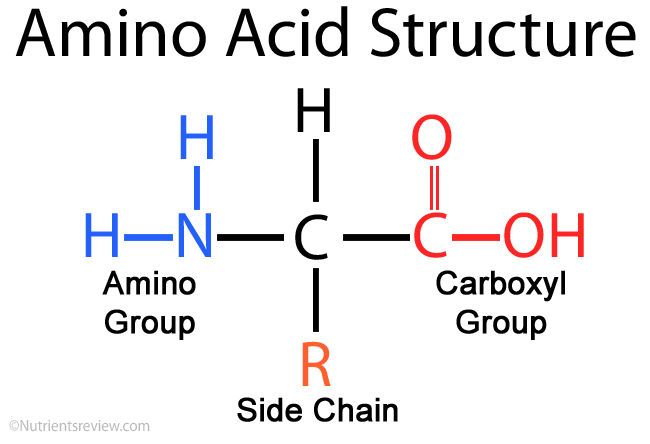
Amino Acids have an Amino Group and a carboxyl group
An amino acids has a basic amino group (NH2) and an acidic carboxyl group (COOH).
This makes the amphoteric - they've got both acidic and basic properties.
They're called chiral molecules because the carbon has four different groups attached (glycine is an exception, its R group is a H). So a solution of a single amino acid enantiomer will rotate plane polarised light.
Seite 2
Amino acids have common and systematic names
Most amino acids have a common name (like glycine or valine), but each one has a systematic name too.
you should be given the common names if you need any of them, but you might be asked to work out their systematic names using the IUPAC naming system.
EXAMPLE
Give the systematic name for the amino acid alanine (it's structure is shown below).
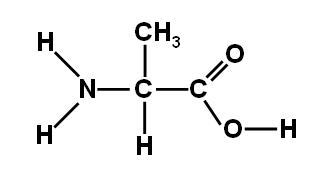
Find the longest carbon chain that includes the carboxylic acid and write down its name. For alanine, the longest carbon chain containing the carboxylic acid is three carbons long. So it's name is propanoic acid.
Number the carbons in the chain starting with the carbon in the carboxylic acid group as number 1.
Write down the positions of any NH2 groups and show that they are NH2 groups with the word 'amino'. Alanine has an NH2 group located on carbon-2.
Don't forget to include other side chains or functional groups when you're naming.
So the systematic name for alanine is 2-aminopropanoic acid
Seite 3
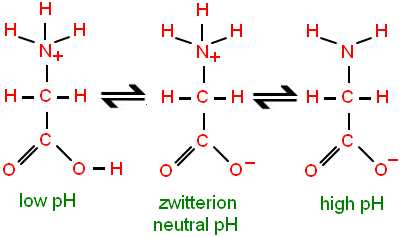
Amino acids can exist as Zwitterions
A zwitterion is a dipolar ion - it has both a positive and negative charge in different parts of the molecule. Zwitterions only exist near an amino acid's isometric point. This is the pH where the average overall charge on the amino acid is zero. It's different for different amino acids - it depends on their R group.
Seite 4
Thin-Layer chromatography is used to identify unknown amino acids
Since different amino acids have different 'R' groups, they will all have different solubilities in the same solvent. This means you can easily separate and identify the different amino acids in a mixture using thin-layer chromatography. Each amino acid will move up the TLC plate at a different rate depending on how soluble it is in the solvent you've used.
Here's what you do:
Draw a line in pencil near the bottom of the TLC plate (the baseline) and put a very small drop of the mixture opf amino acids on it.
Allow the spots on the plate to dry
Place the plate in a beaker with a small volume of solvent (this is the mobile phase). The solvent level must be below the baseline so that it doesn't dissolve the sample away.
The solvent will start to move up the plate. As it moves, the solvent carries the amino acids in the mixture with it - some amino acids will move at different rates so they'll be separated out.
Leave the beaker until the solvent has moved almost to the top of the plate. Then remove the plate from the beaker. Before it evaporates, use a pencil to mark how far the solvent travelled up the plate (this line is called the solvent front).
Leave the plate to dry.
Amino acids aren't coloured so you'll need to make the plate visible either by spraying ninhydrin solution on the plate, turning the spots purple or by using a plate which has a floursecent dye on the stationary phase which glows under UV light, showing dark spots where the amino acids are present.
The result is called a chromatogram. You can use the positions of the spots on the chromatogram to identify the amino acids by working out the Rf values: Rf = distance travelled by spot / distance travelled by solvent
You can then use a table of known amino acid Rf values to identify the amino acids in the mixture
Informationen
- Beschreibung
- A2 Chemistry (Amino Acids, Proteins and DNA) Notiz am Amino Acids, erstellt von Lucy Nove am 28/02/2017.
- Erstellt von
- Lucy Nove · Feb 2017
- Aktualisiert
- 28 Feb 2017
- Aufrufe
- 12
- Bewertung