
Quiz
ISTQB Foundation Software Testing A
Dieses Quiz hat ein Zeitlimit und öffnet sich deshalb im gewohnten Player.
Fragen in diesem Quiz (40)
1Which of the problems below BEST characterises a result of a software Failure? (K1)
- ADamaged reputation
- BLack of methodology
- CInadequate training
- DRegulatory compliance
2What should be taken into account to determine when to stop testing? (K2)
I. Technical risk
II. Business risk
III. Project constraints
IV. Product documentation- AI and II are true; III and IV are false
- BIII is true; I, II and IV are false
- CI, II, and IV are true; III is false
- DI, II, and III are true; IV is false
3What is the process of analysing and removing causes of failures in software? (K1)
- AValidation
- BTesting
- CDebugging
- DVerification
4Which general testing principles are characterised by the descriptions below? (K2)
W. Early testing
X. Defect clustering
Y. Pesticide paradox
Z. Absence-of-errors fallacy
1. Testing should start at the beginning of the project
2. Conformance to requirements and fitness for use
3. Small number of modules contain the most defects
4. Test cases must be regularly reviewed and revised- AW1, X2, Y3 and Z4
- BW1, X3, Y4 and Z2
- CW2, X3, Y1 and Z4
- DW1, X4, Y2 and Z3
5Which of the following MAIN activities is part of the fundamental test process? (K1)
- AInitiating and planning
- BDocumenting root causes
- CCapturing lessons learned
- DPlanning and control
6Which are the following are MAJOR test implementation and execution tasks? (K2)
I. Repeating test activities
II. Creating test suites
III. Reporting discrepancies
IV. Logging the outcome
V. Analysing lessons learned- AII, III, and IV
- BI, III, IV, and V
- CI, II, III, IV
- DIII, IV, and V
7What principle is BEST described when test designs are written by a third party? (K1)
- AExploratory testing
- BIndependent testing
- CIntegration testing
- DInteroperability testing
8Which test levels are USUALLY included in the common type of V-model? (K1)
- AIntegration testing, system testing, acceptance testing, and regression testing
- BComponent testing, integration testing, system testing, and acceptance testing
- CIncremental testing, exhaustive testing, exploratory testing, and data driven testing
- DAlpha testing, beta testing, black-box testing, and white-box testing
9What test can be conducted for off-the-shelf software to get market feedback? (K1)
- ABeta testing
- BUsability testing
- CAlpha testing
- DCOTS testing
10Who OFTEN performs system testing and acceptance testing, respectively? (K2)
- ASenior programmers and professional testers
- BTechnical system testers and potential customers
- CIndependent test team and users of the system
- DDevelopment team and customers of the system
11What is the key difference between (a) contract and regulation acceptance testing and (b) alpha and beta testing? (K2)
- A(a) are performed outside the company and (b) are conducted by the test team
- B(a) are conducted by regulators and (b) are performed b system administrators
- C(a) are mandatory test for government applications and (b) are usually optional
- D(a) are for custom-developed software and (b) are for off-the-shelf software
12Which test measures the system at or beyond the limits of its specified requirements? (K1)
- AStructural testing
- BStress testing
- CError guessing
- DBlack-box testing
13Which test ensures that modifications did not introduce new problems? (K1)
- AStress testing
- BBlack-box testing
- CStructural testing
- DRegression testing
14Which typical defects are easier to find using static instead of dynamic testing? (K2)
L. Deviation from standards
M. Requirements defects
N. Insufficient maintainability
O. Incorrect interface specifications- AL,M,N, and O
- BL and N
- CL,N, and O
- DL, M, and N
15In a formal review, who is primarily responsible for the documents to be reviewed? (K1)
- AAuthor
- BManager
- CModerator
- DReviewers
16Who typically use static analysis tools? (K1)
- ACustomers and users
- BDevelopers and designers
- CBusiness and systems analysts
- DSystem and acceptance testers
17Which aspects of testing will establishing traceability help? (K2)
- AConfiguration management and test data generation
- BTest case specification and change control
- CTest condition and test procedure specification
- DImpact analysis and requirements coverage
18Features to be tested, approach, item pass/fail criteria, and test deliverables should be specified in which document? (K3)
- ATest case specification
- BTest procedure specification
- CTest plan
- DTest design specification
19Which test technique is based on requirements specification? (K1)
- AWhite-box technique
- BComponent testing
- CBlack-box technique
- DData driven testing
20Which test design techniques should a tester use, respectively, to achieve the following:
(a) check the documented features of the system,
(b) ensure 100% decision coverage, and
(c) detect likely defects and distribution? (K3)- ASpecification-based, data driven testing, and defect density techniques
- BSpecification-based, branch coverage, and exploratory techniques
- CStructure-based, equivalence partitioning, and exploratory techniques
- DSpecification-based, structure-based, and experience-based techniques
21What technique captures system requirements that contain logical conditions? (K1)
- ABoundary value
- BEquivalence partition
- CDecision table
- DState transition
22Input and output combinations that will be treated the same way by the system can be tested using which technique? (K1)
- ABoundary value
- BEquivalence partition
- CDecision table
- DState transition
23Which test suite will check for an invalid transition using the diagram? (K3)
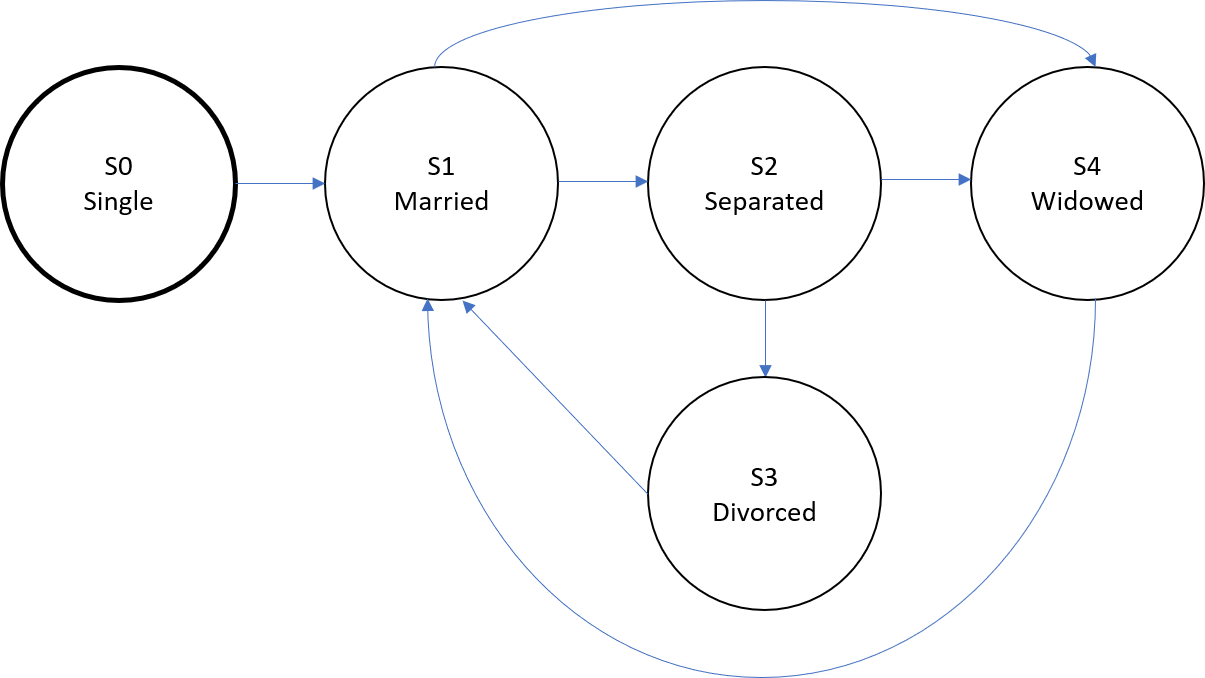
- AS0 - S1 - S2 - S3 - S1 - S4
- BS0 - S1 - S4 - S1 - S2 - S3
- CS0 - S1 - S3 - S1 - S2 - S1
- DS0 - S1 - S2 - S3 - S1 - S2
24How are integration testing and use case testing similar and dissimilar? (K2)
- ABoth checks for interactions: integration for components, use case for actors
- BBoth are black-box techniques: integration is low-level, use case is high-level
- CBoth are static testing: developers perform integration, users execute use case tests
- DBoth are V&V techniques:integration is for validation, use case is for verification
25How many test cases are needed to achieve 100% decision coverage? (K3)
if (p = q){
s = s + 1;
if (s < 5) {
t = 10;
}
} else if (p > q) {
t = 5;
}- A3
- B6
- C5
- D4
26What analysis determines which parts of the software have been executed? (K1)
- AImpact analysis
- BCode coverage
- CGap analysis
- DCyclomatic complexity
27Based on the error guessing test design technique, which of the following will an experienced tester MOST LIKELY test in calendar software? (K3)
i. First two letters of the month, e.g., MA can represent March or May
ii. First letter of the day, e.g., T can mean Tuesday or Thursday
iii. Leap year
iv. Number of days in a month
v. Three-digit days and months- Ai, ii, iv, and v
- Biii and iv
- Ci, ii, iii, and iv
- Di, ii, and v
28Which input combinations will a knowledgeable tester MOST LIKELY use to uncover potential errors when testing a surname field? (K3)
- AJohnson, de la Cruz, and Morgan
- BGo, Stephanopoulous, and Venkatsewaran
- CSmith, Smyth, and Smithsonian
- DO'Brien, Zeta-Jones, and Young Pów
29Which of the following demonstrates independence in testing? (K3)
J. Independent testers are external to the organisation
K. Independent testers are part of the development team
L. Independent testers are from the user community
M. Programmers who wrote the code serve as independent testers
N. Customers who wrote the requirements serve as independent testers- AJ, L, and N
- BJ, K, L, and N
- CK, M, and N
- DJ, L, M, and N
30Which of the following is a KEY task of a tester? (K1)
- AReviewing tests developed by others
- BWriting a test strategy for the project
- CDeciding what should be automated
- DWriting test summary reports
31In software testing, what is the MAIN purpose of exit criteria? (K1)
- ATo enhance the security of the system
- BTo prevent endless loops in codes
- CTo serve as an alternative or "Plan B"
- DTo define when to stop testing
32Which test approaches or strategies are characterised by the descriptions below? (K2)
S. Analytical approaches
T. Model-based approaches
U. Methodical approaches
V. Consultative approaches
1. Relies on guidelines from domain experts
2. Includes error guessing and fault-attacks
3. Uses statistical information about failure rates
4. Focuses on areas of greatest risk- AS4, T3, U2, V1
- BS1, T2, U3, V4
- CS2, T3, U1, V4
- DS3, T4, U2, V1
33Which of the following can be used to measure progress against the exit criteria? (K2)
W. Number of test cases that passed or failed
X. Number of defects found in a unit of code
Y. Dates for milestones and deliverables
Z. Subjective confidence of testers in the product- AW, X, Y, and Z
- BW, X, and Y
- CW and X
- DW, X, and Z
34What type of risk includes potential failure areas in the software? (K1)
- AProject risks
- BProduct risks
- CEconomic risks
- DRequirements risks
35Based on the IEEE standard for Software Test Documentation (IEEE Std 829-1998), in which sections of the test incident report should the following items be recorded? (K3)
Sections
a) Test incident report identifier
b) Summary
c) Incident description
d) Impact
Items
1. Unique identifier
2. Version level of the test items
3. Inputs
4. Expected results
5. Actual results
6. Anomalies
7. Date and time- Aa:1; b:2 and 7; c:3, 4, and 5; d:6
- Ba:1; b:6 and 7; c:3, 4, and 5; d:7
- Ca:1; b:2; c:3, 4, 5, 6, and 7
- Da:1; b:6 and 7; c:3, 4, and 5
36Based on the IEEE Standard for Software Test Documentation (IEEE Std 829-1998), which of the following sections are part of the test summary report? (K2)
a) Test summary and report identifier
b) Summary
c) Variances
d) Anomalies
e) Comprehensive assessment
f) Approvals- Aa, b, e, and f
- Ba, b, c, d, and f
- Ca, b, c, e, and f
- Da, b, c, and f
37What is the name of a skeletal implementation of a software component that is used for testing? (K1)
- AUse case
- BDomain
- CDriver
- DStub
38Which of the following are potential benefits of using test support tools? (K2)
- AEnsuring greater consistency and minimising software project risks
- BReducing repetitive work and gaining easy access to test information
- CPerforming objective assessment and reducing the need for training
- DAllowing for grater reliance on the tool to automate the test process
39Which test support tool can be used to enforce coding standards? (K1)
- AStatic analysis tool
- BPerformance testing tool
- CTest comparator
- DTest management tool
40What should be considered when introducing a tool into an organisation? (K1)
- AAssessing the organisational maturity
- BCounting the number of systems to be tested
- CCalculating the ratio between programmers and testers
- DReviewing the exit criteria of previous projects.
Informationen
- Beschreibung
- 40 questions relating to the ISTQB Foundation software tester qualification syllabus
- Autor
- Robyn Babbage
- Sprache
- English
- Aufrufe
- 905
- Schlagwörter
- Bewertung
- 3,7 von 5 · 3 Bewertungen Bewerte dieses Quiz