
Quiz
Unit 3 MCQs
Erstelle ein kostenloses Konto, um dieses Quiz zu beenden
Speichere deinen Fortschritt und sieh dir dein Endergebnis an.
oder mit deiner E-Mail registrieren
Schon ein Konto? Anmelden
Fragen in diesem Quiz (60)
1One of the most pronounced differences between animal and plant cells is
- Aanimal cells alone have one or more large vacuoles.
- Banimal cells have a nucleolus.
- Canimal cells alone have their nuclear chromatin attached to the spindle fibers during mitosis.
- Dplant cells alone have rough endoplasmic reticulum.
- Eplant cells alone have relatively thick, rigid cell walls.
2Which of the following organelles would only be found within a cell that was both eukaryotic and autotrophic?
- Amitochondria
- Bribosomes
- Crough endoplasmic reticulum
- Dchloroplast
- Evesicle
3After being formed by the ribosomes located on the endoplasmic reticulum, what is the next organelle to which a protein could be transported?
- Amitochondria
- Bsmooth ER
- CGolgi apparatus
- Dnucleus
- Echloroplast
4Which of the following are involved with the movement or transport of materials and organelles throughout the cell?
- Arough ER
- Bcytoskeleton
- Csmooth ER
- Dvesicles
- Eall of the choices are true
5As they flow over rotten logs as a fluid sheet, slime molds appear to lack any partitioning into cell units; however, slime molds do become cellular when they change form to produce spores. And the surface of some parasitic flatworms and some insect tissues are a "syncytium" or layer of living material that contains many nuclei and cell organelles but lacks partitioning by cell membranes. These tissues consume food and produce wastes. In light of the cell theory that "all living things are composed of cells," then
- Athese tissues are not living because they are not cellular.
- Bthese tissues are obviously a bridge between nonliving and primitive living cells.
- Cthe general concept of life-is-cellular still holds because these organisms still utilize cells sometime in their life, but this shows that cell membrane partitions can be abandoned.
- Dthis proves that a "vital force" beyond cell chemistry can give life to substances.
- EAll of the choices are true.
6Which is NOT a reason for the small size of cells?
- AAs the linear dimensions of a cell increase, the volume increases twice as fast as the surface area.
- BNutrients and wastes must enter and leave the cell through the plasma membrane.
- CThe nucleus can only control a certain amount of cytoplasm.
- DThe increased number of organelles requires that eukaryotic cells be smaller than prokaryotic cells.
- EMaterials must be able to move quickly and efficiently through the cytoplasm.
7A high-powered microscope that produces an image from scattered secondary electrons is the
- Aimmunofluorescence microscope.
- Bbright-field light microscope.
- Ctransmission electron microscope (TEM).
- Dscanning electron microscope (SEM).
- Econfocal microscope.
8Which statement is NOT true about bacteria?
- ATheir cell wall is made of a slime layer that is the same as in plant cell walls.
- BSome are photosynthetic.
- CSome are motile due to flagella
- DThey are all prokaryotes.
- EThey have a cell wall that contains peptidoglycan.
9An amino sugar called N-acetylmuramic acid is an important building block of the cell wall of some bacteria. Penicillin prevents this amino sugar from being incorporated into the bacterial cell wall. Therefore,
- Apenicillin affects bacteria but not eukaryotes because eukaryotic cell walls are different.
- Bbacterial cells that had already formed their cell walls would be unaffected.
- Cpenicillin would stop the growth of active colonies of susceptible bacteria.
- Dpenicillin would have no affect on a plant cell wall
- EAll of the choices are correct.
10Most bacteria live in a solution that is hypotonic relative to the cytoplasm of the bacteria. The cell wall of a bacterium is a peptidoglycan polymer that is tightly cross-linked. This would therefore function to
- Aregulate the flow of most molecules into and out of the bacterial cell.
- Bprovide a rigid wall that prevents the cell from swelling.
- Cprovide a rigid wall that prevents the cell from shrinking.
- Dconfirm a close relationship to plant cells that have a similar structure and live in hypotonic solutions.
- Emake all bacteria fairly uniform in metabolic chemistry.
11Which of the following is NOT offered as evidence in support of the endosymbiotic theory, the belief that a eukaryotic cell has evolved as a "committee" of prokaryotic cells?
- AMitochondria and chloroplasts are similar in size and structure to some species of bacteria.
- BThe ribosomes of chloroplasts and mitochondria are similar to eubacteria.
- CMitochondria and chloroplasts can actively break away from eukaryotic cells and live on their own.
- DMitochondria and chloroplasts have their own DNA coding separate from the eukaryotic nucleus.
- EAll of the choices offer support of the endosymbiotic theory.
12The nucleus is NOT important as the site of
- ADNA synthesis.
- BRNA synthesis.
- Csynthesis of ribosomal subunits.
- Dprotein synthesis.
- EAll of these take place in the nucleus
13Cell biologists have introduced radioactively labeled carbohydrates, fats and amino acids to living cells, allowed time for cell metabolism, and then disrupted the cells in a blender and separated out the various cell organelles from the cytoplasm. They found the radioactive molecules could soon be detected as part of various cellular compounds, although the visible cell structures appeared unchanged. This leads us to conclude that
- Athese "food" molecules are used only for energy.
- Bmost cell components are constantly being broken down and rebuilt.
- Cradioactivity was transferred from the introduced molecules to the resident stable molecules.
- Dmolecules diffuse at random through the cytoplasm and into cell organelles.
- Eradioactivity has an unusual role in metabolism of living cells.
14Which is a true statement about ribosomes?
- ARibosomes contain DNA and protein.
- BRibosomes are active in carbohydrate synthesis.
- CRibosomal subunits leave the nucleus after being formed by the nucleolus.
- DPolyribosomes are the subunits of ribosomes.
- ERibosomes are only found associated with the endoplasmic reticulum in prokaryotic cells.
15Which of these is NOT part of the endomembrane system of the cell?
- Amitochondria
- Bendoplasmic reticulum
- Clysosomes
- DGolgi complex
- Evesicles
16Which is NOT true concerning the Golgi complex?
- AIt consists of a stack of saccules.
- BGolgi complexes may have an inner face and an outer face.
- CMolecules are modified within the lumen of Golgi saccules.
- DLysosomes are vesicles that bind to enter the Golgi saccules.
- EGolgi apparatus contains enzymes.
17The springtail is a very common small insect that lives in rotten logs, rich soil, and other humid places. Its cuticle is water repelling (hydrophobic) except for a strange organ, the collophore, on its ventral side. Because it lacks the excretory organs of other insects, the springtail has this organ in contact with the water (it is responsible for ion balance and secretion of wastes). If we examined the cell structure of this collophore, we would expect to find a high number of
- Anuclei.
- Bribosomes.
- CGolgi bodies.
- Dlysosomes.
- Ecentrioles.
18Each time the water in a cell freezes slowly, long sharp crystals spear through the membrane structures of the cell. However, in the frozen state, virtually no chemical reactions occur. The most likely explanation for the bad taste of meat that has "freezer burn" from repeated freezing is the destruction of
- Athe Golgi bodies and their vesicles.
- Blysosomes and resultant autodigestion.
- Crough endoplasmic reticulum causing the release of ribosomes.
- Dribosomes causing them to break into subunits.
- Ethe nuclear membrane causing mixing of nucleoplasm and cytoplasm.
19From your knowledge of the size of cell components and the process of centrifugation, what is the order (from first to last) that the nucleus and organelles will be extracted?
- Aribosomes-mitochondria and chloroplasts-nucleus-soluble cytoplasm
- Bnucleus-mitochondria and chloroplasts-ribosomes-soluble cytoplasm
- Cnucleus-mitochondria and chloroplasts-soluble cytoplasm-ribosomes
- Dmitochondria and chloroplasts-nucleus-soluble cytoplasm-ribosomes
- Esoluble cytoplasm-ribosomes-mitochondria and chloroplasts-nucleus
20Cells that make up salivary glands would
be expected to contain a relatively large
amount of- Asmooth endoplasmic reticulum
- Brough endoplasmic reticulum
- Cgenetic material
- Dlipids
- Eperoxisomes
21Which of the following is the reason plants wilt on a hot summer day?
- Aloss of water
- Black of turgor pressure
- Cheat weakens the plant cell walls
- Dboth loss of water and therefore lack of turgor pressure.
- Ereduced photosynthetic activity
22Which of the following functions does the lipid bilayer component of the cell membrane NOT provide for the cell?
- Acontrols the exchange of matter and chemical information between one cell and adjacent cells or environment
- Bprovides an impermeable, self-sealing membrane capable of dividing or fusing the cell without breaking
- Cprovides the matrix into which are inserted proteins that facilitate the exchange of matter between the inside and outside of the cell
- Dclearly defines a boundary preventing an equilibrium between the outside and inside of the cell
- Eprovides a fluid and flexible boundary that insulates the interior from the variations in humidity, food, and other external conditions
23Which statement is NOT true about the proteins in the plasma membrane?
- AProteins may be attached to the inner surface of the plasma membrane.
- BThe hydrophobic portion of a protein is embedded within the membrane.
- CSome peripheral proteins are connected to cytoskeletal filaments.
- DIntegral proteins are responsible for membrane functions.
- EGlycoproteins contain carbohydrate chains that are oriented toward the inner surface of the membrane.
24Red blood cells come in many "blood types" including type A, type B, type AB, type O [lacking proteins A and B], Rh positive, and Rh negative [lacking Rh factor] and many others. If blood is transfused, the recipient detects any new or "foreign" proteins. These blood type proteins are
- Ain the plasma where they have been secreted by the red blood cells.
- Binside the red blood cell cytoplasm.
- Con the outer surface of the red blood cell membrane.
- Devenly distributed throughout the cell contents and plasma.
- Ein the red blood cell nucleus.
25Freshwater protozoans react to a/an _____ environment by removing water through _____.
- Ahypertonic, turgor pressure
- Bhypotonic, turgor pressure
- Cisotonic, a contractile vacuole
- Dhypertonic, a contractile vacuole
- Ehypotonic, a contractile vacuole
26Which is NOT true about plant cell walls?
- AAll plant cells have a primary cell wall.
- BPrimary cell walls contain cellulose and microfibrils.
- CSecondary cell walls are located just inside the primary cell wall.
- DLignin, a strengthening substance, is found in secondary cell walls.
- ECell walls are penetrated by extensions of cytoplasm that connect adjacent cells' cytoplasms.
27In speculating upon the origin of early cells and the cell membrane, which of the following statements is/are NOT plausible?
- ADue to similarities in basic structure, the endoplasmic reticulum, Golgi body, vesicles, and other "cytomembranes" may have arisen as invaginations of the cell membrane.
- BAs long as a phospholipid-production mechanism is present, these molecules would naturally arrange themselves in two layers with the hydrophobic tails on the inside away from water.
- CIt would be nearly impossible to have a cell without a cell membrane.
- DAll of the choices are plausible.
- ENone of the choices are plausible.
28All life forms currently have a basic cell membrane so we presume that the earliest forms of life had this "fence" isolating the internal organization from the external chaos. It is likely that the primordial environment was acidic. In such a case, the cell membrane would have to include
- Aa sodium (Na+) pump.
- Ba proton (H+) pump.
- Cmitochondria underneath in order to provide energy for active transport.
- Dan acid-proof cell wall.
- Ea totally nonpermeable membrane
29A feature common to most transmembrane proteins is
- Aa phosphorylated exterior domain.
- Ba structure consisting almost exclusively of β-sheets.
- Can amino acid sequence rich in acidic residues.
- Dan α-helical region of about 20 to 25 hydrophobic amino acids.
30The membrane of an animal cell would be impermeable to all of the following EXCEPT
I. a large and primarily polar protein
II. a small lipid based molecule
III. starch- AI only
- BII only
- CIII only
- DI and II only
- EI and III only
31All of the following statements regarding membranes are correct EXCEPT
- APolar heads of phospholipids are located on the periphery of the cell membrane.
- BCell surface receptor proteins transfer small polar substances into the cell.
- CPeripheral proteins may display enzymatic functions.
- DPhospholipids are amphipathic.
- EGlycoproteins are involved in cell-to cell recognition.
32Which of the following signaling mechanisms represent a correctly matched pair?
- Aendocrine- neural communication
- Bsynaptic- intravenous communication
- Cparacrine- communication with nearby, surrounding cells
- Dgap junction- communication via hormones
- Ereceptor- substrate communication
33What is the function of structure E?
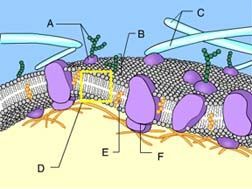
- Atransport across the plasma membrane
- Bstabilization of the phospholipids
- Ccell-cell communication
- Dstructural support of the cell
- Edetection of environmental change
34Using the yeast signal transduction pathways, both types of mating cells release the mating factors.These factors bind to specific receptors on the correct cells,
- Awhich induce changes in the cells that lead to cell fusion.
- Bwhich produce more of the a factor in a positive feedback.
- Cthen one cell nucleus binds the mating factors and produces a new nucleus in the opposite cell.
- Dstimulating cell membrane disintegration, releasing the mating factors that lead to new yeast cells.
- Ewhich in turn releases a growth factor that stimulates mitosis in both cells.
35What is most likely to happen to an animal's target cells that lack receptors for local regulators?
- AThey might compensate by receiving nutrients via a factor.
- BThey could develop normally in response to neurotransmitters instead.
- CThey could divide but never reach full size.
- DThey might not be able to multiply in response to growth factors from nearby cells.
- EHormones would not be able to interact with target cells
36Which of the following is a likely explanation of why natural selection favored the evolution of signals for sexual reproduction?
- AEven in the simplest organisms, sexual reproduction required several coordinated responses by cells.
- BMulticellular eukaryotes required signals that were responded to by multiple organ systems.
- CCells of several kinds of mating types needed to sort themselves to allow self-recognition.
- DRooted plants required chemical diffusible signals that could travel throughout the organism.
- EHormones required a mechanism for introducing changes in their target tissues.
37 In an experiment to track the movement of growth factor molecules from secretion to the point of receptor binding in a particular species of mammal, a student found a 20-fold reduction in mm traveled when in the presence of an adrenal hormone. This is in part attributable to which of the following?
- AThe growth factor is a paracrine signal.
- BThe growth factor depends on osmosis.
- CThe mammal only carries growth factor through the lymph.
- DThe growth factor is an exocrine signal.
- EThe growth factor is an endocrine signal.
38When a neuron responds to a particular neurotransmitter by opening gated ion channels, theneurotransmitter is serving as which part of the signal pathway?
- Areceptor
- Brelay molecule
- Ctransducer
- Dsignal molecule
- Eendocrine molecule
39Which of the following is true for the signaling system in an animal cell that lacks the ability to produce GTP?
- AIt would not be able to activate and inactivate the G protein on the cytoplasmic side of the plasma membrane.
- BIt would activate only the epinephrine system.
- CIt would be able to carry out reception and transduction but would not be able to respond to a signal.
- DIt would use ATP instead of GTP to activate and inactivate the G protein on the cytoplasmic side of the plasma membrane.
- EIt would employ a transduction pathway directly from an external messenger.
40Which of the following is true of transcription factors?
- AThey regulate the synthesis of DNA in response to a signal.
- BThey transcribe ATP into cAMP.
- CThey initiate the epinephrine response in animal cells.
- DThey control gene expression.
- EThey regulate the synthesis of lipids in the cytoplasm.
41Because most receptors are membrane proteins, which of the following is usually true?
- AThey lead to changes in intracellular ion concentration.
- BThey open and close in response to protein signals.
- CThey are only attached to one membrane surface: exterior or interior.
- DThey preferentially bind with lipid or glycolipid signal molecules.
- EThey change their conformation after binding with signal polypeptides.
42Since steroid receptors are located intracellularly, which of the following is true?
- AThe receptor molecules are themselves lipids or glycolipids.
- BThe steroid/receptor complex can cross the plasma membrane.
- CThe unbound steroid receptors are quickly recycled by lysosomes.
- DThe concentration of steroid receptors must be relatively high in most cells.
- EThe receptor molecules are free to move in and out of most organelles.
43 Receptor tyrosine kinases (RTKs) are found at high levels on various cancer cells. A protein,Herceptin, has been found to bind to an RTK known as HER2. This information can now be utilized in breast cancer treatment if which of the following is true?
- AIf Herceptin is found in the breast lymph nodes of the patient.
- BIf HER2, administered by injection, is in sufficient concentration.
- CIf the patient's cancer cells have detectable HER2.
- DIf the patient's genome codes for the HER2 receptor.
- EIf the patient's genome codes for the manufacture of Herceptin.
44The receptors for a group of signaling molecules known as growth factors are often
- Aligand-gated ion channels.
- BG protein-coupled receptors.
- Ccyclic AMP
- Dreceptor tyrosine kinases
- Eneurotransmitters
45Sutherland discovered that epinephrine signals
- Aa decrease in levels of cAMP as a result of bypassing the plasma membrane.
- Blower blood glucose by binding to liver cells.
- Cinteractions with insulin inside muscle cells.
- Dinteractions directly with glycogen phosphorylase.
- Eelevation of cytosolic concentrations of cyclic AMP.
46Which of the following is the best explanation for the inability of a specific animal cell to reduce the Ca2+ concentration in its cytosol compared with the extracellular fluid?
- Ablockage of the synaptic signal
- Bloss of transcription factors
- Cinsufficient ATP levels in the cytoplasm
- Dlow oxygen concentration around the cell
- Elow levels of protein kinase in the cell
47The toxin of Vibrio cholerae causes profuse diarrhea because it
- Amodifies a G protein involved in regulating salt and water secretion.
- Bdecreases the cytosolic concentration of calcium ions, making the cells hypotonic.
- Cbinds with adenylyl cyclase and triggers the formation of cAMP.
- Dsignals IP3 to act as a second messenger for the release of calcium.
- Emodifies calmodulin and activates a cascade of protein kinases.
48Which of the following would be inhibited by a drug that specifically blocks the addition of phosphate groups to proteins?
- AG protein-coupled receptor signaling
- Bligand-gated ion channel signaling
- Cadenylyl cyclase activity
- Dphosphatase activity
- Ereceptor tyrosine kinase activity
49Which of the following most likely would be an immediate result of growth factor binding to its receptor?
- Aprotein kinase activity
- Badenylyl cyclase activity
- CGTPase activity
- Dprotein phosphatase activity
- Ephosphorylase activity
50An inhibitor of phosphodiesterase activity would have which of the following effects?
- Ablock the response of epinephrine
- Bdecrease the amount of cAMP in the cytoplasm
- Cblock the activation of G proteins in response to epinephrine binding to its receptor
- Dprolong the effect of epinephrine by maintaining elevated cAMP levels in the cytoplasm
- Eblock the activation of protein kinase A
51Caffeine is an inhibitor of phosphodiesterase. Therefore, the cells of a person who has recently consumed coffee would have increased levels of
- Aphosphorylated proteins.
- BGTP.
- CcAMP.
- Dadenylyl cyclase
- Eactivated G proteins
52 If a pharmaceutical company wished to design a drug to maintain low blood sugar levels, one approach might be to design a compound
- Athat activates epinephrine receptors.
- Bthat increases cAMP production in liver cells.
- Cto block the G protein activity in liver cells.
- Dthat increases phosphorylase activity.
- Ethat keeps sugar molecules from crossing the plasma membrane of liver cells
53An inhibitor of which of the following could be used to block the release of calcium from the endoplasmic reticulum?
- Atyrosine kinases
- Bserine/threonine kinases
- Cphosphodiesterase
- Dphospholipase C
- Eadenylyl cyclase
54Which of the following statements is true of signal molecules?
- AWhen signal molecules first bind to receptor tyrosine kinases, the receptors phosphorylate a number of nearby molecules.
- BIn response to some G protein-mediated signals, a special type of lipid molecule associated with the plasma membrane is cleaved to form IP3 and calcium.
- CIn most cases, signal molecules interact with the cell at the plasma membrane and then enter the cell and eventually the nucleus.
- DToxins such as those that cause botulism and cholera interfere with the ability of activated G proteins to hydrolyze GTP to GDP, resulting in phosphodiesterase activity in the absence of an appropriate signal molecule.
- EProtein kinase A activation is one possible result of signal molecules binding to G protein-coupled receptors.
55Which of the following is a correct association?
- Akinase activity and the addition of a tyrosine
- Bphosphodiesterase activity and the removal of phosphate groups
- CGTPase activity and hydrolysis of GTP to GDP
- Dphosphorylase activity and the catabolism of glucose
- Eadenylyl cyclase activity and the conversion of cAMP to AMP
56One inhibitor of cGMP is Viagra. It provides a signal that leads to dilation of blood vessels and increase of blood in the penis, facilitating erection. Since cGMP is inhibited, the signal is prolonged. The original signal that is now inhibited would have
- Ahydrolyzed cGMP to GMP.
- Bhydrolyzed GTP to GDP.
- Cphosphorylated GDP.
- Ddephosphorylated cGMP
- Eremoved GMP from the cell.
57A drug designed to inhibit the response of cells to testosterone would almost certainly result in which of the following?
- Alower cytoplasmic levels of cAMP
- Ban increase in receptor tyrosine kinase activity
- Ca decrease in transcriptional activity of certain genes
- Dan increase in cytosolic calcium concentration
- Ea decrease in G protein activity
58In research on aging (both cellular aging and organismal aging), it has been found that aged cells do not progress through the cell cycle as they had previously. Which of the following would provide evidence that this is related to cell signaling?
- AGrowth factor ligands do not bind as efficiently to receptors.
- BTheir lower hormone concentrations elicit a lesser response.
- CcAMP levels change very frequently.
- DEnzymatic activity declines.
- EATP production decreases.
59If an adult person has a faulty version of the human analog to ced-4
of the nematode, which of the following is most likely to result?- Aneurodegeneration
- Bactivation of a developmental pathway found in the worm but not in humans
- Ca form of cancer in which there is insufficient apoptosis
- Dwebbing of fingers or toes
- Eexcess skin exfoliation
60Why has C. elegans proven to be a useful model for understanding apoptosis?
- AThe animal has as many genes as complex organisms, but finding those responsible is easier than in a more complex organism.
- BThe nematode undergoes a fixed and easy-to-visualize number of apoptotic events during its normal development.
- CThis plant has a long-studied aging mechanism that has made understanding its death just a last stage.
- DWhile the organism ages, its cells die progressively until the whole organism is dead.
- EAll of its genes are constantly being expressed so all of its proteins are available from each cell.
Informationen
- Beschreibung
- 6,7,11 - 60 questions
- Autor
- vanshikachowdhar
- Sprache
- English
- Aufrufe
- 216
- Schlagwörter
- Bewertung
- Noch keine Bewertungen Bewerte dieses Quiz