
Quiz
UNIT 1
Erstelle ein kostenloses Konto, um dieses Quiz zu beenden
Speichere deinen Fortschritt und sieh dir dein Endergebnis an.
oder mit deiner E-Mail registrieren
Schon ein Konto? Anmelden
Fragen in diesem Quiz (25)
1
"When the temperature of an object increases, the total power it radiates per square meter (it's energy flux) increases very rapidly (it grows exponentially)". This statement best describes...- Athe Doppler Effect
- Bthe First Law of Thermodynamics
- CWien's Law
- DKirchoff's Law
- EStefan-Boltzmann's Law
2
According to Wein's law, the higher the surface temperature of a star, the shorter the wavelength of its peak emitted EM radiation will be.- ATrue
- BFalse
3
Consider the following scenario: You are sitting on an anchored (stationary) fishing boat on a windy day. Watching the waves you notice they appear identical. You count 6 wave crests pass your anchor rope in exactly 24 seconds. What is the period of the waves?- A144 seconds
- B0.25 seconds
- C0.25 Hz
- D4 seconds
4
Let's say that a particular emission line of helium is originally emitted with an original wavelength of 505.5 nm from a star traveling quickly across our galaxy. Using a research telescope with an attached spectrometer, we observe and measure the wavelength of this emission line coming from the star to be 506.1 nm. Based on these numbers, how fast is this star moving toward or away from us here on Earth? (see example of this type of question in lecture slides or in textbook)- Amoving towards us at 119 km/s
- Bmoving towards us at 356 km/s
- Cmoving away from us at 356 km/s
- Dmoving away from us at 119 km/s.
- Emoving away from us at 422 km/s
5
Suppose you see two stars: a blue star and a red star. Which of the following can you conclude about the two stars? Assume that no Doppler shifts are involved. (Hint: Look in the lecture slides (Part 2): Radiation Laws for a good explanation.)- AThe blue star has a hotter surface temperature than the red star
- BThe blue star is farther away than the red star.
- CThe red star is farther away than the blue star.
- DThe red star has a hotter surface temperature than the blue star.
- EThe red star is more massive than the blue star.
6
When astronomers take the visible light coming from the Sun and spread it out using a prism or spectral grating, the observed spectrum is- Aa continuum with absorption lines.
- Bonly emission lines on a black background.
- Ca continuum with emission lines.
- Da continuum with no lines, as shown by the rainbow.
7
The larger the blue shift of a galaxy's overall spectrum, the faster the distant galaxy is rushing toward us.- ATrue
- BFalse
8 The number of waves that pass a point each second measures
- Afrequency
- Bwave period
- Camplitude
- Dwavelength
9
The spectral lines of each element are distinctive to that element, whether we are looking at emission or absorption lines.- ATrue
- BFalse
10
Visible light is a type of electromagnetic wave that has been known to us since the beginning of human times. Who was the first person to discover another type of invisible energy wave what would later become known as another type of electromagnetic radiation?- AGalileo in 1610 - discovered ultraviolet waves
- BMarie Curie in 1903 - discovered gamma rays
- CWilliam Herschel in 1800 - discovered infrared waves
- DJames Clerk Maxwell in 1867 -discovered radio waves
- EClaudius Ptolemy in 142 A.D. - discovered x-rays
11Which of the following is NOT one of Kirchoff's laws?
- AA low-density, hot gas emits an emission spectrum
- BA luminous solid, liquid or dense gas emits a continuous spectrum
- CA low-density, cool gas absorbs photons from a continuous source, creating an absorption spectrum
- DA low-density, cool gas in isolation creates a continuous spectrum.
12 Consider this diagram. Which statement is true?
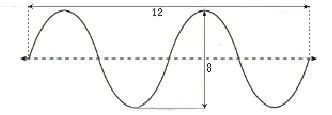
- AThe amplitude is 6 and the wavelength is 8.
- BThe amplitude is 4 and the wavelength is 6.
- CThe amplitude is 8 and the wavelength is 12.
- DThe amplitude is 6 and the wavelength is 4.
- EThe amplitude is 4 and the wavelength is 12.
13
Different photons of visible light can contain different quantities of energy, depending on their frequency (colour).- ATrue
- BFalse
14
If a wave's wavelength is shortened by half and yet its speed is kept constant, the wave's frequency- Awill now become16× higher than it was before.
- Bwill now be 4× higher than before.
- Cwill now be half of what it was before.
- Dwill be unchanged, because c is constant
- Ewill now be double what it was as before.
15 In Bohr's model of the atom, electrons
- Aonly make transitions between orbits of specific energies.
- Bcan be halfway between orbits.
- Care spread uniformly through a large, positive mass.
- Dmove from one orbit to the next orbit in many small steps.
16In the vacuum of space, one of the following properties is the same for all types of electromagnetic waves. Which is it?
- Athey all travel with the same frequency
- Bthey travel with the same speed
- Cthey all travel with the same photon energy
- Dthey all travel with the same amplitude
17In trying to visualize the size of specific forms of electromagnetic waves, it can be said that infrared waves have wavelengths comparable in size to a(n)...
- Ahuman
- Bfinger nail
- Cmicroscopic virus
- Ddust particle
- Eatomic nucleus
18 Of all the forms of electromagnetic waves that attempt to penetrate earth's atmosphere, the two forms that experience the least atmospheric opacity (pass through to the surface most effectively) are:
- Aultraviolet rays and infrared waves
- Binfrared waves and radio waves.
- CX-rays and gamma rays.
- Dvisible light and radio waves.
- Evisible light and infrared waves.
19Regarding electromagnetic radiation, what was William Wollaston's most important contribution?
- AHe discovered that different wavelengths (colours) of light refracted by different amounts when they passed into a different optically transparent medium.
- BHe correctly predicted the discovery of x-rays in 1843.
- CHe discovered that the hotter an object is, the higher the frequency of the wavelengths it most intensely emits.
- DHe developed an improved spectrometer for analysing visible spectra
20 Rutherford's experiment with alpha particle scattering by gold foil established that...
- Aatoms are composed of protons, neutrons and electrons
- Belectrons have a negative charge
- Cproton has 1840 times the mass of an electron
- Dprotons are not evenly distributed throughout an atom
electrons have a positive charge - Eelectrons have a positive charge
21 Scientists point to observations of the phenomena of diffraction and interference to support the idea that...
- Aelectromagnetic waves are fundamentally different in nature than water waves and sound waves which are mechanical in nature.
- Ball electromagnetic radiation can be thought of as a type of wave
- Call electromagnetic radiation can be thought of as either a particle or a wave, depending on the situation being considered
- Dall electromagnetic radiation is a form of particle
22 The range of wavelengths of electromagnetic radiation that the human eye is able to detect is from about _________ to about _________.
- A400 nm; 700 nm
- B600 nm; 1200nm
- C550 nm; 660 nm
- D880 nm; 2000 nm
- E210 nm; 380 nm
23 What is the name of the temperature scale that places zero at the point where all atomic and molecular motion ceases?
- AFahrenheit
- BKelvin
- CCentigrade
- DCelsius
- ERansom
24Which of the following is true for any object that can be thought of as a "blackbody"?
- AIts energy is not a continuum.
- BIts energy peaks at the wavelength determined by its temperature.
- CIf its temperature doubled, the peak in its radiation curve would be doubled in wavelength.
- DIt has a complete absence of thermal energy
- EIt appears black to us, regardless of its temperature.
25
Which of the following places the types of electromagnetic waves listed in the correct order from shortest wavelength -->to--> longest wavelength?- Ainfrared, visible light, ultraviolet, microwave, x-ray
- Bmicrowave, infrared, ultraviolet, gamma-ray, x-ray
- Cultraviolet, microwave, visible light, infrared, radio
- Dgamma-ray, x-ray, ultraviolet, visible light, radio wave
Informationen
- Beschreibung
- Quiz am UNIT 1 , erstellt von maisy r am 04/02/2019.
- Autor
- maisy r
- Sprache
- English
- Aufrufe
- 114
- Schlagwörter
- Bewertung
- 5,0 von 5 · 1 Bewertung Bewerte dieses Quiz